
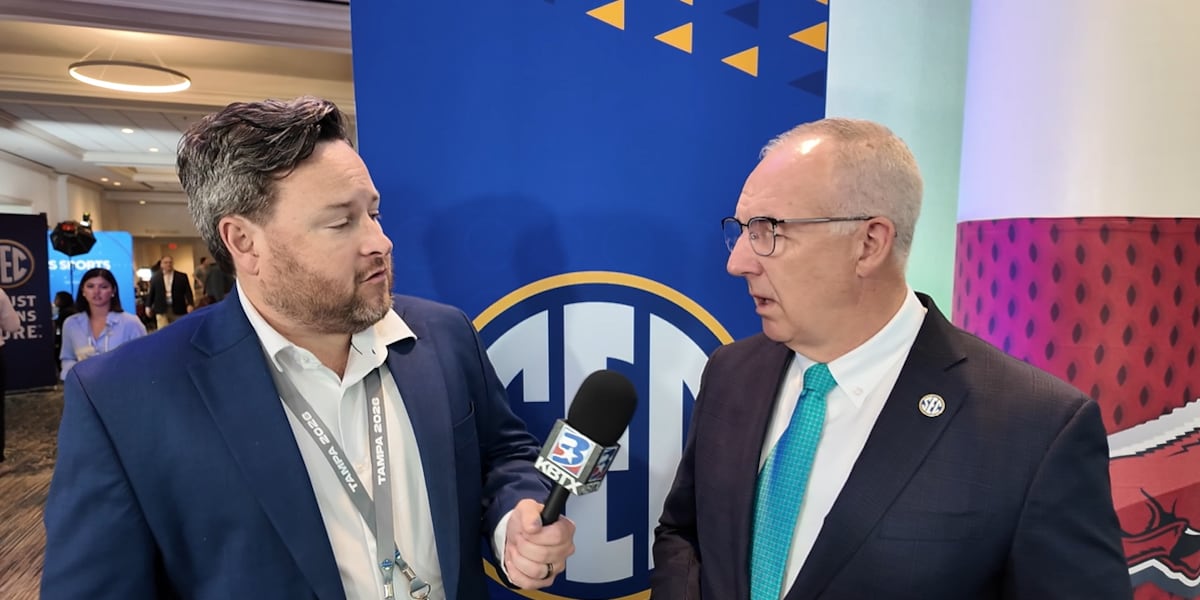
TAMPA, Fla. (KBTX) – Thinking back to the 2026 Southeastern Conference baseball tournament, commissioner Greg Sankey remembered the smile on Missouri catcher Mateo Serna as a defining moment.
In the first year of using the Automated Ball-Strike system in the conference tournament, Serna helped the Tigers claim their first win at the conference tournament since 2017 by going 7-for-8 in ABS challenges behind the plate.
Sankey said believes ABS could be the next technology that is accepted around the country after the SEC was an early adopter.
“I think bringing that into the college experience with our own replay system, but also ABS, can improve both around baseball and softball,” Sankey told KBTX last week at SEC Media Days.
On July 15, the Division I Baseball Rules Subcommittee approved the use of ABS for games during the 2027 in locations where the technology is available. The rule change still needs final approval the NCAA’s baseball oversight committee to become law.
Sankey said the conference is continuing to do research on if implementing the technology conference-wide is feasible for this season.
“We have to go out to our membership,” he said. “We’re examining the costs. We were able to make the cost work for our tournament. All of our baseball stadiums have technology that exists. Whether that’s the right technology to make sure that the ABS system on each campus works properly, that’s the work we have to do at this point.”
Serna’s challenge success quite a debut performance for the technology at the college level, after hitting Major League Baseball ballparks earlier in the spring. The SEC has long been an innovator of technology when it comes to diamond sports, Sankey bragged, allowing changes such as instant replay, the dugout-to-catcher communication devices and the PitchCom system.
For the tournament, the Hawk-Eye system was used for reviewing balls and strikes. Prior to the start of the tournament, each player was measured so a strike zone could be calibrated. For the SEC, the top of the strike zone was set at 58% of the batter’s height and the bottom at 23% of the batter’s height. It was significantly bigger than the MLB zone, which is 53.5% of the batter’s height at the upper boundary and 27% at the bottom.
Blue Bell Park is outfitted with TrackMan technology, which could have a slightly different read than Hawk-Eye. A&M head coach Michael Earley said the challenge would be in games outside the SEC.
“I’m not sure how it could be used effectively in nonconference games because each batter has to be measured – unless every conference is using the same system,” he told KBTX. “I don’t mind the transition from Tuesday games to the weekend, but consistency across the board always makes implementation easier.”
With potential implementation across the conference and country is still in its infancy, coaches have not yet been asked their opinions on how it should work, Earley said. The width of the strike zone would be one issue he would raise, he said.
More information on ABS could be nailed down on August 24 at the next meeting of the Division I Baseball Oversight Committee, along with allowing for bat senior technology and larger bases to name a few.
“At the end of the day, whatever the rules are, we’ll learn them, adapt and execute at a high level,” Earley said.
Copyright 2026 KBTX. All rights reserved.