
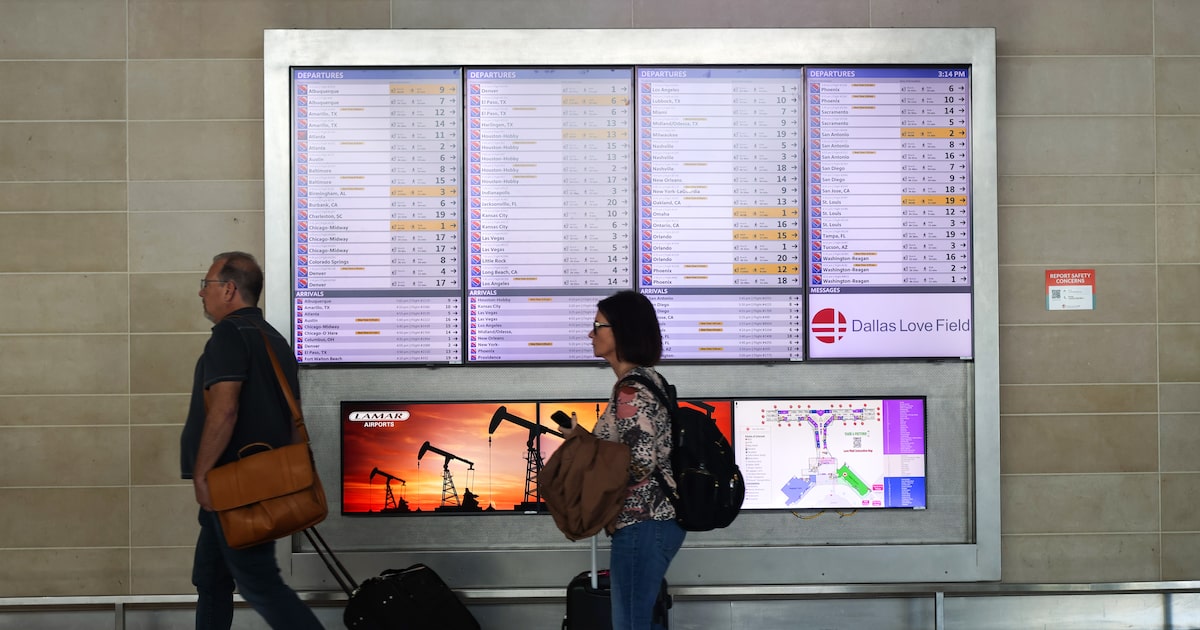
North Texas Airports could see flight cuts by Friday as the Federal Aviation Administration is planning to reduce airspace capacity to ensure safe operations during the ongoing government shutdown.
On Thursday, The Dallas Morning News viewed documents that showed both DFW International Airport and Dallas Love Field on the proposed list of airports where cutbacks will occur.
DFW Airport is the central hub of Fort Worth-based American Airlines. Love Field is the headquarters of Southwest Airlines, which operates 18 of the airport’s 20 gates.
“It’s certainly not going to be unimpactful,” Captain Dennis Tajer, a pilot for American Airlines and spokesperson for the union which represents the carrier’s pilots, said. “10% is a number you try to formulate. If it’s your flight it’s 100% of your day. So, it’s not good. Is it manageable? We’ll see how each airline manages through it.”
Aviation News
Other major U.S. airports across the country, including in Houston, New York, San Francisco, Atlanta and more, will also see reduced flights. Houston’s two major airports, Houston Intercontinental and Houston Hobby, are also on the FAA’s list for flight reductions.
Here’s what North Texas fliers should know to be prepared:
Why is the government reducing flights?
Government agencies overseeing aviation and transportation are proactively cutting flights in response due to staffing issues created by the ongoing government shutdown.
“I think what we’re seeing is that we’ve got a real human vulnerability in our system right now with a lack of air traffic controllers,” Stephen Mattingly, a professor at the University of Texas at Arlington, said. “And the government shutdown exacerbates that problem, significantly.”
Both DFW and Love Field have started to see effects of the shutdown within the past week due to staffing issues. The FAA issued ground delays at DFW Airport on three separate days last week. On Monday, the FAA again issued a ground delay for both DFW and Love Field, slowing flights bound for North Texas at their departure airports.
“We are assessing the risk in the airspace,” Sean Duffy, the U.S. Transportation Secretary, said Thursday on social media. “Delays and cancellations will be based on which controllers are coming to work.”
“Reducing 10% of flight volume will reduce the pressure on controllers, while prioritizing safety, and getting more flights out on time.”
How much is a 10% cut at airports?
Each airport is different in terms of the number of flights departing per day, meaning airports where flights will be cut might not be affected the same.
For example, at DFW, the third-busiest airport in the world, a 10% cut in flights at DFW could mean 96 fewer departing flights or more than 13,000 fewer seats, according to data from Diio by Cirium.
Love Field could see cuts of 20 flights a day, or roughly 3,000 seats, Cirium’s data shows.
“A 10% cut in domestic flights is not catastrophic, necessarily, for normal operating because we do have some ability for the system to absorb the empty seats,” Mattingly said. ”Because right now we don’t really fly with our planes that empty, we’re going to be capable of accommodating at least some flight reduction.”
What are DFW and Love Field saying?
Love Field released a statement Thursday afternoon saying the flight reduction “may affect flights to and from” the airport. “Please check with your airline for the most up-to-date information regarding any changes to your flight schedule.”
Love Field recommends passengers arrive at least two hours before their scheduled flight time.
DFW spokesperson Zachary Greiner referred The News to the FAA for questions about the flight cuts but did provide general advice for travelers.
“I can tell you generally that we ask passengers to continue to check their flight schedules with their airline for any possible changes and allow extra time at the airport,” said Greiner. “Our website and app provide detailed, real-time information on both flights and TSA wait times.”
What are North Texas’s hometown airlines saying?
Southwest Airlines told The News that the airline is “determining the scheduling adjustments needed to meet the required FAA flight reductions.”
The airline said the “vast majority” of customers will not be affected, adding that any customers with flights booked through Nov. 12 can adjust their travel at no cost, or receive a refund, regardless of if their travel is affected.
“We continue to urge Congress to immediately resolve its impasse and restore the National Airspace System to its full capacity,” Southwest Airlines said in a statement.
American Airlines also expects the “vast majority” of customers to be unaffected and long-haul international flights will continue as scheduled. The airline said that it is reducing flight schedules by 4% between Friday and Monday at 40 airports, which is about 220 canceled flights per day.
“Even with these cancellations, we plan to operate around 6,000 daily flights,” American said in a statement.
The airline added that customers whose flights are cancelled or who choose not to travel will be able to change their flight or request a refund without penalty.
Delta Air Lines told The News that it is canceling approximately 170 flights on Friday. United Airlines will preemptively cut less than 200 flights starting Friday, according to CNN.
How will this impact the local economy?
It won’t be good. North Texas’ two major airports are as big economic drivers for the region, and any significant upheaval will ultimately decrease tourism and business travel, which could bring bigger economic consequences. Local travel-dependent businesses, such as hotels and travel agencies, could also suffer.
One local business owner, Alex Ramsey, who runs the Dallas-based travel agency All Aboard Travel, told The News she wasn’t overly worried about the business yet, largely because her agency focuses on more high-end international bookings that aren’t likely to be immediately impacted.
“We’ll weather the storm, whatever it is,” she said. But Ramsey was also hearing that many travelers were already wary of the cancellations and changing their plans. “They’re not thrilled about going to the airport. Instead of flying to Austin they’re going to take the Vonlane or drive,” she added. “Making contingencies is really the key, but it frankly has been in travel for a long time.”
How can I track the status of security checkpoints at Love Field and DFW?
Passengers can download the My TSA app on major app stores on an Apple or android device. You can customize the app to add Love Field and DFW to your favorites tab, which will show each airport any time you open the app.
The app will show you the average wait time at TSA security checkpoints, whether there are any FAA delays and will identify if the TSA PreCheck security lanes are open.
The News recently published a full explainer on how to navigate the app.
 North Texas judge rules Boeing won’t face criminal charge over 737 Max crashes
A deal will allow the Justice Department drop charges in exchange for $1.1 billion in penalties and compensation.
 ‘Unprecedented’: DFW, Love Field targeted for reductions as shutdown rages on
A 10% cut in flights at DFW could mean 96 fewer flights or more than 13,000 fewer seats.