
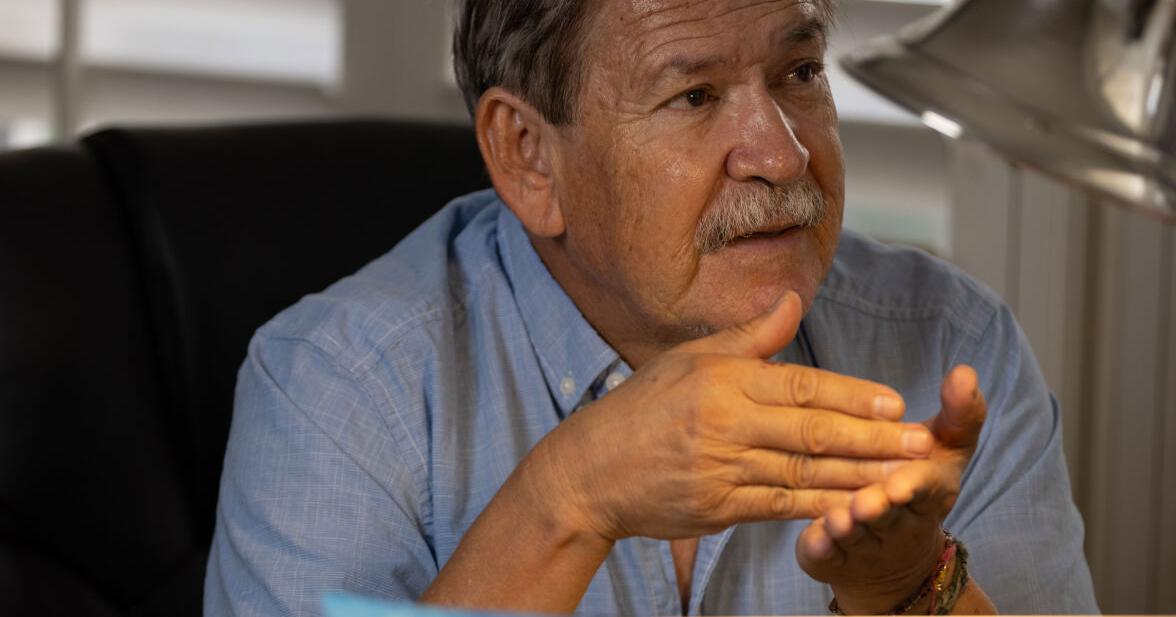
Award-winning Chicano author Benjamin Alire Sáenz died Tuesday in El Paso.
The acclaimed, author, poet, novelist and UTEP professor was 71.
In 2021, he released “Aristotle and Dante Dive into the Waters of the World,” which ranked No. 1 on the New York Times Best Sellers list of young adult hardcover books.
It was a sequel to “Aristotle and Dante Discover the Secrets of the Universe,” named among Time Magazine’s 100 Best Young Adult Novels of All Time, alongside “Little Women,” “To Kill a Mockingbird” and “Catcher in the Rye.”
The novels are set in El Paso in the 1980s and center on two gay Mexican American teen boys – Aristotle “Ari” Mendoza and Dante Quintana – who forge a friendship, explore their sexuality and help each other find their place in the world.
“It might not seem it, but I’m really a private person despite everything that’s out there about my life,” Sáenz told El Paso Inc. Magazine in 2021. “Publishing my books is putting out a little piece of me every time.”
“Aristotle and Dante Discover the Secrets of the Universe” was made into a coming-of-age romantic drama written and directed by Aitch Alberto in 2022. It stared Max Pelayo and Reese Gonzales as the title characters. Verónica Falcón, Kevin Alejandro, Eva Longoria, and Eugenio Derbez complete the rest of the cast.
Sáenz was born on Aug. 16, 1954, in Old Picacho, New Mexico, a small farming community near Las Cruces.
Sáenz was the fourth of seven children raised on a 20-acre farm where the family grew and picked onions, corn, squash, tomatoes, chiles and other vegetables.
“We also had hogs and cows, so we ate well. We were poor, but we ate well,” Sáenz said with a laugh in 2021.
He graduated from Las Cruces High School in 1972, and entered St. Thomas Seminary in Denver, where he received a bachelor’s in humanities and philosophy.
He was ordained a Catholic priest after completing his theological studies at the University of Louvain in Belgium. He returned to El Paso, serving at Lady of Our Light Church in the Lower Valley for three years before leaving his order.
Sáenz was a professor in UTEP’s bilingual creative writing master’s degree program.
The El Paso Community Foundation has established the Benjamin Alire Sáenz Literary Fund at his request to establish a book festival in El Paso and support authors in the region.
Original story: “Benjamin Alire Sáenz on finding his true self,” by Cindy Ramirez; published Nov 9, 2021, in El Paso Inc. Magazine
Celebrated El Paso author Benjamin Alire Sáenz is an open book.
The chapters of his life are reflected in his poetry, his characters, his stories.
“You find yourself in writing a book. You discover a lot about yourself,” Sáenz says. “You put a lot of your life out there.”

Benjamin Alire Sáenz says his coming-of-age novels, “Aristotle and Dante Dive into the Waters of the World” and “Aristotle and Dante Discover the Secrets of the Universe,” are very personal as they depict pieces of his own struggle to accept himself.
Photo by Cosima Rangel.
In faded blue jeans and a button-up shirt of a lighter blue, Sáenz greets El Paso Inc. Magazine at his East Central El Paso home as he rushes to finish lunch. It’s his second interview of the day – one of several he’ll give as he’s been thrust into the literary limelight that has again made his life story very public.
This fall, he released his young adult novel, “Aristotle and Dante Dive into the Waters of the World,” which ranked No. 1 on the New York Times Best Sellers list of young adult hardcover books.
It’s one among a slew of accolades for the book, a sequel to “Aristotle and Dante Discover the Secrets of the Universe” – itself named among Time Magazine’s 100 Best Young Adult Novels of All Time (alongside titles like “Little Women,” “To Kill a Mockingbird” and “Catcher in the Rye.”)
The novels are set in El Paso in the 1980s and center on two gay Mexican American teen boys – Aristotle “Ari” Mendoza and Dante Quintana – who forge a friendship, explore their sexuality and help each other find their place in the world.
“Aristotle and Dante Dive into the Waters of the World” ranked No. 1 on the New York Times Best Sellers list of young adult hardcover books.
Published in 2014 and translated into 25 languages, “Aristotle and Dante Discover the Secrets of the Universe” is coming to the big screen next year – a feat Sáenz is both proud of and nervous about.
“It might not seem it, but I’m really a private person despite everything that’s out there about my life,” Sáenz says. “Publishing my books is putting out a little piece of me every time.”
Sáenz has been working the media circuit, which he says makes him uncomfortable.
“I rather be home, writing, enjoying music, cooking and eating,” he says with a laugh, rattling off a list of recipes he mastered during the pandemic – including canning green chile salsa and cooking red and green tamales.
It was also during the pandemic that Sáenz finished writing the Aristotle and Dante sequel. The film adaptation of the original story started filming earlier this year, although it had been in the works for at least five years, Sáenz says.
Writer and director Aitch Alberto adapted the book for the movie, which is being produced by “Hamilton” and “In the Heights” actor and playwright Lin-Manuel Miranda (who also narrates the Ari & Dante audio books); Mexican actor and comedian Eugenio Derbez (“How to be a Latin Lover,” “Overboard”); and actress Kyra Sedgwick (“The Closer”).
Derbez and Eva Longoria (“Desperate Housewives,” “Devious Maids”) star in the film, with newcomers Max Pelayo and Reese Gonzales playing Aristotle and Dante, respectively.
Sáenz, too, will make a cameo appearance, though he won’t divulge any details.
“Maybe nobody will notice,” he says, adding that a release date for the film has yet to be set.
He finishes lunch, runs his fingers through his gray hair, and dusts off his shirt. He makes his way to his corner office in the living room and tidies up his wooden work desk. Lighters and cigarettes, bills and letters, thoughts and notes scribbled on paper, a chrome lamp and his laptop are scattered on top; some of his acclaimed books stacked up front.
Under the desk plays his beloved Yorkie, Jesus Antonio Sáenz.
“He goes by ‘Chuy,’” Sáenz says.
All around are paintings. Some hang on walls, others sit on couches and the floor. Most are his own doing – his new creative outlet.
‘What I Can’t Bear Losing’ is a self-portrait by Benjamin Alire Sáenz, who says painting makes up for the “poverty of language” in his books because they often say more than his words ever could.
Photo provided by Benjamin Alire Sáenz
“The poverty of language,” he says, “is when words aren’t enough to express emotion, thoughts, feelings. These paintings allow me to express myself differently when the words run out.”
There’s no shortage of words when Sáenz reflects on his 67 years of life.
“I’ve had an interesting life. I’ve had a painful life and I’ve had a wonderful life. It took me a long time to get to what and where I am,” he says.
His story begins in Old Picacho near Las Cruces, the fourth of seven children raised on a 20-acre farm where the family grew and picked onions, corn, squash, tomatoes, chiles and other vegetables.
“We also had hogs and cows, so we ate well. We were poor, but we ate well,” Sáenz says with a laugh.
Despite having a large family, Sáenz grew up feeling distant from them. He found his fondest friendships in his dogs, Rusty and Buster.
He escaped the real world through books.
“I was always reading,” he says. “My mom would look for me and she’d find me lying down in the cotton fields, reading, imagining I was the king of the jungle out there. My imagination would take me places I didn’t think I’d ever go.”
Chapter 2: Foundation of faith
Both his grandmothers were incredibly religious and always went to church, Sáenz says, setting the foundation for his faith.
He graduated from Las Cruces High School in 1972, entering the St. Thomas Seminary in Denver, Colorado, that fall. He received a bachelor’s in humanities and philosophy in 1977.
“I’ve had an interesting life. I’ve had a painful life and I’ve had a wonderful life. It took me a long time to get to what and where I am,” says El Paso author and poet Benjamin Alire Sáenz.
Photo by Cosima Rangel
Sáenz was ordained a Catholic priest after completing his theological studies at the University of Louvain in Belgium. He returned to El Paso, serving at Lady of Our Light Church in the Lower Valley for a short time.
“I saw it as a way of creating social change, so it seemed kind of natural for me,” Sáenz says about his decision to become a priest.
He pauses briefly, trying to find his words, holding back tears. Sáenz says he was sexually abused by a family member as a child.
“It didn’t make my desire to be a priest any less sincere, but it was a factor in it,” he says about the abuse. “When I became I priest, I realized that I was also a spokesman for the Catholic Church, and I didn’t necessarily want that.”
He left the priesthood three years later.
“I wanted to be a good Catholic, but I couldn’t be a spokesman for (the church), especially with all the issues, the abuse. Too painful.”
Chapter 3: School, writing & marriage
Sáenz returned to school, earning a master’s in creative writing from the University of Texas at El Paso. He spent a year at the University of Iowa as a doctoral student in American literature.
“You have to learn to be vulnerable on the page,” says El Paso author and poet Benjamin Alire Sáenz.
Photo by Cosima Rangel
As a Wallace E. Stegner fellow at Stanford University in 1991, he completed his first book of poems, “Calendar of Dust,” which won an American Book Award. He moved back to the border and began teaching at UTEP’s bilingual master of fine arts program, later serving as department chair.
In 1995, he wrote his first novel, “Carry Me Like Water,” which received critical acclaim. He dove into writing, publishing poetry, short stories, novels, young adult novels and children’s books.
Along the way, he married an El Paso woman he adored. They spent 15 years together.
“I would say they were happy, devoted years,” he says thoughtfully.
But his life wasn’t complete – or true.
He fought many internal and private battles, including the trauma of his childhood abuse. He took to drugs and drinking to cope, eventually entering rehab and therapy.
It was in therapy that he faced his truth: He came out as gay.
“I don’t know if I feared it or was ashamed of it or just didn’t acknowlege it,” he says. “I had to come to terms with it.”
He kept writing, finally feeling free.
“Faulkner said to be a writer, you have to abandon all fears,” Sáenz says somberly, referring to the Nobel Prize-winning author William Faulkner. “You have to have courage; and you have to write things that don’t make you feel good.”
That vulnerability was key in his 20th book, “Everything Begins and Ends at the Kentucky Club,” a collection of stories anchored at the popular Juárez bar a few blocks from the Santa Fe Street international bridge.
“It wouldn’t take a lot to guess that I knew a lot about drugs and drinking,” he says.
The book saved him. It served as an outlet during a troubling time in his life. It was also a mirror into it.
“You write with what you know and with all your heart,” Sáenz says. “And that means sometimes writing about the anger that resides within you and all the imperfections. All my characters are so fragile and wounded and hurt and angry, and struggle to be decent when all the world has tried to make them hard and indecent.”
In the coming-of-age novels, Ari and Dante grapple with their racial and ethnic identities, their strained family relationships – and their sexuality and feelings toward one another.
When it comes to love, Dante is the first to feel secure in his feelings for Ari; while Ari feels confused and ashamed about loving another boy.
Benjamin Alire Sáenz’s critically acclaimed YA novel “Aristotle and Dante Discover the Secrets of the Universe” is being adapted into a film by writer and director Aitch Alberto.
It’s a struggle very close to Sáenz, who says developing the characters was another kind of coming out for him.
“It’s a painful thing when you try to be vulnerable. You have to learn how to be vulnerable on the page,” he says. “If readers don’t sense your humanity in your books, they’re not going to sense theirs.”
Which character does he most identify with?
“Both. But maybe at the end, more Ari,” Sáenz says. “Everybody loves Dante, and I’m thinking, ‘What about Ari? He’s telling the story.’ We think that Dante is beautiful because Ari makes him beautiful.”
Like Sáenz, Ari eventually discovers and accepts himself.
“He’s the guy that once he discovers what the truth is, he doesn’t run from it,” Sáenz says. “Once he discovers that he loves Dante, that becomes one of the truths of his life. He’s not going to run from it. He’s going to live it.”