
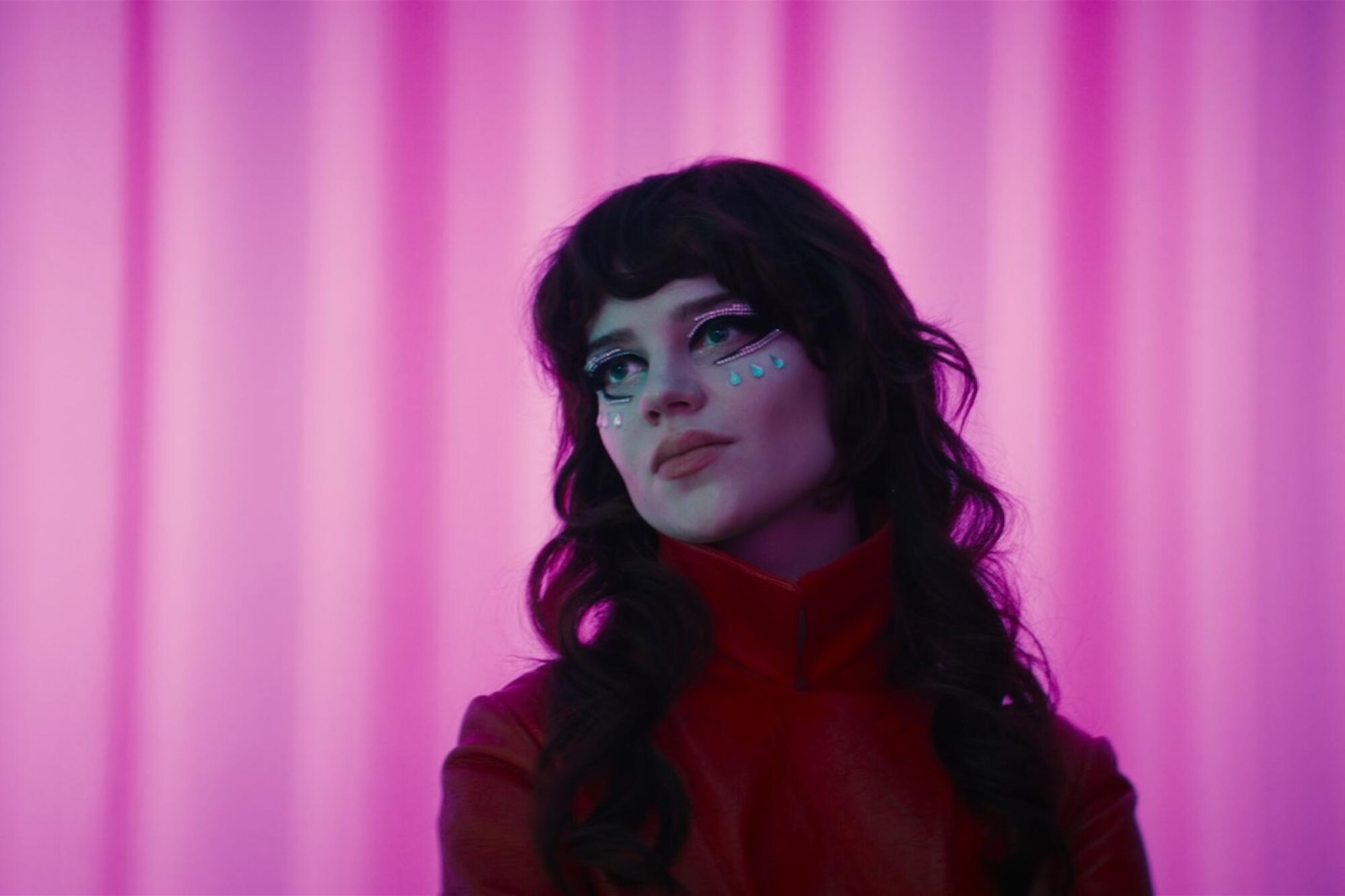
A decade after his last film, Nicolas Winding Refn returns with “Her Private Hell,” a neon-drenched blend of horror and sci-fi. Sophie Thatcher (“Companion”) plays Elle, a young movie star living in a penthouse overlooking a mist-covered metropolis inspired by Travis Scott’s “Astroworld.” Below, a serial killer known as The Leather Man preys on young women, while an American GI (Charles Melton) navigates post-war Tokyo’s underworld, battling the Yakuza in search of his missing daughter. There is no middle ground. You’ll either love or hate Refn’s psychosexual thriller with a giallo aesthetic. One thing we can all agree on is the terrific score by 70s maestro Pino Donaggio, known for his work with Dario Argento and Brian De Palma.
Refn’s dual-narrative feature, his first since 2016’s “The Neon Demon,” opens with veteran actress Elle arriving at the luxurious Tower Hotel, where she lives with her father, famous movie producer-director Johnny Thunders (Dougray Scott), and her young stepmother, Dominique (Havana Rose Liu). Before heading up to the penthouse suite, she meets Hunter (Kristine Froseth), who is stranded in the lobby after a mix-up with her reservation.
It turns out that Hunter, also an actress, has been cast in Elle’s new film, a “Barbarella”-esque sci-fi movie based on the comic book “Candy Floss.” The movie-within-a-movie scenes are pure space camp, as in Roger Vadim’s 1968 sci-fi classic starring Jane Fonda. Expect an all-female crew in spandex costumes with cone-shaped bustiers, old-school laser pistols, and psychedelic visuals when the spacecraft enters hyperspeed. As Austin Powers would say, “Groovy baby yeah.”
Elle offers to let Hunter stay in the hotel suite but becomes quickly annoyed by the fame-hungry aspiring actress who is obsessed with social media. When Elle introduces her to stepmother Dominique, Hunter comments, “But you’re so young.” The three women trade awkward glances and plenty of side-eye, giving the film a soap-opera feel. Daddy issues heighten the melodrama, as Elle reveals that Dominique used to be her best friend (and lover) before marrying her father, Johnny Thunders—no relation to the leader of the punk rock band The Heartbreakers.
Johnny is a work of art. The leather-clad tough guy strikes matches on his ears to light cigarettes, and he prefers to be called “Daddy.” All three women seem to be vying for his affection, but he’s only in the story long enough to spread The Leather Man lore. Johnny explains that the serial killer is a “monster in the mist” who was once a grieving father searching for his lost daughter. He is Refn’s version of Freddy Krueger, a supernatural entity who violently kills women (he rips their rib cages open) and wears gloves encrusted with razor-sharp diamonds, unlike Krueger’s claw glove with knife blades. He also resembles a ghostly pirate from John Carpenter’s “The Fog” because of his glowing eyes and his appearance in a mist.
Meanwhile, the secondary plot gains momentum as a brooding Private K moves through misty, neon-drenched postwar Tokyo; the cyberpunk setting resembles Ridley Scott’s “Blade Runner.” While hunting the Leather Man, whom he believes dragged his daughter to hell, Private K uses brass knuckles and a sword to carve a bloody path through the underworld as he battles the yakuza. He’s guided by two Asian fox witches known as the Kingmakers (Shioli Kutsuna and Aoi Yamada), shapeshifters who appear as seamstresses.
The mythical Leather Man is Refn’s common denominator, tying the double narrative together. We see him in Elle’s world, slaying women as if he were flesh and blood, and then in Private K’s realm, he exists as a supernatural specter—as the Kingmakers put it, “To catch a ghost, you must become a ghost.” The line between fantasy and reality is blurred, as Refn uses the entity to represent paternal grief and trauma, shared by our two protagonists.
Magnus Nordenhof Jønck’s cinematography is beautiful to look at, Havana Rose Liu and Kristine Froseth are fun to watch, and this may be my favorite Charles Melton performance. As a fan of David Lynch and Dario Argento, I can appreciate the surreal aesthetic and giallo undercurrent that encompasses “Her Private Hell.” It’s the perfect vehicle for mesmerizing Sophie Thatcher. But Nicolas Winding Refn is obviously not interested in duplicating the mass appeal of “Drive.” This is his most polarizing film, and not one for rationalists.
(3 stars)
Now showing in theaters
This <a target=”_blank” href=”https://fortworthreport.org/2026/07/30/her-private-hell-review-fans-of-lynch-and-argento-will-appreciate-nicolas-winding-refns-polarizing-return-to-the-cinema/”>article</a> first appeared on <a target=”_blank” href=”https://fortworthreport.org”>Fort Worth Report</a> and is republished here under a <a target=”_blank” href=”https://creativecommons.org/licenses/by-nd/4.0/”>Creative Commons Attribution-NoDerivatives 4.0 International License</a>.<img src=”https://i0.wp.com/fortworthreport.org/wp-content/uploads/2021/04/cropped-favicon.png?resize=150%2C150&ssl=1″ style=”width:1em;height:1em;margin-left:10px;”>
<img id=”republication-tracker-tool-source” src=”https://fortworthreport.org/?republication-pixel=true&post=700784&ga4=2820184429″ style=”width:1px;height:1px;”><script> PARSELY = { autotrack: false, onload: function() { PARSELY.beacon.trackPageView({ url: “https://fortworthreport.org/2026/07/30/her-private-hell-review-fans-of-lynch-and-argento-will-appreciate-nicolas-winding-refns-polarizing-return-to-the-cinema/”, urlref: window.location.href }); } } </script> <script id=”parsely-cfg” src=”//cdn.parsely.com/keys/fortworthreport.org/p.js”></script>