
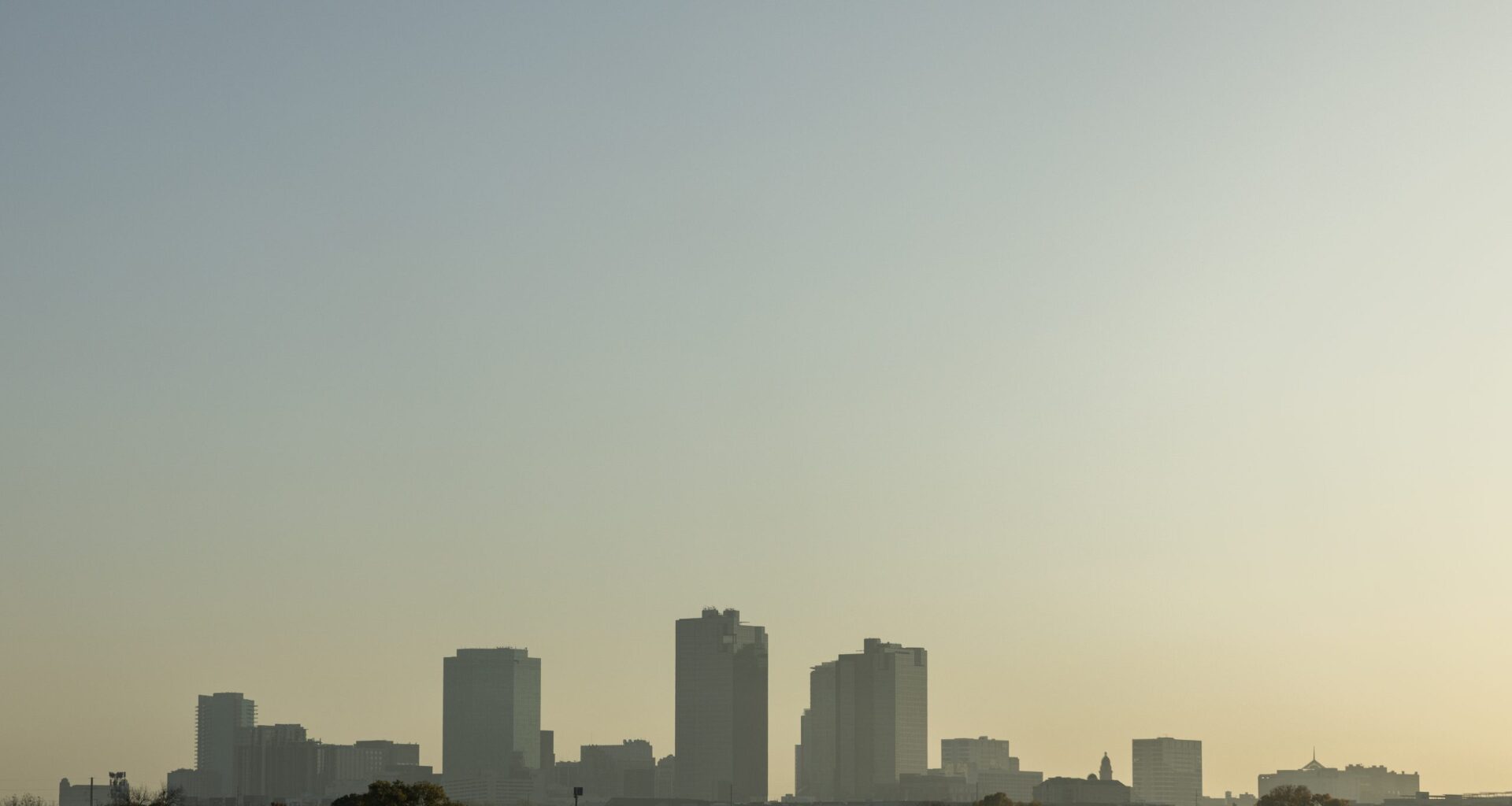
North Texas has seen 14 days when smog reached unhealthy levels this year, according to the latest data.
Of the 14 days that exceeded federal air quality standards, there were 10 days when Ozone Action Day alerts were issued. The notifications are issued by the Texas Commission on Environmental Quality a day in advance so industries, businesses and people can take steps to reduce activity or pollutants that contribute to ozone formation.
The region is down by one alert compared to this time last year, when 11 action day alerts were issued between April through July, according to the Report’s previous coverage.May 9 was the first day when the region’s ozone reached “orange levels,” measured at 71-85 parts per billion.
Smog that exceeds 70 parts per billion is considered unhealthy for small children, older adults and people with respiratory conditions or disease such as asthma, according to the North Central Texas Council of Governments, the agency that monitors that region’s air quality.
Parts per billion is the unit used to measure concentrations of air pollutants or emissions. A part per billion is equivalent to a single drop of water in an Olympic-size swimming pool.
The Environmental Protection Agency’s standard on ozone is set at a design value of 70 parts per billion.
May 13 is the only day so far when ozone reached “red” levels, between 86 to 105 parts per billion. When smog reaches these levels, the public — including children and those with respiratory disease — is advised to limit time spent outdoors.
Fort Worth’s air quality is expected to reach moderate levels of smog and particulate matter through the end of the week. Ozone levels are not expected to exceed 70 parts per billion, according to the state environmental commission’s forecast.
Ground-level ozone, or smog, forms as a gas in the atmosphere when nitrogen oxides and volatile organic compounds emitted by human activities and natural sources react in the sunlight, according to the council of governments.
Major sources of volatile organic compounds include power plants, industrial sites, vehicle emissions and oil and gas operations. While they account for fewer pollutants, area sources such as paints and motorized lawn equipment also contribute to ozone formation.
Breathing in ozone can lead to a variety of health problems, such as chest pain, coughing, throat irritation and congestion, according to the council of governments. Poor air quality can also worsen respiratory conditions such as bronchitis, emphysema and asthma.
The region’s overall design value currently sits at 82 parts per billion, with Fort Worth’s at 80 parts per billion.
Fort Worth’s ozone levels sit just behind Frisco, the city currently with the highest levels of smog in North Texas, data shows.
The design value is the average of the fourth worst day of ozone across a three year period, according to the council of governments.
North Texas began this year’s ozone season with a design value of 74 parts per billion.
The region’s current design value is slightly down from the 2023-2025 value of 83 parts per billion.
Ozone season in Texas begins in March and runs through November.
Nicole Lopez is the environment reporter for the Fort Worth Report. Contact her at nicole.lopez@fortworthreport.org.
The Report’s environment coverage is supported by the Marilyn Brachman Hoffman Foundation.
At the Fort Worth Report, news decisions are made independently of our board members and financial supporters. Read more about our editorial independence policy here.
This <a target=”_blank” href=”https://fortworthreport.org/2026/07/30/north-texas-sees-14-days-of-unhealthy-levels-of-smog-moderate-air-quality-to-come/”>article</a> first appeared on <a target=”_blank” href=”https://fortworthreport.org”>Fort Worth Report</a> and is republished here under a <a target=”_blank” href=”https://creativecommons.org/licenses/by-nd/4.0/”>Creative Commons Attribution-NoDerivatives 4.0 International License</a>.<img src=”https://i0.wp.com/fortworthreport.org/wp-content/uploads/2021/04/cropped-favicon.png?resize=150%2C150&ssl=1″ style=”width:1em;height:1em;margin-left:10px;”>
<img id=”republication-tracker-tool-source” src=”https://fortworthreport.org/?republication-pixel=true&post=701230&ga4=2820184429″ style=”width:1px;height:1px;”><script> PARSELY = { autotrack: false, onload: function() { PARSELY.beacon.trackPageView({ url: “https://fortworthreport.org/2026/07/30/north-texas-sees-14-days-of-unhealthy-levels-of-smog-moderate-air-quality-to-come/”, urlref: window.location.href }); } } </script> <script id=”parsely-cfg” src=”//cdn.parsely.com/keys/fortworthreport.org/p.js”></script>