
FILE – This Sept. 18, 2007 file photo shows former Texas head football coach Darrell Royal posed at his apartment complex in Austin, Texas. The University of Texas says Royal, who won two national championships and a share of a third, has died. He was 88. UT spokesman Nick Voinis on Wednesday, Nov. 7, 2012 confirmed Royal’s death in Austin. (AP Photo/Harry Cabluck) / mug – mugshot – headshot – portrait / 11082012xNEWS 11082012xBRIEFING 12302012xSPORTS
Harry Cabluck/AP
The job changed around him. Heck, the whole sport did.

As a young man, he thought coaching college football was about instilling an attitude, and teaching players to be tough, and preparing for the big games that used to seem like they meant everything.
Article continues below this ad
But gradually he grew to consider himself more of a politician, which he’d sworn he never wanted to be. The money was getting out of hand. And the kids had gained so much power, it felt to one of the most successful men in his profession as though teenagers were keeping him “jangling at the end of their string.”
“I don’t care if a coach is on vacation in Greece, sometime every day he’s thinking about some sophomore back home,” the old coach said. “I’ve gone on vacation and spent two or three hours a day talking to recruits on the phone.”
This is not the story of how the transfer portal convinced Nick Saban it was time to go from Alabama to ESPN, or how the name, image and likeness era pushed championship-winning coaches from Jim Harbaugh to Jay Wright to Dusty May out of college sports.
Instead, it’s an excerpt from an astoundingly great Texas Monthly profile of Darrell K Royal, published way back in 1982. A friend stumbled onto it and passed it along last week, and reading it 50 years after Royal walked away from his job as head coach at Texas, it’s a reminder of how much that supposedly plagues the college game is new.
Article continues below this ad
As a character study of a then-58-year-old retiree, “Coach Royal Regrets” remains nothing short of brilliant. Over the course of about 8,000 words, longtime magazine writer Jan Reid weaves interviews with Royal in his pickup and his lake house into a portrait of a proud, accomplished man still coming to terms with where he came up short.
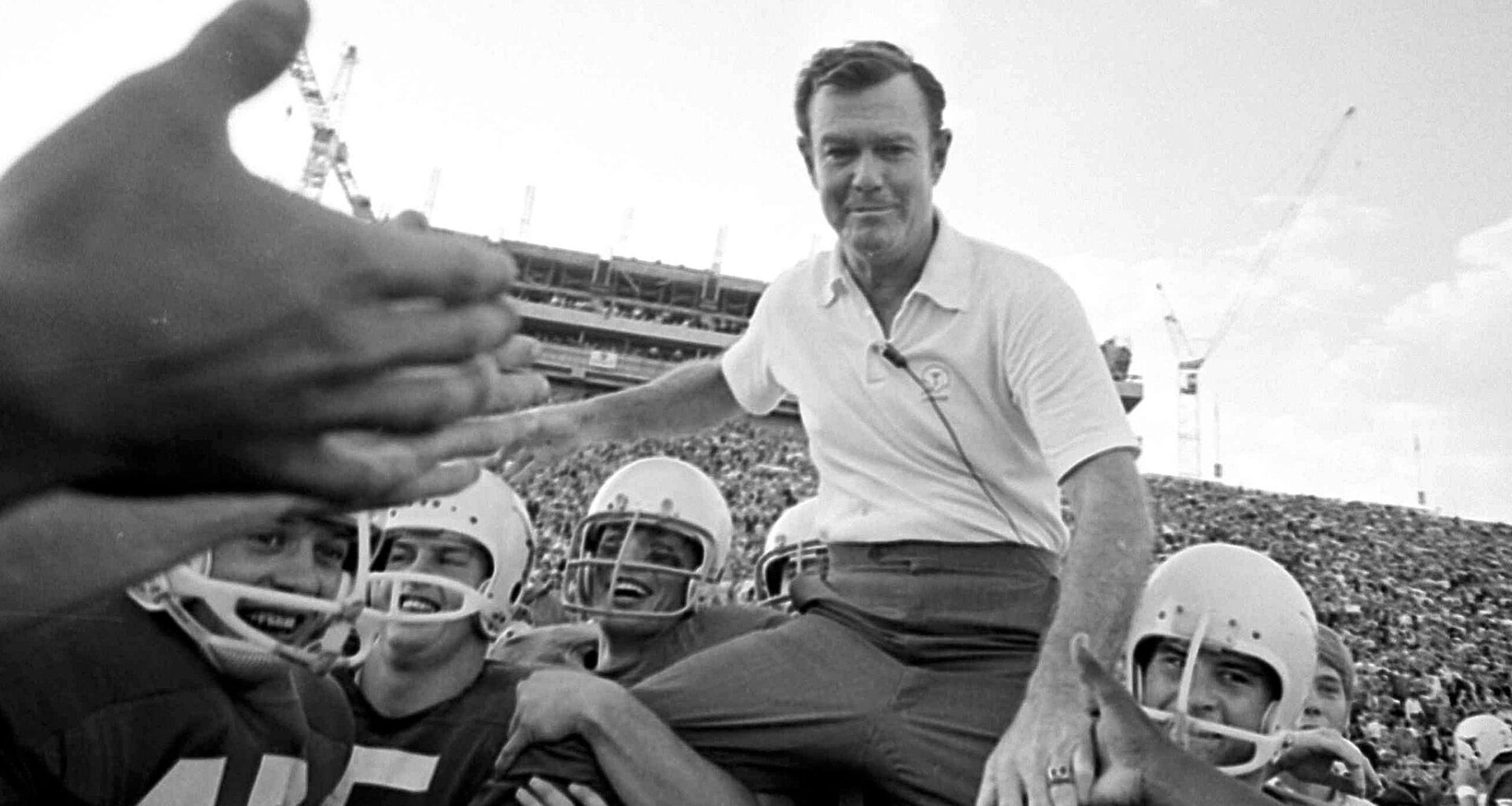
FILE – In this Dec. 5, 1970, file phot, Texas coach Darrell Royal is carried from the field on the shoulders of his Longhorns following Texas’ 42-7 triumph over Arkansas in Austin, Texas. Royal, who won two national championships and turned the Longhorns program into a national power, died early Wednesday, Nov. 7, 2012, at age 88 of complications from cardiovascular disease, school spokesman Bill Little said. Royal also had suffered from Alzheimer’s disease. (AP Photo/File)
Anonymous/AP
Royal acknowledges “Meat on the Hoof,” the 1972 book that called into question the often-brutal culture around a Longhorns powerhouse that won three national titles from 1963-’70. He reflects on being slow to integrate a program that holds the ignominious distinction of fielding college football’s last all-white championship team. He doesn’t try to hide how much he was tormented by his bitter rivalry with Oklahoma’s Barry Switzer.
Article continues below this ad
But aside from all of that, the piece illustrates how there always has been bellyaching about how college sports is losing its soul. In one scene, which presumably was funny in 1982 but is even more hilarious now, Royal and his wife Edith are discussing that year’s big controversy — that Texas A&M had made coach Jackie Sherrill the highest-paid university employee in the nation.
Sherrill’s exorbitant new deal was set to pay him a total of $1.6 million — over six years.
“They didn’t have to go public with that,” Royal said in the Texas Monthly story. “You keep the coach’s salary in line with the deans at the university. Then if you want to do a little something extra on the side, that’s fine, that’s private business. But to come right out and publish the figure, that just puts Jackie in a bad spot with the faculty.”
That idea, of course, became antiquated in a hurry. Eventually, coaches like Jimbo Fisher and Brian Kelly would earn more by getting fired and collecting a buyout than a whole university of deans make in a lifetime, and the school presidents stopped worrying about the optics of it.
Article continues below this ad
But there still are plenty of through lines from Royal, who died at 88 in 2012, to today. Back in his time, there was no such thing as the transfer portal or NIL money, but there was no shortage of grumbling about under-the-table payments, or about a system run amok.
Then, as now, recruiting was a circus, and coaches often found it humiliating. Reid wrote about an anecdote in which Royal visited a high-school recruit and was told he was sitting in the kid’s favorite chair.
“Well,” Royal said, “unfortunately, I was so taken off guard — I should have more poise than that — I just moved over like a little poodle dog.”
Talk to Saban, or Harbaugh, or Wright, and they probably have similar stories. Talk to May, who just left Michigan to become the coach of the Dallas Mavericks, and he’ll probably admit that assembling a national championship roster made him feel like a poodle dog at times, too.
Article continues below this ad
But even now, there are folks who can’t help feeling sentimental about the circus.
Just like Royal was in 1982.
“I guess it sounds like I’m bitter about the game,” Royal told Reid. “I’m not. I think it can be properly administered, that the people in charge of the program can understand that it’s just a part of the university, and not the most important part. It’s still part of education, and there’s a place for it.”
Article continues below this ad
No matter how much it changes.
James Street on the sidelines with coach Darrell Royal during the 1970 Cotton Bowl game against Notre Dame. (Courtesy UT Sports Information) 01012015xCFPspecialsection
unknown/Dallas Morning News
In this photo taken Sept. 1, 2012, former Texas legendary head football coach Darrell K. Royal gives the “Hook’em Horns” hand gesture when was honored before Texas’ season-opening NCAA college football game against Wyoming in Austin, Texas. Royal, who won two national championships and turned the Longhorns program into a national power, died early Wednesday, Nov. 7, 2012, at age 88 of complications from cardiovascular disease, school spokesman Bill Little said. Royal also had suffered from Alzheimer’s disease. (AP Photo/Statesman.com, Ralph Barrera) MAGS OUT; NO SALES; INTERNET AND TV MUST CREDIT PHOTOGRAPHER AND STATESMAN.COM
Ralph Barrera/AP
The Texas side, including coach Darrell Royal (2nd from left), reacts to the winning touchdown over Arkansas in 1969. The 1969 Texas vs. Arkansas football game, sometimes referred to as the “Game of the Century”, was a college football game played on December 6 in which No. 1 Texas visited No. 2 Arkansas at Razorback Stadium in Fayetteville, Arkansas. The Longhorns came back from a 14-0 deficit after three quarters to win 15-14.
Linda Kaye/Dallas Morning News
FILE – In this Dec. 27, 1963, file photo, coach Darrell Royal, center, of the University of Texas, chats with two of the team’s captains, David McWilliams, left, and Scott Appleton, tackle, Dec., in Austin, Texas. McWilliams, who has spent more than five decades serving the University of Texas’ athletic department, believes it’s time to go fishing. Austin American-Statesman reports McWilliams, who turns 73 next month, announced Friday, March 27, 2015, he is retiring this August. (AP Photo/Ted Powers, file)
Ted Powers/AP
ORG XMIT: *S0415050914* Jan. 1 1970 Cotton Bowl_Texas head coach Darrell Royal shaking hands with Notre Dame coach Ara Parseghian after Texas’ 21-17 victory over the Irish in the 1970 Cotton Bowl. 1970×1970
Credit: AT&T Cotton Bowl/Digital File_EMAIL