
Early in his tenure as San Antonio police chief, William McManus took heat from some social conservatives for his outreach to the LGBTQ+ community. It did not faze him. Above, Pride San Antonio board members James Poindexter, left, and George Perez give him an award at the Pride Bigger Than Texas Night Parade on June 27, 2026.
Sam Owens/San Antonio Express-News
As San Antonio’s LGBTQ+ leaders planned the city’s 2007 Pride parade, they struggled to find a public official willing to serve as grand marshal.
So they turned to Police Chief William “Bill” McManus. No police chief had ever led the parade before, but McManus said yes. The Police Department wanted him inside a secure patrol car during the event. He chose to walk.
For weeks afterward, social and religious conservatives packed City Council meetings, angry that McManus had lent his stature to what they called “the gay parade.” Some carried crosses. Many demanded the city manager fire him.
Undaunted, McManus kept walking, year after year. On June 27, he flashed his trademark smile and waved from the head of the Pride Bigger Than Texas Night Parade, keeping a brisk pace behind four SAPD motorcycle officers. “Thank you, McManus. Thank you, chief!” spectators called out.
It was his last Pride parade as chief, and it was a fitting symbol of his skill at cultivating relationships and his determination to be seen as a chief for all the people.
McManus, 74, retired July 10 after nearly 20 years in the job — the longest tenure of any San Antonio chief and one of the longest in modern American policing. His longevity allowed him to shape SAPD more profoundly than any of his predecessors. He expanded the force, modernized its technology and training, strengthened its response to family violence and mental-health crises, and made public engagement central to the job.
But he also concentrated authority around himself and clashed with union leaders and commanders, who believed he put his own popularity and his standing with his bosses above the interests of the rank and file. That tension is at the heart of his legacy.
For this story, I visited and spoke with McManus over a 10-month period. He let me accompany him on and off duty. I interviewed dozens of people who knew or worked with him and reviewed court records, internal documents and archives related to his career.
What emerged was a portrait of a public figure who craved privacy; a man who cherished order and yet chose a profession in which his life could be upended at any moment; a chief who spoke his mind, sometimes bluntly, but often felt misunderstood.
William McManus, seen during a City Council meeting on Sept. 18, 2025, became the face of SAPD during his nearly 20-year tenure as chief.
Josie Norris/San Antonio Express-News
‘Faith shaped him’
As chief, McManus woke at 5:30 every morning and checked overnight emails, texts, command notifications and law-enforcement news. He kept his phone close at hand — under his pillow at night and within reach even in the shower. “There’s no such thing as off duty,” he said. Chess relaxed him and exercised his mind. He kept boards in his SAPD office, where matches unfolded in the background.
Off duty, his life was narrow by design: home, church, gym, supermarket and an occasional short hunting trip. At six-foot-one and 190 pounds, he lifted weights daily, practiced intermittent fasting, avoided alcohol and rarely ate out. When the weather cooled, he ran bleachers at the University of the Incarnate Word or Trinity University.
He cooks almost all his own meals — brisket, turkey, pork shoulder, venison sausage, vegetable soup and oat pancakes.
“If I didn’t cook it, I don’t eat it,” he said.
At home, he reads Scripture and prays before an altar in his family room. He attends Mass every Sunday and many weekdays at Our Lady of Sorrows Catholic Church northeast of downtown. He was there at 8 a.m. on July Fourth, sitting by himself in the Adoration Chapel. “I like the solitude,” he said.
Years ago, his faith connected him to Father Jimmy Drennan, a Catholic priest, former San Antonio police officer and McManus’ longtime personal chaplain. When McManus arrived in the city in 2006, having left his family in Minneapolis to finish the school year, Drennan arranged for the new chief to live at the St. Paul Catholic Church rectory near Woodlawn Lake.
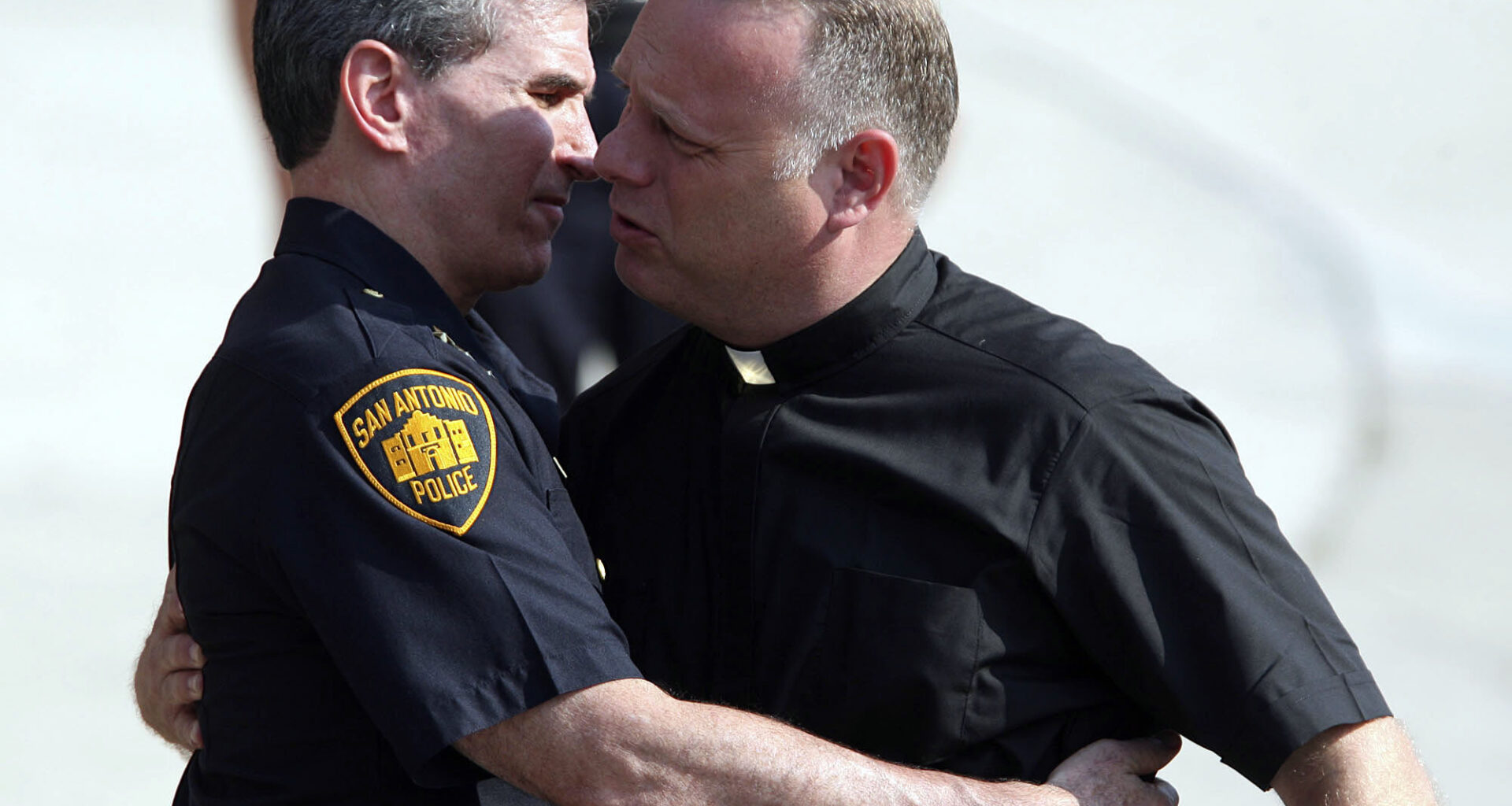
Father Jimmy Drennan, a Catholic priest and former San Antonio police officer, embraces Police Chief William McManus in September 2007. Drennan is McManus’ longtime personal chaplain.
Delcia Lopez/San Antonio Express-News
Drennan introduced McManus to San Antonio’s churches, neighborhoods and history. “He came from a very Catholic family, and he has lived out a very Catholic life,” Drennan said. “Faith shaped him as a servant leader.”
His wife Lourdes and their three children anchored him. So did habit and routine. Then-Bexar County District Attorney Nico LaHood recommended a barber to McManus in 2015. More than a decade later, the chief was still in Mario Gamboa’s chair every Wednesday.
William McManus’ life is bounded by faith and routine. Left, he has gone to the same barber, Mario Gamboa, for more than a decade. Top right, he wears his father’s Sacred Heart medallion. Bottom right, an altar in his family room.
Sam Owens/San Antonio Express-News
Philadelphia roots
McManus grew up in a crowded Northeast Philadelphia rowhouse, the second of five children and the only boy. His father hung wallpaper, maintained buildings and delivered appliances. Though he worked with his hands, he had “a brain like a calculator,” McManus said. His mother held together a Catholic household built around school, Mass, order and expectation.
McManus played quarterback at Father Judge High School, boxed at a West Philadelphia gym and attended Villanova University on a football scholarship. After graduating with a liberal arts degree in 1973, he tried out for the Philadelphia Eagles but didn’t make the cut. He applied for a job teaching physical education in Paris. Then, at 22, he took the Washington D.C. police test with a college friend “just for fun.”
He passed and joined Washington’s Metropolitan Police Department in 1975. He worked patrol and investigative assignments and rose to sergeant, lieutenant, then captain. For the captain’s exam, McManus studied every day for more than a year. To avoid falling asleep, he stood at a workbench, using a spotlight. In the final months of preparation, his father, a longtime smoker, was dying of lung cancer.
The night before the exam, McManus’ mother called. “You better come up,” she said.
McManus drove to Philadelphia and sat with his father through the night. Months earlier, he had placed his Sacred Heart medallion, a devotional pendant with a depiction of Jesus, around his father’s neck. When his father died at 6 that morning, McManus reclaimed it.
The medallion was around his neck when he drove nearly three hours back to Washington and took the captain’s exam without having slept. He finished first with a score of 148 out of 150. He still wears the medallion every day.
In 1998, McManus took command of the Metropolitan PD’s First District, which includes Capitol Hill and areas west of the White House. In short order, he transformed the station house. He cleared out old furniture, emptied closets, repainted walls, restriped the parking lot and gave employees scripts for answering the phone.
“I want this place to look like a cross between a Marine barracks and a hospital,” McManus recalled telling officers.
A new D.C. police chief arrived in April of that year. Charles H. Ramsey had been second-in-command of the Chicago Police Department. He noticed that most of the station houses he visited were run-down. McManus’ was spotless, its floors “gleaming.”
“It created an environment for the men and women that worked for him that showed that he cared about them,” Ramsey said in a recent interview. He promoted McManus to assistant chief in 1998. In November 2001, McManus left to become head of the Dayton Police Department in Ohio. In February 2004, he took over the Minneapolis Police Department.
He faced rough going at times. In Dayton, police union members approved a no-confidence vote in McManus, the result of disputes over the chief’s tough disciplinary policies and restrictions on high-speed pursuits and deadly force against fleeing suspects.
McManus also won over some early critics. In Minneapolis, civil rights activist Tyrone Terrill had wanted the city to hire a Black chief. McManus turned him into an ally by getting out, meeting residents and showing he cared, Terrill said. Years later, he still calls McManus “brother.”
William McManus was assistant chief of the Metropolitan Police Department in Washington D.C. before becoming police chief in Dayton, Ohio, and later Minneapolis. He took over SAPD in 2006.
Sam Owens/San Antonio Express-News
McManus studies a chessboard in his office at Public Safety Headquarters on Sept. 8, 2025. He played the game constantly as a form of mental exercise.
Sam Owens/San Antonio Express-News
McManus grew up in Northeast Philadelphia and went to Villanova University on a football scholarship.
Sam Owens/San Antonio Express-News
Wanted: ‘an outsider’
In 2006, San Antonio was looking for a new chief, and City Manager Sheryl Sculley and Mayor Phil Hardberger were not interested in a caretaker.
“The department had challenges and needed an outsider to shake up the organization and get things right,” Sculley recalled.
She wasn’t impressed with the initial pool of applicants, so she reached out to then-Houston Police Chief Harold Hurtt. He had a reputation as a reformer and had reported to Sculley when he was Phoenix’s police chief and she was an assistant city manager.
Hurtt put together a short list of alternative candidates. McManus stood out, Sculley recalled. He had experience in big cities and was eager to move to the Southwest.
City staff members and SAPD leaders warned Sculley that hiring an outsider would prove controversial, so she convened three community panels to interview McManus and the other finalists. McManus was the consensus choice.
He was sworn in as chief on April 17, 2006, and for the first two years, he reported directly to Sculley rather than through a deputy or assistant city manager, as was customary. Sculley anticipated internal resistance, and she wanted to help him navigate it.
Then-City Manager Sheryl Sculley, right, was looking for someone to “shake up” the San Antonio Police Department when she recruited William McManus. Above, Sculley introduces the new chief at a news conference on March 15, 2006. At left is McManus’ wife, Lourdes.
Jerry Lara/San Antonio Express-News
McManus moved quickly to modernize equipment, update tactics and stiffen discipline. He reassigned commanders he thought would oppose or slow-walk his agenda. By early 2007, he had put 100 more patrol officers on the streets, accelerated approval of Tasers and created a Crime Response Unit that concentrated officers where crime was rising. Reported major crime, which had risen sharply early in 2006, was declining by year’s end.
Family violence was another focus. McManus was shaken by a domestic assault that left a woman partly paralyzed. He directed officers to seek arrest warrants immediately in high-risk cases — by “walking a warrant” directly to a judge — rather than wait for the District Attorney’s Office to decide whether to bring charges, which could take weeks or longer.
Many big city departments had come under federal court oversight for civil rights violation. To avoid such an outcome. McManus revisited how SAPD handled encounters likely to lead to litigation or public distrust. The department rewrote its policies to minimize high-speed chases. Officers were schooled in de-escalation techniques, and McManus expanded the specialized unit that handled mental health cases.
SAPD instituted crisis-intervention training for all officers, as well as instruction in dealing with diabetic emergencies and interacting with LGBTQ+ individuals and people with autism.
Police Chief William McManus confers with Sgt. Jesus “Jesse” Salame Jr., center, and then-Deputy Chief Anthony “Tony” Treviño before a presentation to City Council members in January 2016.
Bob Owen/San Antonio Express-News
McManus was San Antonio police chief for nearly 20 years, longer than any predecessor. He left an indelible mark on the department’s training, technology, tactics and reputation in the community.
Bob Owen/San Antonio Express-News
As Sculley anticipated, all that change sparked opposition and litigation. In 2007, Deputy Chief Rose Mary Flammia and Lt. Cozette Fogus filed sex-discrimination lawsuits against McManus, SAPD and the city, alleging they had been passed over for promotion in favor of less-qualified men. A court dismissed Fogus’ complaint, and the city settled Flammia’s for $249,000 without admitting wrongdoing.
Mike Helle, then president of the San Antonio Police Officers’ Association, was both ally and antagonist as McManus sought to put his stamp on the department. He said that during the early “golden years,” the union and SAPD worked “hand in glove.”
Helle advocated for officers facing termination. McManus, he said, heard him out. The two hunted antelope and wild pigs together at King Ranch in South Texas. Eventually, they would clash. Helle, now retired, said the source of their disputes was what he called McManus’ greatest flaw: The chief, he said, paid too much attention to “the political winds.”
A brief absence
By late 2014, McManus had led SAPD for nearly nine years and wanted a break. He left at the end of December to become senior director of security at city-owned CPS Energy.
Anthony “Tony” Treviño, a San Antonio native and longtime SAPD leader, became interim chief and quickly built support from rank-and-file officers and community groups.
McManus, meanwhile, struggled to settle into his new job. “I had buyer’s remorse almost right away,” he recalled. Recruiters called. An opening for police chief in Tucson interested him. But what he really wanted was his old job, and it was still open: The city had not yet found a permanent replacement for him. He called Sculley. She made him submit a resume and compete for the position like any other applicant.
Community and labor leaders campaigned for Treviño, citing his deep familiarity with the department and the city. In July 2015, 50 of his supporters rallied on the steps of City Hall, chanting “We want Treviño.”
Police Chief William McManus confers with Deputy Chief Anthony “Tony” Treviño in 2014 as he prepares to pitch City Council members on a purchase of body-worn cameras for officers.
BOB OWEN/San Antonio Express-News
Supporters of interim Police Chief Anthony “Tony” Treviño rally on the steps of City Hall in July 2015 to demand that he be named permanent successor to William McManus. It was not to be.
Matthew Busch/For the San Antonio Express-News
Sculley disappointed them. For the second time, she picked McManus. City Council unanimously confirmed his reappointment on Oct. 1, 2015. He had been gone less than a year.
Henry Rodriguez, a civil rights leader and head of a San Antonio chapter of the League of United Latin American Citizens, took the news hard. In 2006, he had wanted the city to hire a qualified Hispanic chief. In 2015, he believed Treviño had earned the job. “That was not right,” Rodriguez said of McManus’ rehiring in a recent interview. “It did not sit well with me.”
William McManus resigned as SAPD chief at the end of 2014 to become head of security for city-owned CPS Energy. He regretted it immediately and returned as police chief less than a year later. Above, then-City Manager Sheryl Sculley, center, announces his return. At left is Anthony “Tony” Treviño, who served as interim chief and who some had hoped would be given the job permanently.
John Davenport/San Antonio Express-News
‘He’s family’
McManus liked to call himself “the community’s chief.” He put a premium on visibility and became a fixture at neighborhood meetings, vigils for shooting victims, parades, church services and civic lunches. At a National Council of Jewish Women meeting last fall at a synagogue in far North San Antonio, he gave out his cell number and stayed to chat with people long after the room had begun to empty.
On National Night Out, an annual event to promote police-community partnerships, Sculley rode with McManus from neighborhood to neighborhood. Residents crowded around to give him medals and pose for photographs. He was a constant presence at the scenes of homicides and officer-involved shootings. Often, he would sit with grieving relatives and offer a shoulder or an embrace.
Police Chief William McManus was a fixture at neighborhood meetings, vigils for shooting victims, parades, church services and civic lunches.
File/San Antonio Express-News
That personal touch went a long way with Rodriguez, who said he had been “a victim of police brutality” in the pre-McManus era. Over time, Rodriguez said, their relationship came “full circle.” McManus won him over by showing up — at civic meetings, immigration-related events and neighborhood functions.
In September, Rodriguez invited McManus to his 81st birthday party. The chief arrived with an SAPD-monogrammed blanket as a gift and found guests waiting to take selfies with him.
“You feel like he’s family,” Rodriguez said.
By some accounts, the mood was different for those on the inside. In a letter to city officials in 2023, Roy Waldheim, a former deputy chief who had retired the year before after 33 years with SAPD, wrote that the department’s problems “all stem from one person: William McManus.” He said the chief relied on a small inner circle of loyalists and used threats of demotion to keep underlings in line.
“I was advised by my supervisor that I was either on ‘Team McManus’ or ‘Switzerland,’” another departing SAPD official said in a 26-page exit questionnaire in 2023. “The McManus team is exclusive to 3-4 individuals who make decisions in a vacuum, and no one else is included to collaborate.”
Hardberger, now 92, said it was inevitable that a leader as forceful as McManus would make enemies. “I don’t know of any situation where a person is in command of so many people that there’s not going to be criticisms from within,” he said.
The real test of a chief’s effectiveness, Hardberger said, is whether the police department earns and keeps the public’s trust. By that standard, he said, McManus excelled. “We have a peaceful community, and I think the police chief helped make it so.”
Civil rights leader Henry Rodriguez, left, long maintained that San Antonio, a Hispanic-majority city, should have a Hispanic police chief. But over time, he became a friend and supporter of Police Chief William McManus. The two are seen above at Rodriguez’s 81st birthday party in September 2025.
Sam Owens/San Antonio Express-News
High stakes
Three of the crises McManus faced as chief encapsulate the challenges of leading a big city police department. Two centered on the use of deadly force, the other on the department’s role in immigration enforcement in the Trump era.
On Feb. 4, 2016, SAPD Officer John Lee fatally shot Antronie Scott, 36, in the parking lot of an apartment complex while trying to arrest him on felony warrants. Lee said Scott spun around while holding what appeared to be a gun. It was a cellphone. Scott was Black and unarmed, and his death sparked public outrage.
McManus initially decided to fire Lee. After further review, he ordered the officer to receive additional training but let him keep his job.
Still, members of the San Antonio Police Officers’ Association approved a resolution of no confidence in McManus by a near-unanimous vote. Helle said officers could not stomach seeing Lee second-guessed over a split-second, life-or-death decision.
The executive board of the San Antonio Police Officers’ Association meets in March 2016 after union members approved a statement of “no confidence” in Police Chief William McManus. Then-union president Mike Helle, second from left in red-striped tie, was both friend and foe to McManus.
John Davenport/San Antonio Express-News
McManus bridled at the accusation that he was willing to sacrifice officer safety to political considerations. He called it “the most ridiculous, the most ludicrous, the most preposterous statement that I have heard.”
Sculley and other city leaders defended McManus, and the controversy dissipated. But Helle said McManus was slow to let go of his resentment over the no-confidence vote. “You represent the department. I represent the rank and file,” Helle said he told the chief. “I have to defend the guy that gets into trouble.”
The fatal shooting of Melissa Perez seven years later exposed the same divide. Perez, a 46-year-old mother of four with schizophrenia, was acting erratically and vandalizing property when police responded to her Southwest Side apartment on June 23, 2023. She threw a candlestick at officers and later came at them with a hammer. Three officers fired at her through a locked glass door, killing her.
McManus stayed up all night monitoring the investigation. The next day, homicide detectives charged all three officers with murder. McManus said the arrests sent “a shock wave … through the department. It was like a 10 on the Richter scale.”
Perez did not pose a deadly threat to the officers, the chief said. They should have called in the mental health unit or backed off and returned the next day, McManus said. “It boiled down to a failure of leadership, a failure to follow proper protocols and procedures. This should have never happened.”
Two years later, a jury took less than 90 minutes to acquit the officers of all charges. “I like Bill. I worked with him,” said LaHood, the lead defense attorney. “But that was a pretty resounding message from the jury.” McManus, however, betrayed no second thoughts. The episode reinforced his willingness to impose discipline and insist on adherence to policy, even at the cost of support within the ranks.
McManus found himself at the center of a different kind of storm in late December 2017. Two days before Christmas, SAPD officers had discovered 12 immigrants in a tractor-trailer on the Northeast Side. Police charged the driver with human smuggling and released the immigrants to Catholic Charities of San Antonio.
Helle and others said the immigrants should have been turned over to ICE to see if they were in the country legally. They complained to Texas Attorney General Ken Paxton that SAPD had violated Senate Bill 4, a state law that requires local law enforcement to cooperate with federal immigration agencies.
Paxton sued McManus and the city, contending that SAPD deliberately kept U.S. Immigration and Customs Enforcement agents away from the migrants. Paxton sought to impose $150 million in civil penalties on the city. He filed a related suit demanding that McManus be removed as chief.
City officials rejected Paxton’s allegations and said federal agents weren’t able to detain the migrants because they took hours to show up and SAPD had no legal basis to hold them in the meantime.
Police Chief William McManus, seen with then-Mayor Ron Nirenberg, right, in 2017, had to navigate controversies over police use of force and the department’s role in immigration enforcement in the Trump era.
Kin Man Hui/San Antonio Express-News
The lawsuits hung over McManus and his department for years. In 2019, a judge dismissed part of the case, and in 2022 city officials settled the rest of the litigation for $300,000. On top of that, the city incurred $6.4 million in legal expenses.
Speaking at the National Council of Jewish Women meeting in September, McManus was philosophical about the episode. “They accused me of not cooperating,” he said. “They wanted me fired. … The litigation was more than $6 million — for something that I really didn’t do.”
In the late summer of 2023, McManus had a bitter public spat with Bexar County District Attorney Joe Gonzales. Six police officers had been shot and wounded over a two-week stretch by wanted felons with violent histories. McManus faulted Gonzales, saying prosecutors too often failed to seek tough bail conditions for dangerous suspects. Gonzales responded, heatedly, that judges, not prosecutors, set bail.
But even as the two men traded barbs publicly, they kept talking, and McManus in private was unfailingly civil, Gonzales said. Before a widely publicized town hall on public safety, the DA picked up the phone. “We can’t keep this up,” he recalled telling McManus. At the forum, the two shook hands for the news cameras to signal they had moved on.
“He’s ethical. He’s hardworking,” Gonzales said of McManus. “I know he had the best interests of San Antonio at heart.”
Bexar County District Attorney Joe Gonzales, left, and Police Chief William McManus had a bitter falling-out in 2023 over whether the DA’s office was doing enough to keep violent suspects behind bars pending trial. At a public safety town hall, the two shook hands to show they had patched up their quarrel.
Billy Calzada/Staff photographer
‘No chief serves forever’
Late last year, McManus did not sound like a man preparing to leave his job. He said he felt great and believed he was still effective. But in January, he announced he would retire at the end of September. Later, he moved up his departure to July 10. Silver Ventures, owner and developer of the Pearl entertainment district, announced he would become its vice president of safety and security.
Several people close to McManus said his decision to retire may have stemmed in part from friction with Mayor Gina Ortiz Jones, who took office in June 2025.
Emails published recently by the Express-News show Jones told City Manager Erik Walsh and other top officials in October that she had “no confidence” in McManus. She was reacting to an Oct. 2 KSAT report that disclosed details of SAPD security arrangements at her home.
Jones called McManus the day the report aired, and in an email to Walsh on Oct.3, she complained that his response was “lackadaisical.” She said McManus failed to spell out how he would ensure her safety or find out who leaked the information. “The Chief’s response was woefully inadequate and leaves me with no confidence in his ability to lead,” Jones wrote.
Walsh emailed back that McManus had opened an Internal Affairs investigation into the leak, and he told Jones he remained “confident in (McManus’) leadership abilities.” McManus said in an interview that he “took the matter seriously from the beginning.” Jones did not respond to a request for comment on the tiff.
Under San Antonio’s council-manager form of government, McManus reported to Walsh, not Jones. Still, a strained relationship with the mayor could make a chief’s life miserable. Manny Pelaez, a City Council member from 2017-25, has no doubt that’s why McManus chose to retire when he did. “A guy of his pedigree … ain’t got time for that,” he said.
Ron Nirenberg, who worked closely with McManus during eight years as mayor, said McManus’ stature was such that no one could force him to step down. “He’s literally the most popular civic official in San Antonio.” But Nirenberg sensed “the joy was diminishing” for McManus over the last year. “He’s at a place in his career where, if the joy runs out, he doesn’t have to remain,” he said.
McManus said tensions with the mayor had no bearing on his decision. “I was fortunate to receive an outstanding opportunity in the private sector, and the timing worked well,” he said. “No chief serves forever.”
‘I cared’
As his departure date neared, McManus professed to have no interest in a farewell party or final roll call. He said he wanted to go out “like Tim Duncan,” the Spurs great who retired without fanfare after 19 seasons and five NBA championships.
Police Chief William McManus receives an honorary Spurs jersey, to applause from RC Buford, CEO of Spurs Sports & Entertainment. The presentation was held before Game Five of the 2026 NBA Finals at the Frost Bank Center on June 13.
Sam Owens/San Antonio Express-News
Still, on July 2, about 70 people from SAPD and City Hall gathered at police headquarters to honor McManus. Some told stories. Others thanked him.
Outside Our Lady of Sorrows two days later, he appeared unburdened, at peace. Told that Laura Barberena, a San Antonio political consultant, believed he could win elective office, he smiled. He said people had urged him to run for mayor or City Council. For now, he was focused on his new job at the Pearl, he said, but he did not close the door.
Asked how he hoped to be remembered, he paused and let the question sit.
“That I cared,” he said finally. “And I did a good job.”
Police Chief William McManus monitors a protest against U.S. Immigration and Customs Enforcement from the second floor of City Hall in June 2025.
Sam Owens/San Antonio Express-News