
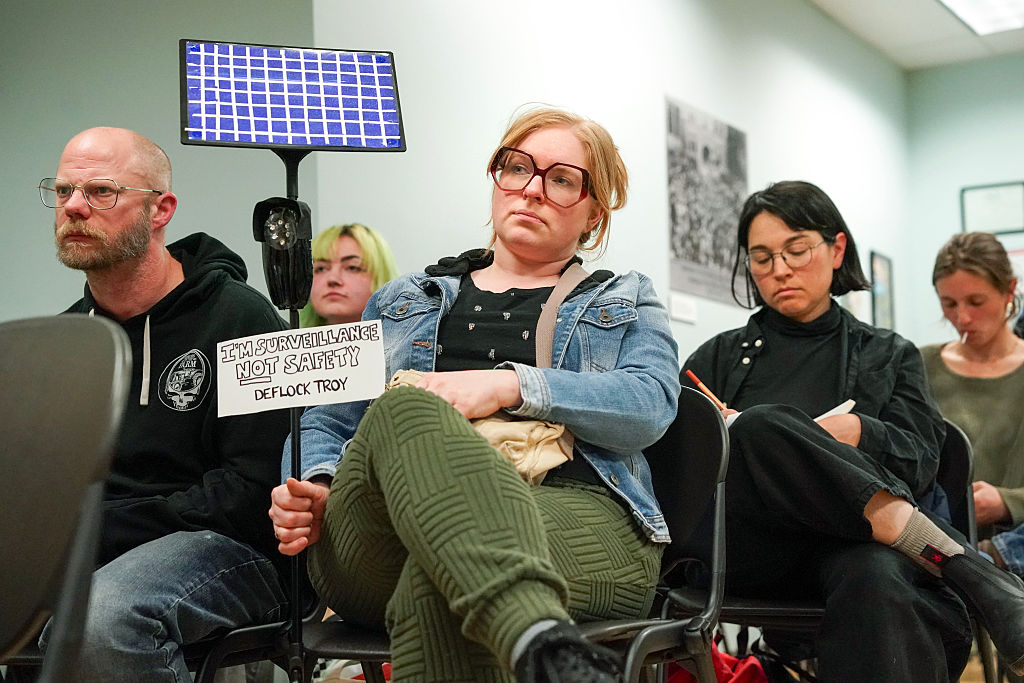
Resident holds a prop that reflects her feelings about the Flock cameras during a council meeting where citizens had the opportunity to speak out against the cameras during a public comment period (Photo by Cindy Schultz for The Washington Post via Getty Images)
The Washington Post/The Washington Post via Getty Im
Three Houston area law-enforcement agencies conducted internal investigations this summer over officers’ alleged abuse of the Flock license plate surveillance database.

Although law enforcement agencies statewide have repeatedly emphasized that Flock automatic license plate readers (ALPR) solely trace vehicles, not people, recent investigations in Fort Bend County and Pasadena have revealed some officers used the system to track people in their personal life.
Article continues below this ad
Meanwhile, a Baytown police officer resigned this week amid a criminal investigation into alleged misconduct involving the Flock search system.
Together the investigations have fueled further scrutiny on how agencies oversee access to one of the country’s fastest-growing surveillance technologies.
Can ALPRS track my whereabouts?
Law enforcement and Flock Safety, a privately owned company, have consistently maintained that their license plate readers are only aimed at tracking vehicles associated with crime.
Article continues below this ad
An advanced motion-activated camera and artificial intelligence tracks license plates and identifies unique vehicle features like make, model, color and other visible characteristics. Recordings are maintained in the system for 30 days and can be accessed by any law enforcement agency in the country.
However, in Houston and other similar areas with vast camera networks, critics argue the technology can reveal where someone lives, works and travels by tracking the vehicles they drive. That level of location surveillance typically requires a warrant, Civil Rights advocates told Chron.
Flock street camera. Photo by Cindy Schultz via Getty Images
Cindy Schultz/The Washington Post via Getty Im
“Everyone in America has the right to move freely without being surveilled by the government,” said Nick Hudson, senior manager of policy and advocacy at the ACLU of Texas. “If the government suspects us of wrongdoing and wishes to track our movements, they need to get a warrant.”
Article continues below this ad
Fort Bend Sheriff’s Lieutenant searches woman’s license plate 148 times
According to records obtained by Chron, a Fort Bend Sheriff’s Lieutenant searched for a woman with whom she had a “very contentious familial relationship with” over 148 times from 2022 to 2025.
Suspecting the lieutenant was “stalking” her, the woman searched her license plate on haveIbeenflocked.com, a crowdsourced database using audit logs from records requests. Her plates had been searched within the system a multitude of times, records state.
Fearing for her and her “family’s safety” the woman reported the findings and lieutenant to the Fort Bend Sheriff’s office, which later confirmed the violation. The lieutenant admitted that the searches were “not related for official FBCSO purposes,” according to the internal affairs memorandum.
Article continues below this ad
The Sheriff’s office declined to provide details on the disciplinary action the lieutenant faced, however reporting from ABC13 stated that they faced a two day suspension.
In a statement to Chron, the Fort Bend County Sheriff’s Office maintained that “every allegation of misconduct is taken seriously and investigated thoroughly,” adding that “appropriate disciplinary action is taken” when officers violate department policy.
Pasadena Officer uses Flock to track female officer, per city official
Meanwhile, the Pasadena Police Department confirmed an internal investigation is underway regarding allegations of officer misuse of the Flock database system.
Article continues below this ad
On July 8, Pasadena Police Sergeant Michael Palitz resigned from his position following claims that he allegedly used the database to track another officer in the department.
“These are serious allegations that demand transparency and accountability,” Council Member Carlos Heredia Sr. said during a July 21 city council meeting.
Further comments from Council Member Emmanuel Guerrero to KPRC confirmed that Palitz used the system to “track and stalk” a female officer.
Guerrero also shared that it was the Flock system itself that flagged the repeated searches, alerting the agency account to a potential misuse. According to a Flock spokesperson, the security platform is designed to include safeguards like this.
Article continues below this ad
In regards to the misuse, Flock referenced a July 17 interview in which CEO and founder Garrett Langley noted “it is a disappointing story when I see it.” However in response to growing concerns, he points to a new Audit Assistance tool now built into the system that is designed to flag abnormal search patterns for agency review.
“We heard from customers, we heard from communities loud and clear that Flock should do more,” said Langley regarding the new Audit Assistance tool. “We support almost 7,000 law enforcement agencies with over a million crimes a year, and [it is] our responsibility to safeguard that technology.”
Palitz had been with the department since 2017 and was promoted to sergeant in 2023. While he has since resigned, the internal investigation continues, the department confirms.
Baytown Police Officer resigns following criminal investigation into Flock abuse
As of July 24, Baytown Police Chief John Stringer announced that an internal affairs and a criminal investigation have been opened after allegations of officer misconduct involving the Flock system.
Article continues below this ad
Stringer on Friday announced that the officer in question resigned amid the investigation.
“In the interest of objectivity and transparency, I requested the assistance of the Harris County District Attorney’s Office throughout the entirety of the criminal investigation,” Stringer said in a video uploaded onto the department’s Facebook page.
While internal investigations were opened up in Pasadena and Fort Bend, Baytown appears to be the first department in the area to escalate the matter to possible criminal charges and involve the Harris County DA.
“If these allegations are sustained, then the employee involved will be held accountable to the fullest extent of the law and policy,” said Stringer.
Article continues below this ad
Due to the nature of the open investigation, Baytown officials said they could not comment further on any additional details related to the case.
A growing trend
The investigations in the Houston area reflect a growing nationwide trend of officers abusing the Flock system for personal gain.

Smart, funny and sometimes unhinged look at the week that was.
By signing up, you agree to our Terms Of Use and acknowledge that your information will be used as described in our Privacy Policy.
Based on a report by the Institute for Justice, there have been at least 28 recorded cases in which an officer used the ALPR camera network to track romantic interests, whether that is a current or former partner, or someone they have a sexual attraction towards.
Article continues below this ad
Hudson believes cases like these underscore how the technology’s capabilities can extend far beyond locating stolen vehicles or criminal suspects.
“What Flock enables is not just a snapshot of the vehicle. It creates a really powerful surveillance tool. And when you string together these data points it allows the government to take an intimate look at the movements of people.”