

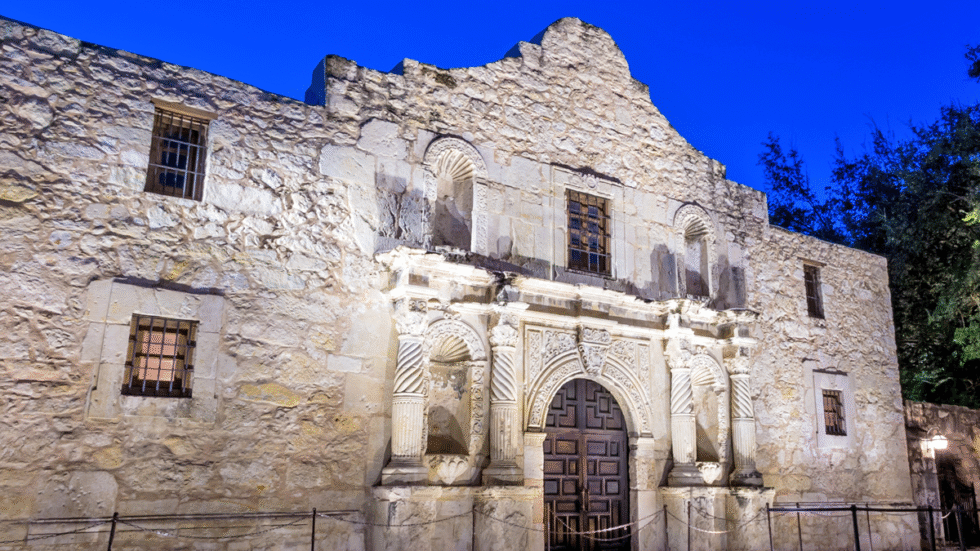
Things seemed to be going well for Dr. Kate Rogers. She had recently been promoted from executive director to the CEO and president of the Alamo Trust Inc., the nonprofit organization established in 2015 to manage and operate the expansion of the historic Alamo site in San Antonio, Texas.
The trouble started on October 23rd when Texas Lt. Gov. Dan Patrick suddenly posted on X that he had forwarded a letter to the Board of Directors of ATI calling for Rogers’ resignation or removal.
And then, just a day later, Rogers, who had envisioned the renovated Alamo site as “a beacon for historical reconciliation” yielded to Patrick’s demand and tendered what the Editorial Board of the San Antonio Express News referred to as her “forced” resignation.
Patrick had apparently taken exception to excerpts appearing in the last two pages of the doctoral dissertation Rogers had written at the University of Southern California.
One of the specific points of contention for Patrick, according to reporting by the San Antonio Express News, was a reference Rogers included in her dissertation to a book entitled “Forget the Alamo: The Rise and Fall of an American Myth.” This insightful analysis of the mythology associated with the Alamo siege and battle espoused the position that the Texas Revolt “was fought primarily against Mexico to expand slavery in the American South.”
“Forget the Alamo” is, of course, not the only or even the first historical analysis to advance this position, however. There’s also Randolph B. Campbell’s “An Empire for Slavery: The Peculiar Institution in Texas, 1821–1865” and Alice L. Baumgartner’s “South to Freedom: Runaway Slaves to Mexico and the Road to the Civil War” and Andrew J. Torget’s “Seeds of Empire: Cotton, Slavery, and the Transformation of the Texas Borderlands, 1800–1850” and Gerald Horne’s “The Counter-Revolution of 1836: Texas Slavery & Jim Crow and the Roots of U.S. Fascism,” among others.
In fact, this particular feature of the Texas Revolt is rarely even disputed by historians at this point and is certainly not in any way “controversial,” at least not from any historical perspective. Serious historical analysis of the Texas Revolt has, after all, shifted decisively over the course of the past several decades toward acknowledging that the issue of slavery played a central, albeit not exclusive, role in the conflict between the Anglo-Texan settlers and the Mexican government.
There are, however, those who, for whatever reason, continue to downplay the idea that slavery was the primary cause of the Texas Revolt. In a recent editorial, for example, Patrick appears to be signaling his commitment to telling a fantasy version of the Texas Revolt. He romantically characterizes the Alamo siege and battle as part of a larger fight for “liberty” and “independence” and fails to even mention the issue of slavery as a factor in the conflict.
A new state law that will transfer control of the Alamo from the Texas General Land Office to a newly created Alamo Commission by 2028 similarly mandates that the renovated Alamo portray the site as “a symbol of liberty and freedom.”
This fantasy or mythical version of the Texas Revolt preferred by Patrick and others frames the conflict between the colonists in Texas and the Mexican government as a heroic struggle between truth, justice, and the American way, on the one hand, and the tyranny and authoritarianism of the evil Mexicans, on the other. According to this mythical version of events, the Anglo-Texan colonists, inspired by an innate sense of American liberty, were fighting a valiant and noble revolution to defend their freedom in the face of the Mexican government’s stifling tyranny.
The only problem with this rendering of the tale is that it simply isn’t true. Decades of academic scholarship have definitively established that the Texas Revolt was not fought in pursuit of some lofty set of moral ideals but instead was fought to preserve and expand the base institution of slavery. Full stop.
In fact, from its inception, the success of the colonization project that Stephen F. Austin had inherited from his father, Moses Austin, was contingent upon the viability of slavery in the colony. The vast majority of Anglo-Texan colonists were, after all, pro-slavery Southerners who had migrated to Texas with the singular intention of farming cotton which, by its very nature, was a slave-intensive enterprise.
There was, however, one intractable complication for the colonists. Mexico had emerged from a brutal and debilitating decade-long attritional war of independence from Spain with a deep-seated hostility towards the institution of slavery.
Austin, of course, was keenly aware of the existential threat that this hostility posed to his colonization project and would accordingly lobby the Mexican government to protect slavery in the nascent colony. In fact, it wasn’t until Austin recognized the futility of his diplomatic efforts to preserve slavery in Texas that he fully endorsed the path of armed rebellion against the Mexican government.
It’s also important to recognize that the essential cause of the Texas Revolt was never really in controversy even at the time of the conflict. Mexican political and military officials certainly recognized the root cause of the revolt. Col. Jose de la Piedra, a Mexican commander in East Texas, for example, warned that the Texans would undoubtedly revolt if laws prohibiting slavery were rigorously enforced noting that the colony “was formed for slavery[.]”
Northern abolitionists also understood the role that slavery played in the Texas Revolt and astutely denounced the insurgency as the world’s first pro-slavery rebellion.
Perhaps most importantly though, the Texas colonists themselves understood that they were fighting for the freedom to own slaves. In an unmistakable reference to their slaves, leaders of the revolt justified the rebellion as a fight to preserve the colonist’s “property.” And, upon securing their independence from Mexico, the Texas colonists immediately proceeded to enshrine protections for slavery in the Texas constitution effectively outlawing any form of emancipation in the independent Republic of Texas.
This isn’t some new “woke” or “politically correct” interpretation or part of a larger “political agenda” as critics on the right including Patrick and Texas Gov. Greg Abbott have charged, and it really shouldn’t even be considered, in any historiographic sense, as revisionist. The essential cause of the revolt has been settled in the historical record for decades and has been widely recognized as an early episode in the larger struggle between slave and free states occurring in the United States that would culminate in the American Civil War.
Unfortunately, the mythology obscuring the origins and nature of the Texas Revolt has not gone gently into that good night as recent developments have demonstrated. Many Texans, including some of the most prominent political figures in the state apparently, continue to promote what is essentially a fairy tale even when confronted with compelling and conclusive historical evidence that clearly establishes the true origins and nature of the revolt.
As a Mexican American, I am exceedingly proud of the fact that the newly independent republic of Mexico attempted to resist the expansion of slavery into Texas. If political figures like Patrick are allowed to control the narrative of the Texas Revolt, however, this feature of the conflict may not even be told at all.
It is therefore incumbent, in my opinion, upon Mexican Americans to confront this enduring historical intransigence presented by Patrick and others. Let’s start by insisting that the truth about the Alamo and the Texas Revolt be told in its entirety and with all of its complexity in the renovated Alamo site.
This article first appeared on Fronterizo News.
Like Us and Follow Us On Our Social Media!
Visited 10 times, 10 visit(s) today