
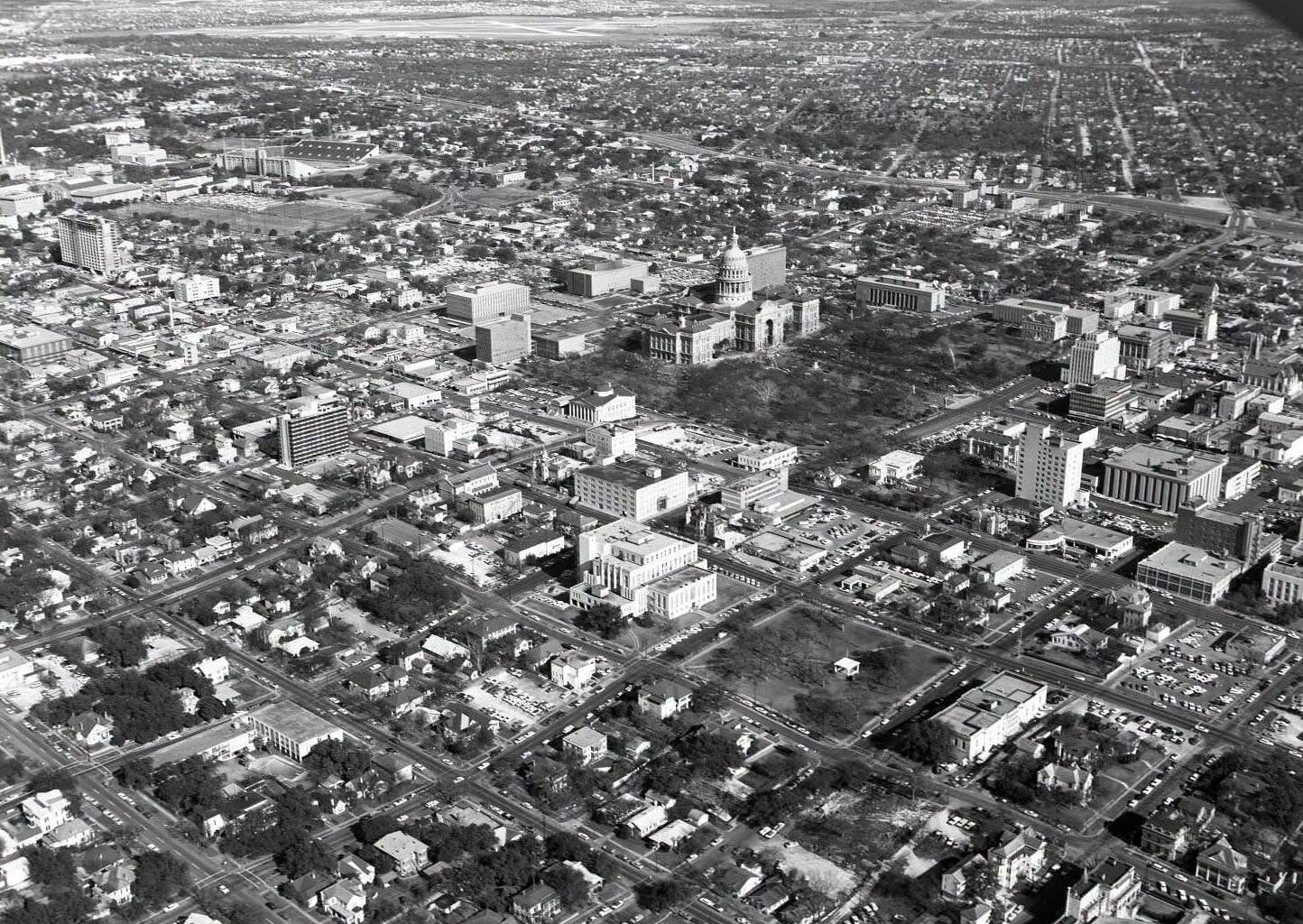
What do you see in this 1960s aerial photo of the Texas Capitol Complex in Austin? What don’t you see?
Austin History Center
Take a few seconds to look closer at this aerial photo of the Texas Capitol Complex taken during the 1960s.

Name five things that you see.
Article continues below this ad
Name five things that you don’t see.
We asked readers to play along with this historical puzzle.
Their responses could not have been more varied. Some turned angry when they wrote about the changes during the past 60 years. Others waxed nostalgic and wistful.
Several lent us a crucial clue to one mystery, noting that the Westgate Tower was under construction southwest of the Capitol grounds, which would date this photographic flyby to late 1964 or early 1965.
Article continues below this ad
What readers saw first
These are the top 10 sites that readers correctly identified, here numbered on the image.
Readers correctly identified these 10 sites from a 1960s aerial photo of the Texas Capitol Complex in Austin.
Graphic by Alice Bazerghi/American-Statesman
1. Texas Capitol: The domed 1888 building at the center of the frame is hard to miss. It must have been winter because many of the trees are leafless. When this picture was taken, the prominent place of this building in the urban landscape could not be matched. No Capitol Mall. Fewer state office buildings.
Article continues below this ad
2. Memorial Stadium: The modified 1924 football palace on the University of Texas campus certainly looked a lot smaller back then. In the 1920s, it took the name “Memorial” to honor World War I veterans. The extra moniker, “Darrell K. Royal,” borrowed from the coach of the Longhorns from 1957 to 1976, came in 1996.
3. Old Central Public Library: Several readers identified the 1933 building across the street from Wooldridge Square Park in the foreground. Later, from 1979 to 2025, it served as the Austin History Center, which has since expanded next door into the John Henry Faulk Building, unbuilt when this photo was taken. Parts of the 1933 building will reopen this fall as the temporary home of Mexic-Arte Museum.
4. Texas Governor’s Mansion: Fewer readers noticed this white, pre-Civil War residence that was completed in 1856. It burned in 2008 and reopened in 2012, but access to the public has been fairly restrictive ever since.
5. Travis County Courthouse: Located squarely in the foreground, this deco-inspired building was completed in 1931, expanded in 1958 and 1962, then renamed after integration hero Heman Marion Sweatt in 2005. It replaced a Victorian-era courthouse that was located at East 11th Street and Congress Avenue. That beauty was sadly allowed to disintegrate. The 1931 version is in serious need of sensitive renovation or restoration, as well as a new role in the community.
Article continues below this ad
6. Old Texas General Land Office: Completed in 1857, this Romanesque Revival structure has been better known since 1992 as the Capitol Visitors Center. It once housed a museum about the Confederacy and recently its exterior received an award-winning redo. (Time to explore again.) It is somewhat overshadowed in this photo by the more modern office building behind it.
7. Cambridge Tower and The Penthouse: Readers identified these two pioneering residential towers. The first, which appears to be under construction in this image, was considered a high modernist gem located next to campus; the other is somewhat forgotten except as part of the UT Tower mass shooting in 1966. The shooter murdered his mother there — and his wife at the couple’s Bouldin house — before he climbed the Tower.
8. Interstate 35: The 1960s was the decade when the Interregional Highway was completed through Central Austin as part of the interstate system. It looks slender and somewhat benign in this photograph, but it encouraged heavy traffic and suburban sprawl while it disrupted communities and intensified racial segregation.
9. East Austin: From a distance, it looks leafy and bucolic, and that’s how some residents remember their youth there, despite the racial animus of the 1960s. It was laid out along streets that converge with the original downtown grid at angles, because the later neighborhoods responded to the different topography.
Article continues below this ad
10. Robert Mueller Municipal Airport: Several readers referred to the lighter shades of the airport runways that spread across that vast space above Memorial Stadium in the photo. Growing from a small structure in an open field, it served the city from 1930 to 1999. Most of the area became the new urbanist Mueller development after air traffic moved to Austin-Bergstrom International Airport.
More sites that readers saw
Some of these sightings are idiosyncratic.
David Hibbs: “Five things I see: Austin History Center, Wooldridge Park across the street from it, the fourplex nearby at West 8th and Nueces streets where I lived in the late ‘70s, Gregory Gym and business school building across the street from Gregory Gym.” (Sharp eye, David!)
Article continues below this ad
August Harris: “Where to begin? The beautiful mansions like the Butler house that were demolished. More broadly, the skyline, the prominence of the Capitol, of course the airport and UT.”
Wendy Wheeler: “In the upper left corner I see the roof of my beloved 1938 house in Hyde Park.”
Joe O’Connell: “Wooldridge Park where, as a kid, my sisters and I rolled down the hill like logs while our mother did research for her master’s degree across the street in the Austin Public Library. Later, when she was done and the sun dipped below the trees, we caught fireflies in peanut butter jars.”
Pam Thompson: You can see the Capitol for miles around in every direction!
Article continues below this ad
Sites readers didn’t see
For the most part, readers didn’t see the following sites — or people — because they were not there in the 1960s. Many of the more crowded additions to the 1960s view can be identified in the matching drone photo taken by Aaron Martinez on June 23, 2026.
Several readers mentioned Dobie Dorm and Dobie Mall, which were not completed until 1972, and would have been just outside of frame anyway.
Dan Dodson: “(Lt. Gov.) Bob Bullock wheelin’ & dealin’ at Scholz Garten.” For that matter, Dodson could not see the Bob Bullock Texas State History Museum, finished in 1998. He added: “LBJ and John Connally schmoozing at the Austin Club.” On that note, no sign yet of the LBJ Presidential Library here. It opened in 1971.
Article continues below this ad
Jennifer Bristol: “Mueller community.” I like this term. Rather than “Mueller Development,” may we adopt “Mueller Community,” since it is almost fully developed?
Joe Nick Patoski: “Statues of Bari Weiss.” Thanks for this timely joke about the journalist, political commentator and founder of the new University of Austin, who is now the controversial editor-in-chief of CBS News.
Ian Davidson: 1. The Longhorn Baseball Stadium, gone now, was where the Performing Arts Center is today. 2. No Upper Deck — not built yet — on Interstate 35 (early 1970s). 3. No Jester Dorm Complex (1969). 4. Westgate Building, next to the Capitol — under construction in this photo (construction began in 1964, completed in 1965).
Nicki Turman: No scaffolding on the First Methodist Church just west of the Capitol. “We were married there May 17, 1980. From Class of 1972, Austin High and McCallum High.
Article continues below this ad
Trey Oberpriller: “Dad was in college in 1965. You can see the back side of Prather Hall and Roberts Hall with the intramural fields behind them. He talked about the bars where (libraries) are currently. He said that he and his friends knew the delivery schedules for each distributor. If you were sitting at the bar, drinking the beer that the delivery driver was delivering, you got a free beer.”
David W. Peters: “Tech bros!” (A little early for that social set.)
Catherine Bartoli: “I don’t see the underground extension north of the Capitol.” (Completed in 1993.)
Gary Anderson: Don’t see: LBJ Presidential Library and Sid Richardson Hall, Westgate Tower, State Bar of Texas Headquarters, Bullock Texas State History Museum, or Highland Mall. Ken Capps replied: “Highland Mall! Mom and I spent 9 hours there on opening day 1975!”
Article continues below this ad
Tom Williams: Don’t see skyscrapers, freeways, cell towers, bumper-to-bumper traffic, ozone.
Then there’s this amusing and technically accurate response:
Noe Gutierrez: “Things I do not see: Aardvark. Dinosaur. Liberty Bell. Meteor. Zebra.”
Article continues below this ad
Please send tips and suggestions to mbarnes@statesman.com.