
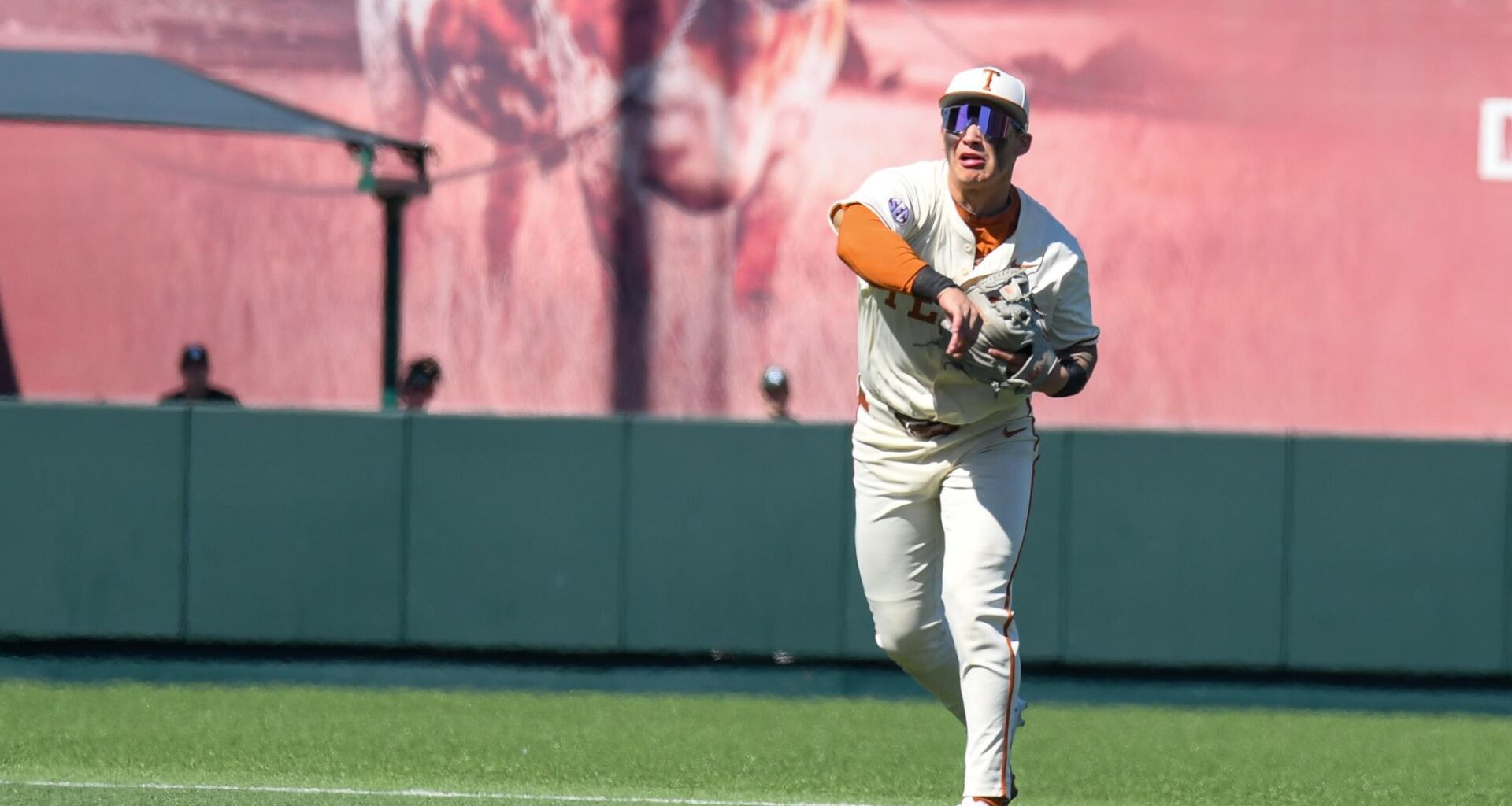
Ethan Mendoza had just clobbered his second home run in as many games, a statistical anomaly for a hitter who had hit just eight long-bombs across his previous 106 games.
Just one thing had changed.
“No, I’m just the same hitter I was last year,” Mendoza said during a post-game media availability. “Just added more strength, more weight.”
The Longhorns’ rising senior second baseman had undergone a transformation that offseason, entering a baseball chrysalis as a contact-oriented leadoff man and emerging, 15 pounds of muscle later, as a slugging cleanup-bat.
The change was immediately noticeable. Mendoza more closely resembled hulking former Texas catcher Carson Tinney than Adrian Rodriguez, a spry rising junior and middle infield mate.
“We made a couple jokes because A-Rod (Adrian Rodriguez) got skinny and Doza (Mendoza) gained some weight,” said Casey Borba, a rising senior corner infielder. “I made a joke (to Mendoza) ‘Oh, what are you taking dude?’”
As visible as the change was, it was even more evident at the plate.
Mendoza homered in each of the Longhorns’ other two nonconference series before adding another six shots after the opening of Southeastern Conference play, doubling his home run count from 2025.
His slugging percentage rose from .476 in 2025 to .478 in 2026, and his isolated power jumped from .143 to .200. He had seven more extra-base hits and his home run-to-fly ball percentage went from 9.3% to 12%.
His stats would look even more impressive had his batting average on balls in play not dropped from an unsustainable .402 to a below-average .278. BABIP is a largely luck-driven stat, and while Mendoza’s decreased sprint speed was detrimental to it, his slide in the metric is mostly due to misfortune.
Still, the results back up head coach Jim Schlossnagle’s team-building philosophy, which places an emphasis on strength and athleticism.
“You look at the teams in the last several years in the College World Series, they’re not little teams, they’re big and strong and fast,” Schlossnagle said back in April. “You can be tall, you can be short, but you can’t be weak.”
Schlossnagle spent the offseason acquiring sizable position players like the 6-foot-4, 240-pound Tinney, Aiden Robbins, a 6-foot-2 and 205-pound former Texas outfielder, and a trio of freshman pitchers in Michael Winter, Brett Crossland and Sam Cozart, all of whom are an average height of over 6’5 and weigh an average of 252 pounds. His efforts were rewarded with Texas’ first trip to the College Baseball World Series since 2022.
There is science behind what Schlossnagle believes.
While being heavier does not necessarily make a player a better hitter, adding muscle allows one to swing their bat faster, which then drives the ball farther, according to Steven Finkelstein, a professor in the University of Texas’ Department of Astronomy.
“Power is really speed, and so the faster you swing the bat, the harder you will hit the ball,” Finkelstein said. “You’re transferring momentum from the bat to the ball.”
While there are many other factors at play, being able to get the bat around faster is a very reliable way to increase a hitter’s power, according to Finkelstein.
Mendoza’s Schlossnagle-style evolution has added another tool to a well-rounded ball-player. More impressively, he did most of the transforming on his own.
“It was mostly just diet,” Mendoza said. “I looked up some meals on TikTok, actually.”
Whatever he was cooking, it clearly worked.