
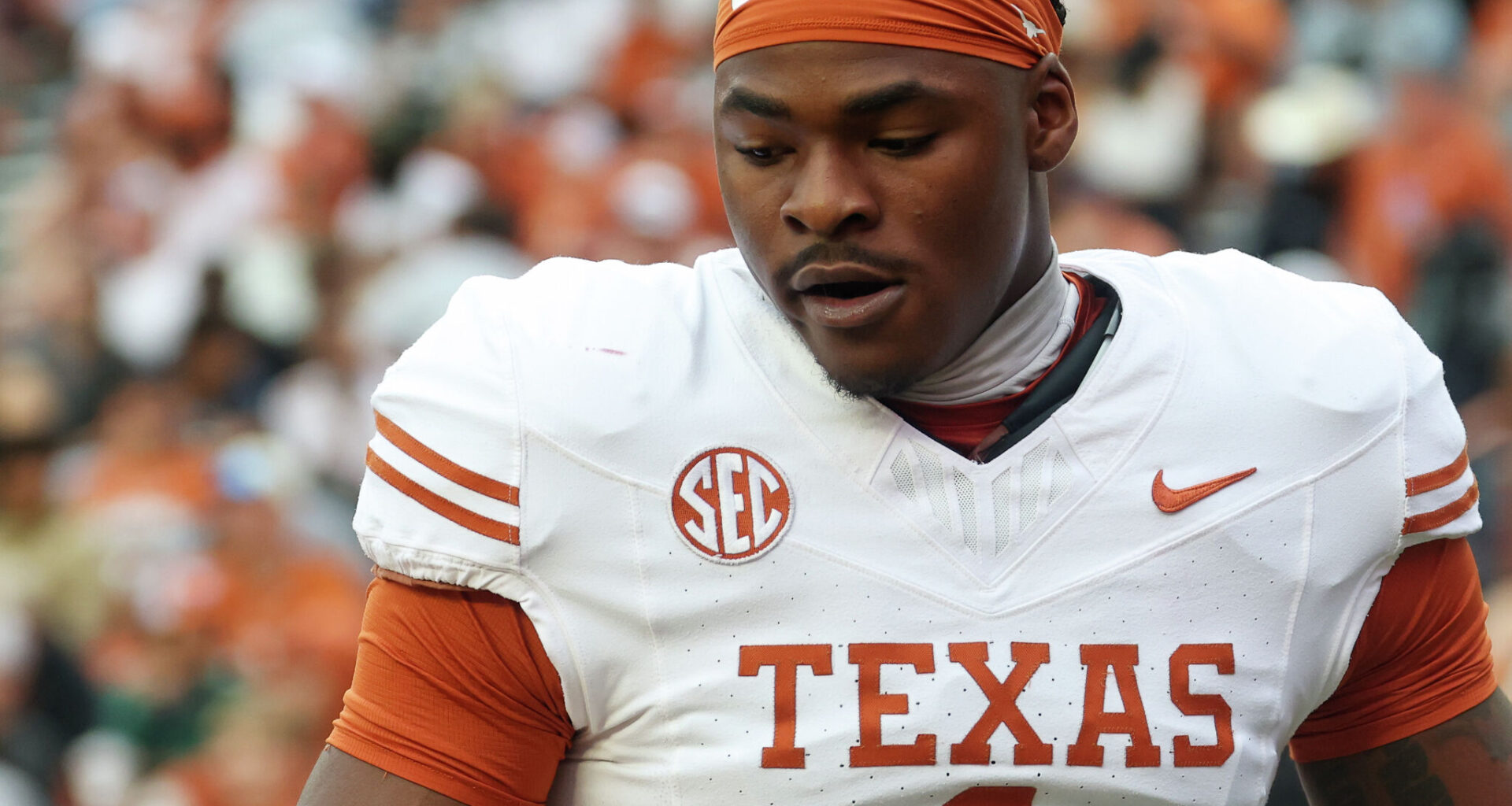
The most prime marketing real estate in the country right now might be space for a jersey patch on a Texas Longhorns uniform.
Icon Sportswire/Icon Sportswire via Getty Images
The athletic programs for the Ohio State Buckeyes and the Notre Dame Fighting Irish announced jersey patch deals last week worth $17 million (with Chase Bank for Ohio State) and $18 million (with SoFi for Notre Dame). This news immediately prompted discussions about how much the Texas Longhorns and Texas A&M Aggies could potentially earn from similar deals.

“It won’t be long until a school signs a jersey patch deal for over $20 million,” Nola Agha, sports economics consultant and professor of sports management at the University of San Francisco.
Article continues below this ad
“More [brands] are showing interest in the jersey patch, more so than in the pro leagues, because it’s so new and so different,” Jason Miller, EVP of commercial revenue and head of properties at Excel Sports Management, said to MarketingBrew in April. “They see that as a national platform, whereas no matter how much you want to say that a local sports team is a national platform, Duke, Alabama, Ohio State [are] arguably more national than some of the biggest NBA teams.”
The Longhorns and Aggies will likely play every one of their games on national television. Given that both are determined to be at the forefront of the financial arms race of recruiting and resources, a jersey patch deal seems inevitable.
“The current climate, given the demands on athletics departments, the way things are changing under our feet on almost a daily basis and, quite frankly, the need to find revenue and resources however you possibly can — everybody’s heads have turned very quickly on this,” American Conference Commissioner Tim Pernetti said to SBJ, who oversees a league that houses three Texas schools.
SoFi and Chase Bank both dropped nearly $20 million on jersey patch deals with Notre Dame and Ohio State. How much could Texas or Texas A&M command on the open market for a jersey patch?
In February, Texas athletic director Chris Del Conte came vehemently against desecrating the Longhorns uniform with a patch this fall.
Article continues below this ad
“We’re burnt orange and white,” Del Conte said at a Texas Athletics town hall in February. “We’re not wearing black, we’re not wearing green … Why would I want to put Sonic on my jersey?” (Why did Sonic have to catch a stray? Jeez.)
However, money talks, and Del Conte has buckled under the monetary pressure before, including the Longhorns’ agreeing to one of the most lucrative on-field sponsorship deals in college sports, with Humann—a cardiovascular health and supplement company—emblazoned on every playing surface of the school’s athletic program. This deal was signed just one year after Del Conte said he leaned traditionalist.
“We haven’t contemplated any of that,” Del Conte said in 2024, before signing the deal with Humann.
Given the current state of college sports business, major national brands would likely trip over themselves to put their logo on the Longhorns and Aggies. The fact that Texas-based brands like Dell, Yeti, AT&T, and American Airlines could likely benefit from local and national activation would be a bonus.
Article continues below this ad
“The trends in private equity and privatization of commercial revenue in college athletics will increasingly force schools to find more inventory to sell,” Agha said.
Experts have indicated that Texas is one of a select few schools that could secure a jersey patch deal worth $30 million annually, according to FOS. The leading candidates for this partnership are likely finance sector brands, similar to Chase and SoFi. One potential candidate is Charles Schwab, the 13th-largest bank in America, with nearly $500 billion in total assets and based in North Texas.
For Texas and Texas A&M, one course of action could be to just sit tight and wait. Other national programs like Michigan, Oklahoma, Alabama, USC, and Penn State are also circling patch deals, which only sets the market for them to cash in when ready. $20 million? $30 million? $40 million? Even the jersey patch deal might inevitably be bigger in Texas, compared to the rest of college sports.
Article continues below this ad