
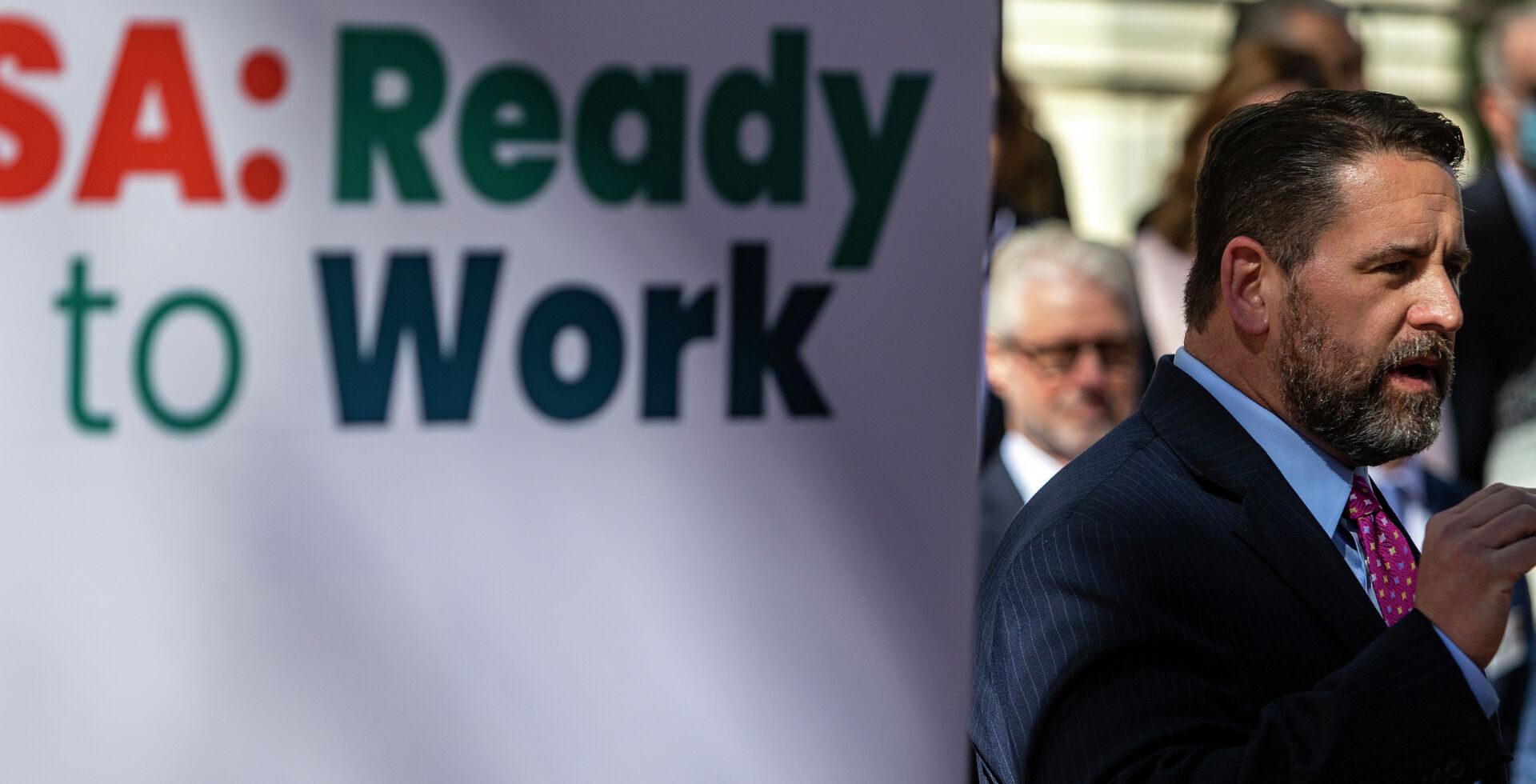
San Antonio city manager Erik Walsh speaks during a 2022 press conference about Ready to Work, the city’s job-training program. Ready to Work has worked pretty well and could accomplish more if local employers integrated their recruitment pipelines with the public training programs that have demonstrated results.
William Luther/San Antonio Express-News
Ready to Work has graduated 5,817 workers and steered them to career-oriented employment. Our guest columnist says it would be a mistake for city voters to end the program prematurely.
Ready to Work
Recently Mayor Gina Ortiz Jones argued that the city’s Ready to Work program, approved by voter referendum, had about $123 million that she’d like to see applied to other city services.

That would be a big mistake and not only because the city attorney’s opinion says it would be illegal to transfer funds promised to the voters for career training services. Jones offered to use the money to pay for other city training programs at no net loss of commitment.
Article continues below this ad
The program has been disappointing to many observers, but I read commentaries that repeat the same misleading information every time the program comes up. I think the program could be better, too, but to know how to do it better requires understanding what works and what is lagging $100 million can still accomplish a lot.
The repeated phrase about Ready to Work is that the program fails to achieve the promise to find jobs for 80% of its graduates within six months that pay $15 an hour.
Recall that the goal of the program was to provide the training and wrap-around support services that will enable an individual to start career-oriented employment to support a family.
The program goal of $15 was always far too low and none of the lead agencies wants to recommend taking a job paying below the city’s mean income.
Article continues below this ad
Fortunately, Ready to Work’s actual wage is $22.50 for the almost two-thirds of graduates it places. Project Quest and Alamo Colleges District have achieved greater success than Workforce Solutions, the largest and traditional training agency.
Additionally, Ready to Work depends on local employers to hire graduates at the appropriate wage for career-oriented jobs. A key feature of Ready to Work compared to most failed training programs is close coordination with employers to create demand for useful skills for job ladders for graduates to climb.
Ready to Work contracted with SA Worx of greater:SATX to coordinate key employers in the targeted industries with the most potential for good jobs.
SA Worx drew upon a compatible program sponsored by the U.S. Chamber of Commerce, Talent Pipeline Management, to help companies develop common standards and show them how to integrate their recruitment strategies with public training programs. Some local employers embraced the concept, but most have not integrated with Ready to Work. Rather, some of even the biggest employers treat Ready to Work as a welfare program to which to offer a few jobs.
Article continues below this ad
Also consider that Ready to Work’s online dashboard does not tell the full story of placements.
Ready to Work staff also promotes apprenticeship, largely because of a Biden administration grant, and pre-apprenticeship programs, which are a separate category. Ready to Work also began a large on-the-job training program in 2024. About half of the participants are incumbent employees who are not counted in the dashboard’s placements. Another factor is that a job placement may pay well, but not offer health benefits, which is a rarely noted program requirement. Finally, as many as 20% of trainees leave early to take a job on their own.
Ready to Work has graduated 5,817 workers and steered them to career-oriented employment.
The individual successes are impressive examples of how this program has made a difference in the lives of San Antonians. The program has worked pretty well and could accomplish more if local employers integrated their recruitment pipelines with the public training programs that have demonstrated results.
Article continues below this ad
Also, beyond San Antonio, supportive state and federal policies about wages, childcare, education finance, workers’ and immigrant’s rights, and market competition, would raise the bar to achieve an economy that works for everyone.
Stephen Amberg is professor emeritus of political science at the University of Texas at San Antonio. He now lives in Denver.