
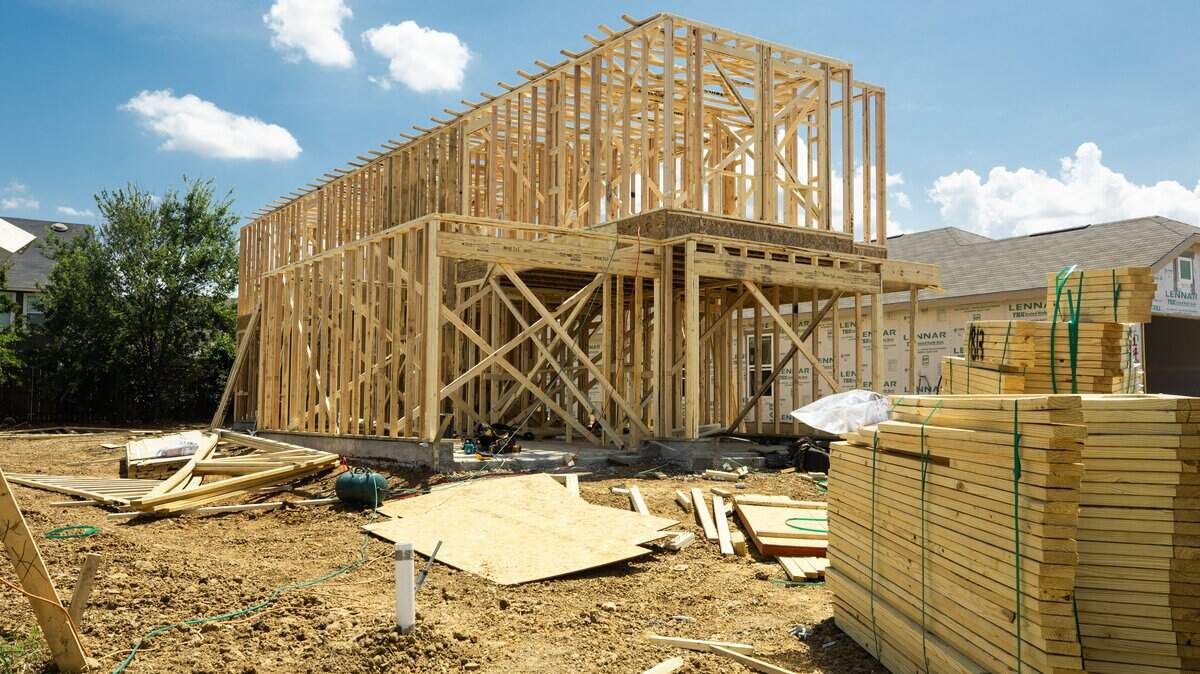
A house under construction on June 27, 2024, in Fort Worth. The Housing Development Lennar at South Oak Grove Estates provided houses for sale under $300,000.
Joel Solis
jsolis@star-telegram.com
The federal Road to Housing Act is expected to make housing easier to access and more affordable for renters and homebuyers as housing affordability has become a challenge across the country.
Some say the law’s vision is admirable, but it will fall short of making significant changes in affordability.
The 21st Century Road to Housing Act became law in July. Its goal is to increase housing supply, modernize federal housing programs and reduce barriers that have made homeownership increasingly difficult for families.
Perry Pillow, CEO of the Fort Worth Apartment Association, says the bill highlights the need for housing affordability nationwide and the necessity of minimizing barriers to the development and redevelopment of the housing supply.
Across the country, the challenges of housing affordability and supply have grown, and there is a need for answers. According to a 2023 Fort Worth housing report, the city is adding jobs faster than housing, which is driving up home values and putting ownership out of reach for most residents. The income required to buy a home in Fort Worth has roughly doubled in the last 10 years, as the median-income household cannot afford a median-priced home, the report said.
The report also shows areas of the city where residents could feel pressure due to rising home values and rents. Most of the residents in these areas identify as Hispanic or Black, according to the report.
The median home price in Fort Worth was $335,975 in June, according to the Greater Fort Worth Association of Realtors, a 0.3% decline from June 2025. In Tarrant County, the median price was $360,000, up 1.7%.
Some key provisions of the law include the Choice in Affordable Housing Act, which will reduce duplicative inspections by allowing a single passed inspection to satisfy federal requirements across housing programs. Another is the Accelerating Home Building Act, which provides grants to local governments and tribes to implement pre-reviewed housing designs to streamline affordable housing construction, with 10% of total funding reserved for rural areas.
Pillow still says housing affordability is a systemic issue as many people are cost-burdened, meaning they pay over 30% of their income on housing. More than 50% of households in Fort Worth are cost-burdened, according to the U.S. Census Bureau. He says that to address this, there needs to be a variety of housing options to serve different populations.
“How do you address generational poverty, or how do we ensure, as a society, that everyone’s thriving?” Pillow said.
The bill passed with bipartisan support, passing the Senate 85–5 and the House 358–32 in June. It became law on July 10 without President Donald Trump’s signature. He was protesting the Senate’s failure to pass his voter ID law called the SAVE America Act.
The Bipartisan Policy Center, a D.C. based think tank that promotes cross-party solutions, established an implementation tracker to follow the law’s provisions as they move from statute to practice.
In a 2024 report on the housing supply shortage and the affordability crisis, Kristen Klurfield, associate director of the J. Ronald Terwilliger Housing Policy Center at the Bipartisan Policy Center, explained that the United States is short between 1.5 million and 5.5 million housing units. Across the country, suburbs, towns and rural counties cannot meet residents’ housing needs because there is not enough housing available for renters and homebuyers.
“I think overall it really is our view that the legislation will help make it easier to build the housing that we desperately need, and that’s required to bring down housing costs for households across the country,” Klurfield said.
While the legislation is positive for lowering construction costs through deregulation, some, like Donna VanNess, president of Housing Channel, a housing development organization, say she is concerned that relaxed deregulation of zoning and land practices will shift the focus to making a profit rather than affordability.
VanNess says to help with housing affordability, there needs to be more focus on nonprofit developers whose aim is not greed.
“I want the people who are going to be benefiting from all this incentive actually to build affordable homes,” VanNess said. “There needs to be some guardrails to make sure that they’re utilizing them for affordable housing and not for increased profit.”
VanNess says there are positives to the legislation. The Road to Housing Act helps expand eligibility community land trusts and increases homeownership income limits from 80% to 100% for the HOME Investment Partnership program. The program provides grants to state and local governments to create affordable housing, provide down payment assistance, and support home repairs for low-income households. As of June, the area median income for a family of four is $88,250.
Kirk McClure, a professor of Urban Planning at the University of Kansas, says the Road to Housing Act is a good-faith effort. Still, it is not a landmark bill due to its lack of budgetary or statutory authority, he said. McClure argues there is no housing shortage, rather the problem is income-based, as many people are cost-burdened and spend more than 30% of their household income on housing.
The federal minimum wage of $7.25 has increased by only $2.50 since 1996, when it was $4.75.
McClure says one way to help solve housing affordability is to expand the eligibility for the Housing Choice Voucher program for renters. For homeowners, he advocates down payment assistance and high loan-to-value loans, which are loans with low down payments and loan amounts closer to the value of the asset.
“I don’t believe we can build ourselves out of the affordability problems,” McClure says.
Related Stories from Fort Worth Star-Telegram

Fort Worth Star-Telegram
Kamal Morgan covers racial equity issues for the Fort Worth Star-Telegram. He came to Texas from the Pensacola News Journal in Florida. Send tips to his email or Twitter.