
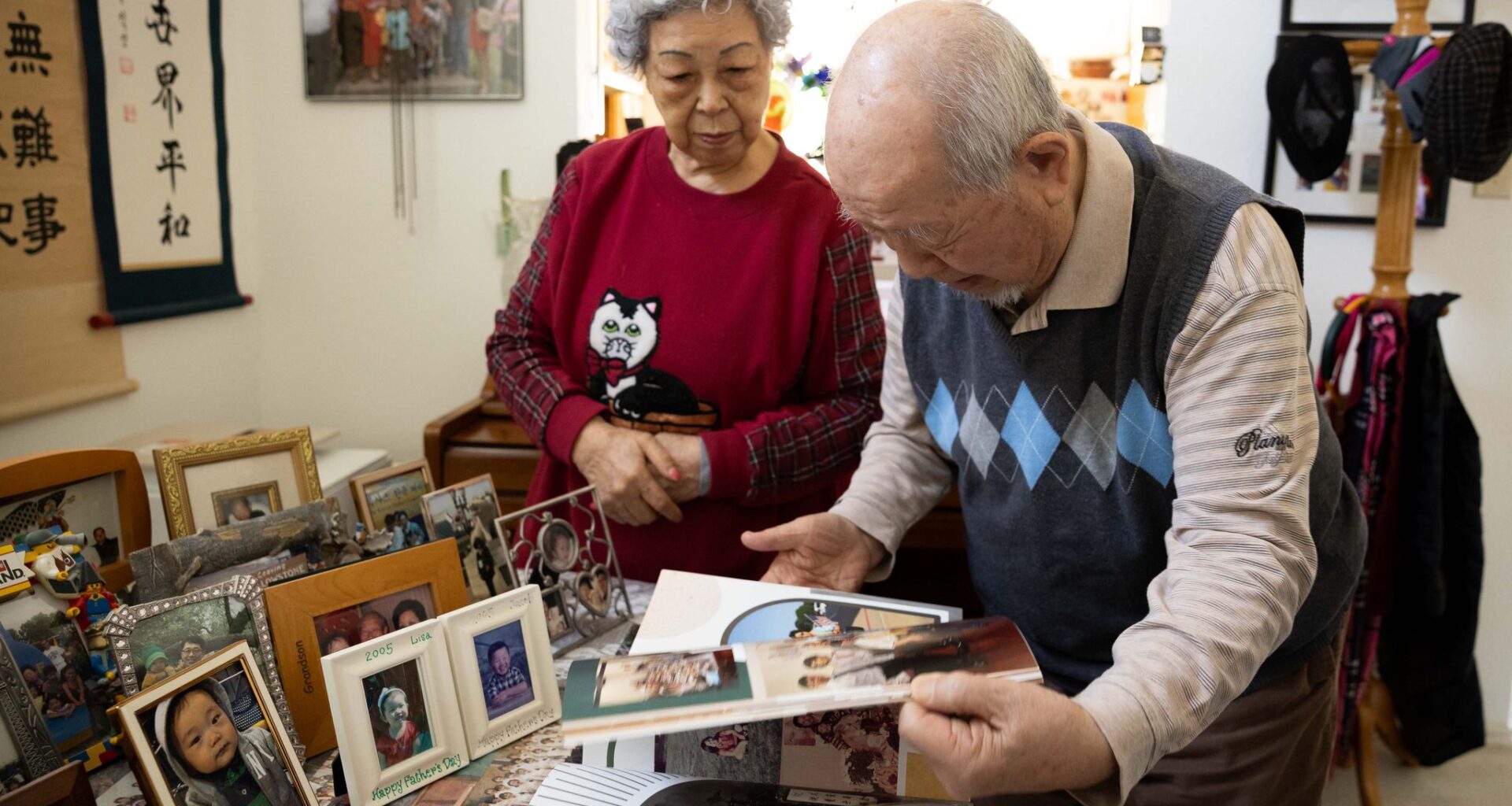
Charles Park, a Korean American community leader and elder, and Susie Aeja Park look through a photo book at their home in Garland, Friday, Jan. 30, 2026.
Juan Figueroa/The Dallas Morning News
Charles Park first came to the U.S. over half a century ago, but he still remembers arriving at the LAX airport from Korea in 1970, unable to get the pay phone to work or ask for help finding his way in English.

Today, at age 88, he has spent decades championing Korean American representation in North Texas and working to provide his community with the resources and information to succeed.
“It’s a different system from Korea to here,” he said at a bakery in Dallas’ Koreatown. He waved to a staff member, who had recognized him sitting in a wooden booth in his signature pageboy hat. “They need to understand … the American system.”
Article continues below this ad
To Stephanie Drenka, co-founder of the Dallas Asian American Historical Society, Park is a “bridge builder.”
“Both within the Korean American community as a connector between generations, but also with the Korean community and those outside,” she said. “He’s like the unofficial leader of the Dallas Korean community.”
Charles Park, a Korean American community leader and elder, at his home in Garland, Friday, Jan. 30, 2026.
Juan Figueroa/The Dallas Morning News
Park serves as a representative of the North Texas Council of Korean Elders and works to connect and celebrate his community. His story began thousands of miles away nearly nine decades ago.
Path to Texas
Park was born in northern Korea in 1937, but when he was in grade school, his family moved south to escape the communist government. War broke out. His father was kidnapped and his sister likely died, he said. His family was shattered.
Article continues below this ad
He studied hard, majoring in business administration at a good school in Korea.
“That’s the only way I can survive,” he said.
He also took part in pro-democracy protests and student-led uprisings in South Korea in 1960, and was awarded for his participation on the 50th anniversary of the April 19 Revolution, which took a stand against authoritarianism and corrupt government.
Related: Carrollton’s Korean American businesses rattled by shooting amid mounting economic pressure
He graduated in 1964 and married his wife that same year. After a family member got a job in California, he followed with his wife and two young kids in 1970. He and his wife had a third child in the U.S.
Article continues below this ad
“It was very difficult to make a living,” he said. “I thought I knew some English, but … they don’t understand me. … I have to start it all over.”
In California, he was very active in the Korean community. He made a directory for alumni of his university living in Los Angeles, to help spread information and resources and build community.
The family moved to Oklahoma and then to Dallas around 1978 in search of stable work and more Korean community. Park wanted a better future in Texas.
“For the kids and me,” he said. “Kids are always better educated in a bigger city.”
Public service honoree Eunsup Kim poses for a photo with Charles Park, president of North Texas Council of Korean Elders, after receiving his award during the fourth annual Community Awards Fest at Korean Culture Center, Tuesday, Feb. 24, 2026, in Dallas.
Chitose Suzuki/Dallas Morning News
In Dallas at that time, Park said many Korean Americans worked as professors, nurses, doctors or in the garment and janitorial industries. He opened an accounting business on Harry Hines Boulevard, before it became the Koreatown and Asian Trade District it is today.
Article continues below this ad
Dallas-Fort Worth is home to one of Texas’ largest Korean American communities, in Carrollton, according to the city’s Koreatown site. Texas as a whole is home to one of the largest Korean populations of any state in the country, with about 6% of the country’s Korean population of 1.8 million, according to Pew Research.
Community involvement
Park saw how Korean Americans in Dallas faced barriers to making a living, filing taxes, buying a house and getting public support. He saw a lack of Korean Americans in public office and on local boards. He wanted to bring representation to these spaces.
Park became involved in several community groups, including the Korean American Coalition, Korean Society of Dallas and the Korean American Chamber of Commerce in North Texas. To succeed in the U.S., he noticed, Korean Americans needed to share information, get involved and build community.
Related: How a Garland matriarch fled war in Vietnam to fight for representation in North Texas
Article continues below this ad
Churches became vital community spaces and the Korean newspaper helped share information.
Around 2000, Park ran for City Council in Garland. He did not win the election, but continued community work. He served on advisory boards and participated in citizen academies.
“I wanted to know more about how the system worked, then I can advise any Korean,” he said. “I can tell them the system works this way.”
Park made an effort to get involved in “the mainstream,” he said.
“Otherwise it was so segregated,” he said. “The American community did not know what the Korean community was doing. And the Korean community did not know what they were doing. I want to break that up.”
Article continues below this ad
Charles Park, president of North Texas Council of Korean Elders, speaks during the fourth annual Community Awards Fest at Korean Culture Center, Tuesday, Feb. 24, 2026, in Dallas.
Chitose Suzuki/Dallas Morning News
He hosted forums for discussion and understanding, seeking to bring diverse communities together. He especially worked to strengthen ties between the Black and Korean American communities amid tensions in the 1990s. In 2005, he received the “Bridge Builder’s Award” from the Garland NAACP.
The strength of America comes from its diversity, Park said.
“We have to maximize the benefit of having all those nations together,” he said.
Park today
Park is slowly retiring but still very active in the community. He travels to Korea often. He has three kids and eight grandchildren and can rattle off their accomplishments, from stints in the Peace Corps, to their various international degrees, to their appearances in production credits.
There are still generational differences and barriers to communication within the Korean American community, Park said, that are hard to overcome. But the country is very different from when he first arrived in 1970.
Related: North Texas Black and Korean American business leaders commit to building stronger ties
“We are very well treated nowadays, much better than the day I came to the states,” he said. “I came here 55 years ago … Americans understand Koreans better … but still, Koreans are minorities.”
Park now works to celebrate other Korean American leaders in the community — like Drenka, awarded “Person of the Year” in 2023 — with an annual recognition ceremony. Park was one of the first oral history narrators recorded through her historical society.
Drenka views Park like a grandfather and said his lessons are gifts to many generations in North Texas.
“We need that inspiration for the fights that we have ahead of us,” she said.
Email tips on all things Collin County to lilly.kersh@dallasnews.com.