
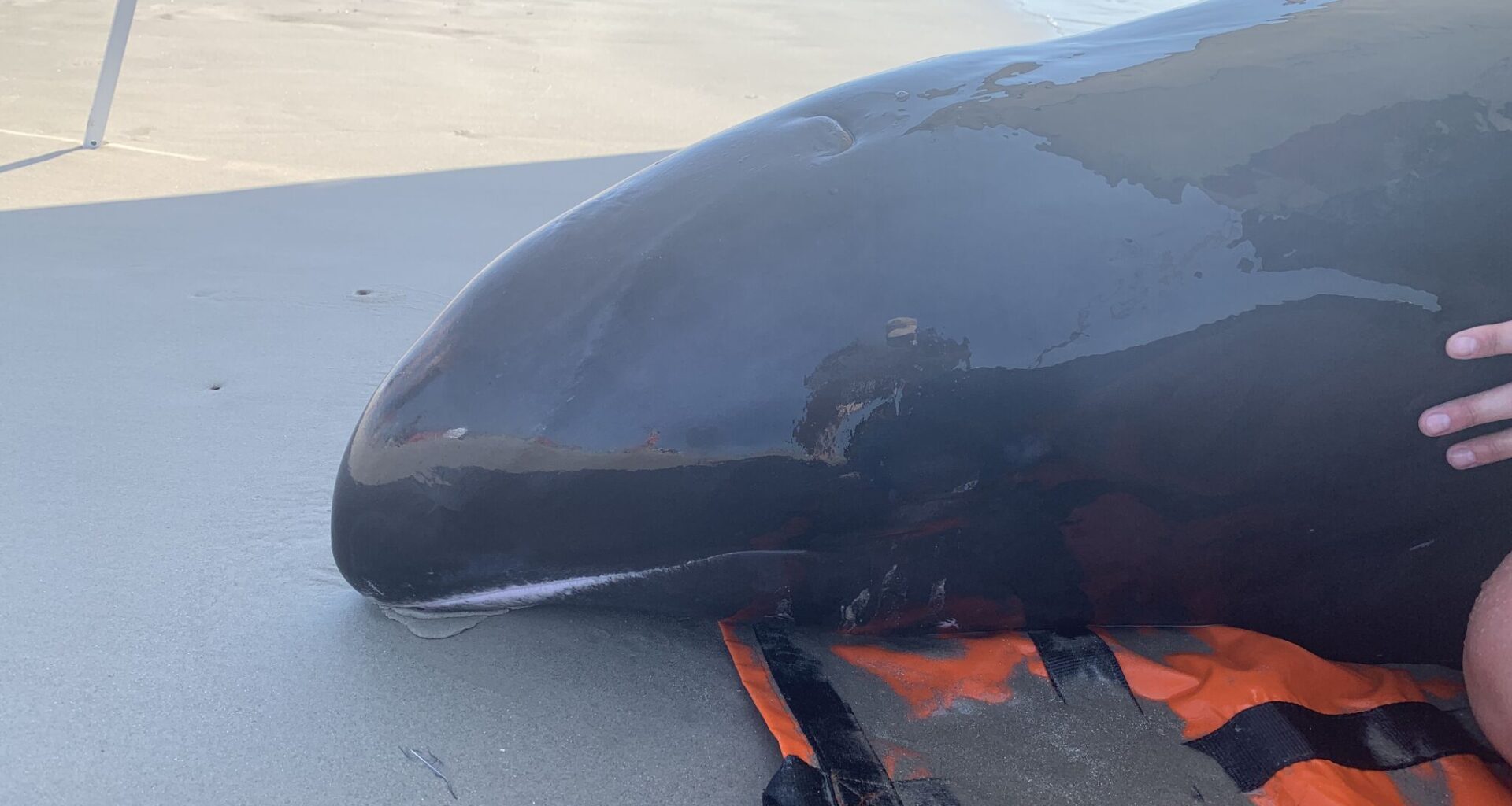
A rare offshore whale that seldom comes close to land washed up on Mustang Island near Port Aransas over the weekend, prompting a response from marine mammal experts who traveled hundreds of miles to help.
TMMSN teams responded from Galveston to Port Aransas. Although the incident was outside the organization’s normal response area, Whitehead said the network receives frequent reports of stranded dolphins and whales from the Port Aransas and Corpus Christi regions. She said the Port Aransas area has historically been the organization’s second-busiest response region along the Texas coast, highlighting the need for additional marine mammal response capacity in South Texas.
Throughout the response, TMMSN said it received reports that the whale had repeatedly stranded and had been returned to the water by well-meaning beachgoers.
“While the desire to help is understandable, stranded whales and dolphins are on the beach for a reason,” the organization wrote. “Returning them to the water can prolong suffering and delay the professional assessment they need.”
Instead, the organization urges anyone who encounters a stranded whale or dolphin not to push it back into the water or attempt to move it. Beachgoers should give the animal space, keep pets and crowds away, and immediately call the TMMSN hotline at 1-800-9MAMMAL so trained responders can assess the situation.
By the time crews arrived, beachgoers had given the whale space while providing it with shade.
“After assessment and veterinary support, the most humane decision was made to euthanize the animal,” TMMSN wrote. “As a deep-diving cetacean species, melon-headed whales do not tolerate long-term care in a rehabilitation setting, and there are no rehabilitation options for stranded animals of this species.”
The organization performed a necropsy Sunday to determine what caused the whale to strand. Additional samples were collected and will undergo further analysis.
“We’re incredibly grateful to everyone who supported this response—from those who reported, to the beachgoers who gave the animal space and assisted our team, responding law enforcement, and especially the veterinarian and veterinary technician who generously gave their time and expertise,” TMMSN wrote. “The compassion, cooperation, and respect shown throughout the response made a difficult situation a little easier for everyone involved.”
Named for the rounded “melon” on its head and its lack of a discernible beak, melon-headed whales are members of the dolphin family, Whitehead said. They have dark bodies, relatively large dorsal fins and pointed, tapering flippers.
Despite rarely being seen close to shore, they are the third most common whale species to strand on Texas beaches, according to TMMSN.
Since 1980, TMMSN has responded to nearly 7,000 stranded dolphins and whales representing 24 species along the Texas coast, Whitehead said. Most of those strandings involve bottlenose dolphins.