
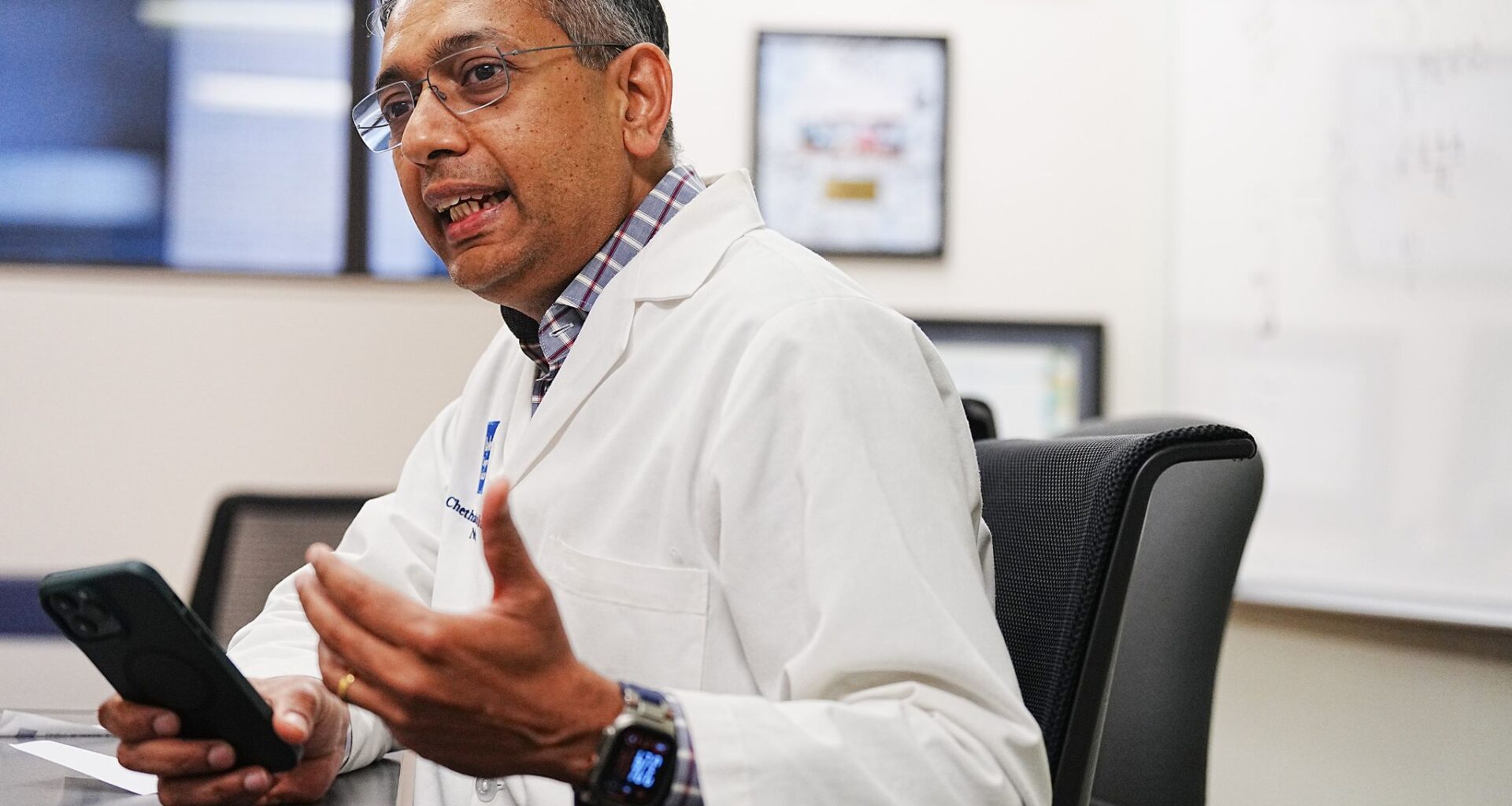
Dr. Chethan Rao, who has overseen the implementation of AI in stroke treatment at Baylor St. Luke’s Medical Center, shows one example of how AI technology is helping patients at the hospital in Houston on Monday, July 6, 2026.
Elizabeth Conley/Houston Chronicle
Dr. Chethan Rao, who has overseen the implementation of AI in stroke treatment at Baylor St. Luke’s Medical Center, shows one example of how AI technology is helping patients at the hospital in Houston on Monday, July 6, 2026.
Elizabeth Conley/Houston Chronicle
Dr. Chethan Rao, who has overseen the implementation of AI in stroke treatment at Baylor St. Luke’s Medical Center, shows one example of how AI technology is helping patients at the hospital in Houston on Monday, July 6, 2026.
Elizabeth Conley/Houston Chronicle
Houston, with its concentration of sprawling hospitals, is primed to become a proving ground for artificial intelligence in medicine.
For years, AI has helped Houston’s largest hospitals speed up stroke care by instantly analyzing brain scans, then delivering the information in real-time to physicians’ cellphones.
More recently, Texas Children’s Hospital developed its own AI software that can estimate bone age in children on hand X-rays — a routine task that now takes significantly less time with its technology. HCA Houston Healthcare, part of the largest for-profit health system in the U.S., is using AI to find brain aneurysms earlier. And Houston Methodist is deploying AI tools to flag pulmonary embolisms and other conditions on CT scans.
Article continues below this ad
The capabilities of AI are rapidly expanding, especially in radiology, with newer models expected to improve workflow and patient care in what experts consider a pivotal moment in the technology’s evolution.
“Are we today at that moment of transformative change in the radiology world? We’re getting closer,” said Roberta Schwartz, chief innovation officer at Houston Methodist. “I’m not 100% sure I could tell you we’re there yet, but the ability to synthesize these very large data sets gets us closer.”
There are more than 1,000 FDA-cleared algorithms in radiology with a wide range of functions. The appeal of the technology is so broad that Space X founder and trillionaire Elon Musk has encouraged users on X to upload their medical images, so that the AI chatbot Grok can read them.
The clearest advantages of AI are related to workflow, with radiologists using AI to prioritize the most severe cases for review and catch potential misses.
Article continues below this ad
While Houston’s largest hospitals are all adopting AI in radiology, some move slower than others, citing high costs and uncertainty about its potential to improve health outcomes.
EXPANSION: Texas Children’s just unveiled a $200 million expansion. Here’s what it means for moms and babies.
“The technology is expensive, but one of the real challenges with adopting AI in any sort of practice, not just clinical medicine — are there enough resources to really do the analytics internally to understand what the impact is?” said Dr. James McCarthy, executive vice president and chief physician executive at Memorial Hermann Health System.
“I think this is very true of many kinds of health advances. It starts in the academic medical centers. It starts in the big health systems. The others follow once it’s well validated, and everyone starts to use it,” he said.
AI speeds up care for strokes
Radiology, in particular, lends itself to AI assistance. The images are digitized, and disease detection comes down to pattern recognition — a task that AI can perform effectively. About 76% of all AI algorithms cleared by the U.S. Food and Drug Administration are in radiology.
Article continues below this ad
Since 2019, Dr. Chethan Rao, medical director of the neuroscience ICU at Baylor St. Luke’s Medical Center, has been using a platform called Viz.ai to save precious time in stroke treatment.
When patients go to the emergency room after suffering a stroke, they undergo a CT scan that shows doctors the cause, most often a blocked blood vessel to the brain. Viz.ai instantly picks up the blockage and pings an alert to Rao and the rest of the stroke team. It also sends the CT scans straight to their cellphones, with sections of the brain image shaded light green and red, showing how much of the brain is salvageable or not salvageable.
Dr. Chethan Rao, who has overseen the implementation of AI in stroke treatment at Baylor St. Luke’s Medical Center, shows one example of how AI technology is helping patients at the hospital in Houston on Monday, July 6, 2026.
Elizabeth Conley/Houston Chronicle
Minutes matter in stroke treatment.
Patients who suffer a stroke from blocked vessels can lose 2 million brain cells per minute, costing significant brain function. Rao said the technology has helped dramatically cut down the time it takes to deliver clot-busting drugs and get the patient into surgery, from an average of 84 minutes to under 25 minutes.
Article continues below this ad
“You save almost an hour of time, or 120 million nerve cells,” said Rao. “That makes a big difference.”
Other Houston hospitals use Viz.ai for stroke care, but some are applying AI radiology tools more broadly.
Hospital stays get shorter
Houston Methodist this year implemented AI algorithms from Israel-based company Aidoc to help radiologists flag multiple diseases, including rib fractures and pulmonary embolisms — a heart condition that causes 300,000 deaths a year.
An FDA-approved algorithm flags the case for review, sends the scan to the top of the radiologist’s work queue and automatically alerts the care team. The radiologists still review and approve the diagnosis, but can better prioritize their caseload and get patients into treatment faster, said Schwartz.
Article continues below this ad
In hospitals, the turnaround time of a CT scan can inflate wait times by more than two hours. While the technology is still new at Methodist, the University of Texas Medical Branch has been using Aidoc’s pulmonary embolism model for several years and, in a 2023 study, said it helped reduce the length of hospital stays by 36%, from 6.7 days to 4.2 days.
HEART HEALTH: UTMB heart study to track thousands of Galveston residents’ long-term cardiovascular health
There are clear benefits to speeding up time-sensitive treatment, but the advantages for less serious conditions can be murkier, especially for hospitals with high-performing radiologists, said McCarthy of Memorial Hermann.
Take, for example, an X-ray that shows a nodule on a patient’s lung suspected to be cancer. AI may find a nodule three hours faster than a radiologist alone, but that won’t change the treatment if it proves to be cancerous, said McCarthy. And while there’s ample evidence showing AI improves detection rates, there’s not robust data to show how much it changes health outcomes.
“There’s great promise, but until we have evidence that the outcomes that we’re most interested in (are improving), it’s hard to invest on a broad scale in all of this new AI tech that’s coming out,” he said.
The next generation of AI technology is expected to make a bigger impact in radiology.
Until recently, the development of AI in the field has been slow. Companies developed algorithms to handle one task or condition at a time, and the FDA reviewed performance data for that specific purpose. A model could prove to be effective at flagging a pulmonary embolism, for example, but other models would need to be tested and reviewed to find other conditions.
That’s beginning to change.
The future of AI in healthcare
A new generation of AI radiology tools are based on so-called foundation models. They act more like ChatGPT, pulling from vast data sets to become more adaptable and detect a wider range of conditions in medical images.
It took Aidoc nine years to receive FDA clearance for tools that help diagnose 30 conditions. Within two years, their AI tools could target more than 100 conditions — all because of their foundation model.
This year, the company received FDA clearance for a comprehensive AI radiology tool that can flag up to 15 new conditions in a single CT scan, including appendicitis, liver injuries and large aortic aneurysms. Performance data reviewed by the FDA show Aidoc’s model was highly effective at correctly identifying cases when the condition appeared on scans.
The agency also gave Aidoc a breakthrough device designation — a regulatory pathway that allows innovative devices to reach patients quicker — for a separate, newer AI model that can detect more than 100 different conditions in a chest X-ray and automatically draft reports. That model is still in the investigation phase.
One of the major benefits of foundation models, experts say, is the ability to flag irregularities that radiologists may not be looking for on an image.
For example, if a patient comes into the emergency room with a severe infection of the urinary tract, doctors may focus on the kidneys and miss an aortic aneurysm, a potentially life-threatening condition that causes the main vessel carrying blood from the heart to bulge like a balloon, said Dr. Jesse Ehrenfeld, Aidoc’s global chief medical officer.
TIMELINE: How Houston became home to the largest medical center in the world
“When you can cover the body from head to toe, basically, and find pretty much anything that’s on the list of acute problems on an image, the utility for these tools just changes markedly,” said Ehrenfeld, former president of the American Medical Association.
It’s too early to know the clinical benefit of the technology, but patients at Houston Methodist may soon find out.
Schwartz expects the hospital to be among the first in the country to implement Aidoc’s more comprehensive radiology tool in the fall. “I will tell you, there’s an awful lot of people excited about where we’re going,” she said.
Despite the technology’s evolution, fears about AI replacing doctors haven’t come to fruition. Even as new research shows AI can beat ER doctors at diagnosing complex conditions, Houston hospitals are still relying on physicians to make the final decision.
For computational scientists like Dr. Zhandong Liu, who at Texas Children’s Hospital developed AI models to streamline genetic diagnoses, developing a fully autonomous AI system is a long-term goal. But as a patient himself, he believes humans should always be in the loop.
“All of these (AI) benchmarks will have flaws,” he said. “Humans always have this sense of discovery to capture certain signals that are not obvious or not traditional. That’s where discovery happens.”