
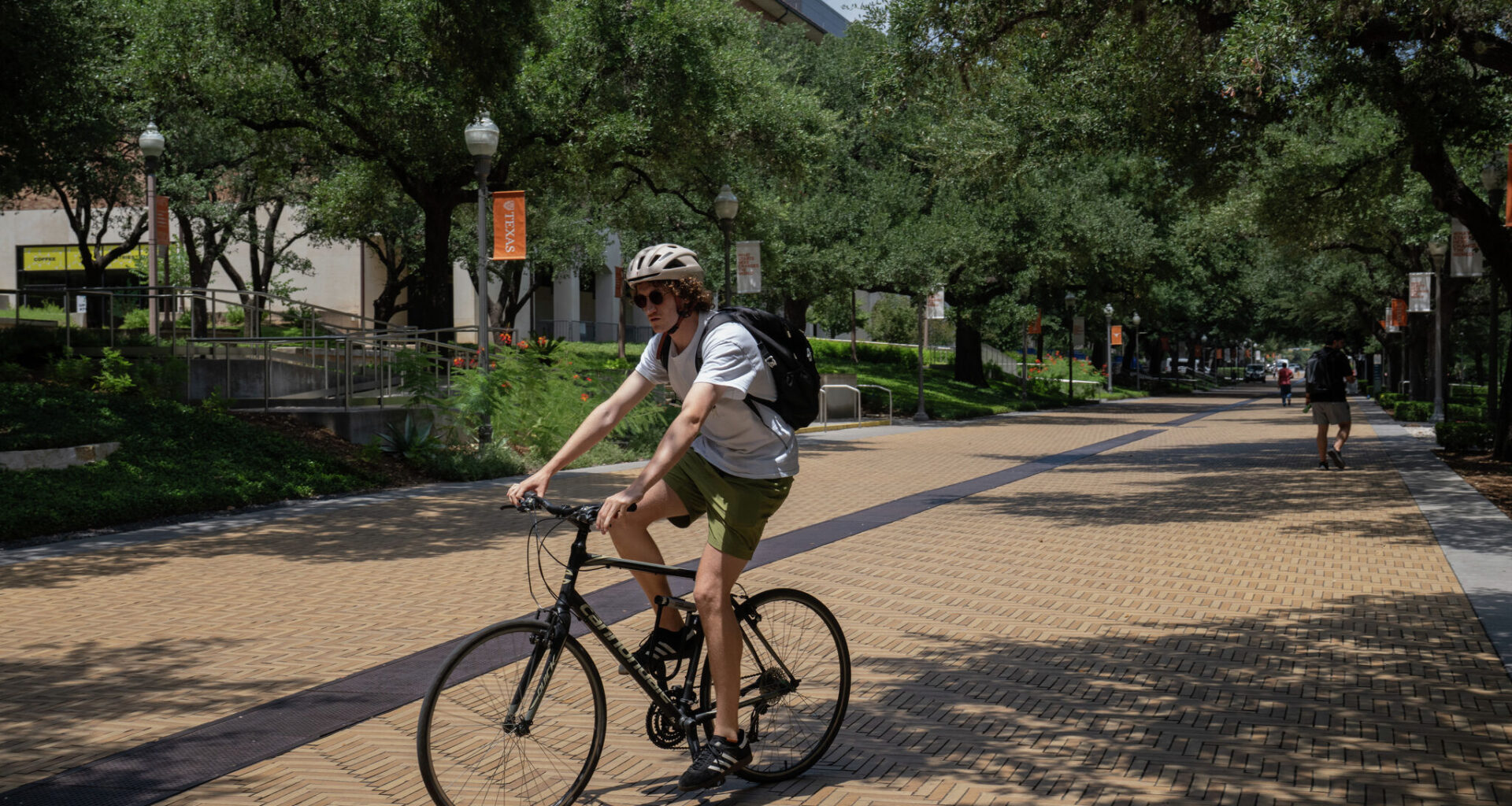
A cyclist rides their bike on Speedway at the University of Texas in Austin, Tuesday, Aug. 4, 2026.
Mikala Compton/Austin American-Statesman
A sign urges scooter riders to yield to pedestrians on Speedway at the University of Texas in Austin, Tuesday, Aug. 4, 2026.
Mikala Compton/Austin American-Statesman
A man rides two scooters on Speedway at the University of Texas as he transports them to a charging station in Austin, Tuesday, Aug. 4, 2026.
Mikala Compton/Austin American-Statesman
Chelsea Burns and Alejandro de la Vega are concerned with the idea of a dismount zone on Speedway at the University of Texas in Austin, Tuesday, Aug. 4, 2026.
Mikala Compton/Austin American-Statesman
University of Texas officials appear poised to ban bicycles, scooters and other micromobility devices from a large area of central campus with little warning — a move cycling advocates say would have wide-ranging implications for students and commuters alike.

A new rule posted on the university’s website would require cyclists to dismount and walk their bikes through some of the busiest central-campus pedestrian corridors, including the Speedway Pedestrian Mall, beginning Aug. 24.
Article continues below this ad
The pending change has prompted calls for reconsideration from Austin cycling leaders like Alejandro De La Vega and Chelsea Burns. De La Vega and Burns, the chair and vice chair of the Austin Bicycle Advisory Council, respectively, penned a letter to UT Parking and Transportation Services last week urging department leaders to explain their decision and consider community input before implementing the dismount zone.
Burns and De La Vega told the American-Statesman in an interview that limiting cycling through central campus would force riders onto busier roads with inadequate bike infrastructure such as Guadalupe Street and San Jacinto Boulevard.
“Without a safe, allowable route across campus, bicycles are going to get shunted onto less-safe roads for bicycles,” Burns said. “The biggest concern that I have is about the ability to safely get across campus in a timely fashion.”
Alejandro de la Vega and Chelsea Burns discuss their concerns with a dismount zone on Speedway at the University of Texas in Austin, Tuesday, Aug. 4, 2026.
Mikala Compton/Austin American-Statesman
University officials declined to comment and have since removed maps and pages about the policy change from the university’s website. Signs advising cyclists to “walk your wheels” have begun to appear around Speedway in recent days.
Article continues below this ad
An archived webpage accessed via the Internet Archive shows the dismount zone would cover an area of campus stretching roughly from Guadalupe Street to San Jacinto Boulevard and from 21st Street to 24th Street. The entire Speedway Pedestrian Mall would also be included. Speedway was closed to cars in 2016. Since the mall was completed, it has become a popular cycling route across campus.
It’s not yet clear why the university plans to implement the new policy or how it would be enforced.
Students would be among those most impacted by the change, De La Vega said, noting many students would not be able to make it across campus to classes on time without micromobility devices. But commuters with no connection to UT could feel its effects, too, according to Austin cyclist Michael Haertel.
Haertel drives a pedicab for a living, but he’s “more concerned about the city being bikable and people being able to get where they want to go,” he said.
Article continues below this ad
“That path is the connection between North Austin and Hyde Park north of campus all the way to the Capitol Complex and downtown,” Haertel said. “Demanding that cyclists and people using scooters and other micromobility devices take the most dangerous corridors in our city to get to their job, or school, or class, or home, or wherever they’re going is really absurd.”
A cyclist rides their bike on Speedway at the University of Texas in Austin, Tuesday, Aug. 4, 2026.
Mikala Compton/Austin American-Statesman
De La Vega and Burns said the policy change appeared to have been introduced suddenly, without advance communication or engagement from university leaders. The apparent lack of transparency has been frustrating, De La Vega said, adding that limiting bicycle use would be antithetical the city of Austin’s goal to reduce reliance on cars and increase micromobility use.
“I think we want to have a conversation with leadership that involves everybody, not just us, but students and other faculty and staff, people that work here, about how to build a better campus where people can get around better,” he said. “It feels like we’re taking a step in the wrong direction.”
Article continues below this ad
Haertel said he’s encouraging other cyclists concerned about the change to contact university leaders and Austin City Council members.