
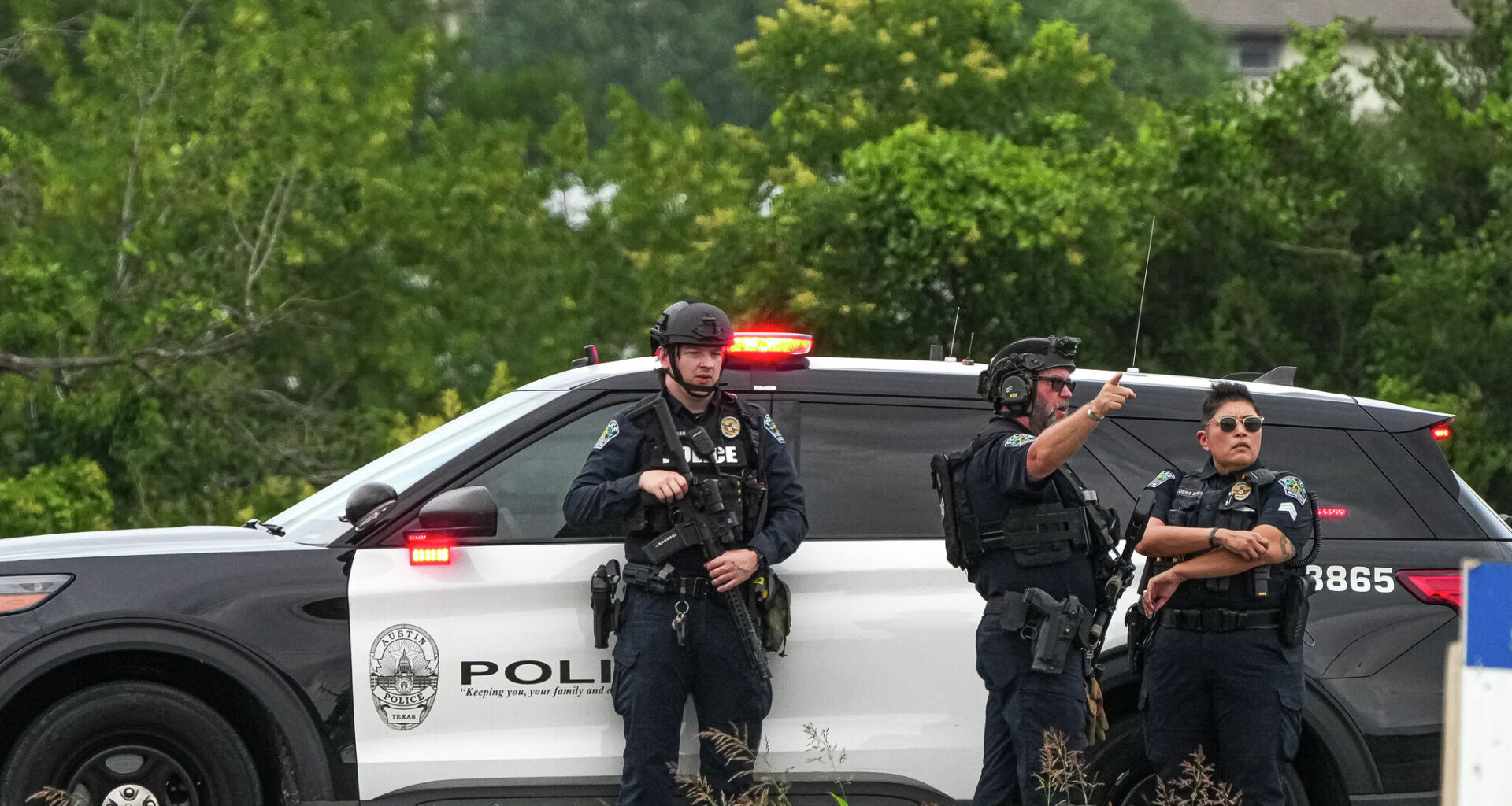
Austin Police Department officers stage on Suncrest Road in Manor, where they were searching for a suspect that fled after a series of shootings on Sunday, May 17, 2026, in Austin.
Aaron E. Martinez/Austin American-Statesman
Violence-prevention advocates and city staff urged Austin City Council members Monday to preserve funding for community programs they said are a critical part of the city’s strategy for preventing shootings and homicides.

Their appeal came as the council prepares to adopt a city budget that would eliminate a combined $130,120 in grants to three violence-prevention nonprofit organizations: $58,500 for Sunrise Community Church, $42,120 for Lock Arms for Life and $30,000 for Life Anew Inc.
Article continues below this ad
The proposed cuts would affect programs that intervene in conflicts, respond to shootings and work with residents in neighborhoods experiencing high levels of violence. Advocates told the council’s Public Safety Committee that reducing the funding could weaken a violence-prevention network the city has spent several years building.
“The only two things that actually affect the homicide rate and the violence rate in the city are the personnel and the resources we can provide,” said Eddie Franz, program director for ATX Peace. “So sustainable funding is everything for a [community violence intervention] model.”
Austin established its Office of Violence Prevention in 2021, when community violence intervention was still a relatively new concept locally. The office partnered the following year with the nonprofits Jail to Jobs and Life Anew to create ATX Peace, whose outreach workers seek to mediate disputes and prevent retaliatory violence before police intervention becomes necessary.
The programs have since gained support from Austin Police Chief Lisa Davis, who told council members Monday that their trusted relationships with people in affected communities complement the Police Department’s work.
Article continues below this ad
Davis said the organizations assist police with what she calls “place network investigations,” which examine the people, conditions and physical characteristics surrounding locations where violence occurs.
“Without the community’s engagement and their voice at the table, it makes it really hard to take that space and reactivate it in a way that serves community needs,” she said. “I think that this type of work is critical for opening up those channels and having those discussions.”
Franz said support from a police chief is unusual because community-based programs can sometimes be viewed as competing with traditional law enforcement for public safety funding.
“That is not something that happens very often in law enforcement,” Franz said. “A lot of times, a [community violence intervention] team can look like a threat to the law enforcement budget.”
Article continues below this ad
ATX Peace reported that homicides declined 41.7% in the areas where it concentrated its work in 2024. The organization said it also conducted 44 conflict mediations, responded to 76 shootings and carried out 81 de-escalations last year. The figures were provided by ATX Peace and have not been independently verified by the American-Statesman.
“We work in hotspot locations where homicides are the most prevalent, and then they do work such as conflict mediation and establishing peace agreements,” said Michelle Myles, manager of the Office of Violence Prevention. “This community-based aspect of public safety is crucial because we’re able to address violence before it happens or intervene right before it’s about to happen.”
Public Safety Committee members voiced support for the programs Monday, but the full council will decide their funding as it finalizes the city budget. The council is scheduled to vote on the budget Thursday.
Article continues below this ad
Budget Director Kerri Lang’s recommendations would retain about $2.72 million in violence-prevention funding while reducing one grant and eliminating another. Life Anew’s reduced grant for youth restorative practices is categorized in Lang’s memo as providing “child and youth” services.
Advocates said the city reductions would come as organizations in Austin’s violence-intervention network also face the potential loss of millions of dollars in federal and Travis County funding. They warned that those overlapping cuts could destabilize programs that depend on trained outreach workers and long-term relationships within neighborhoods.