
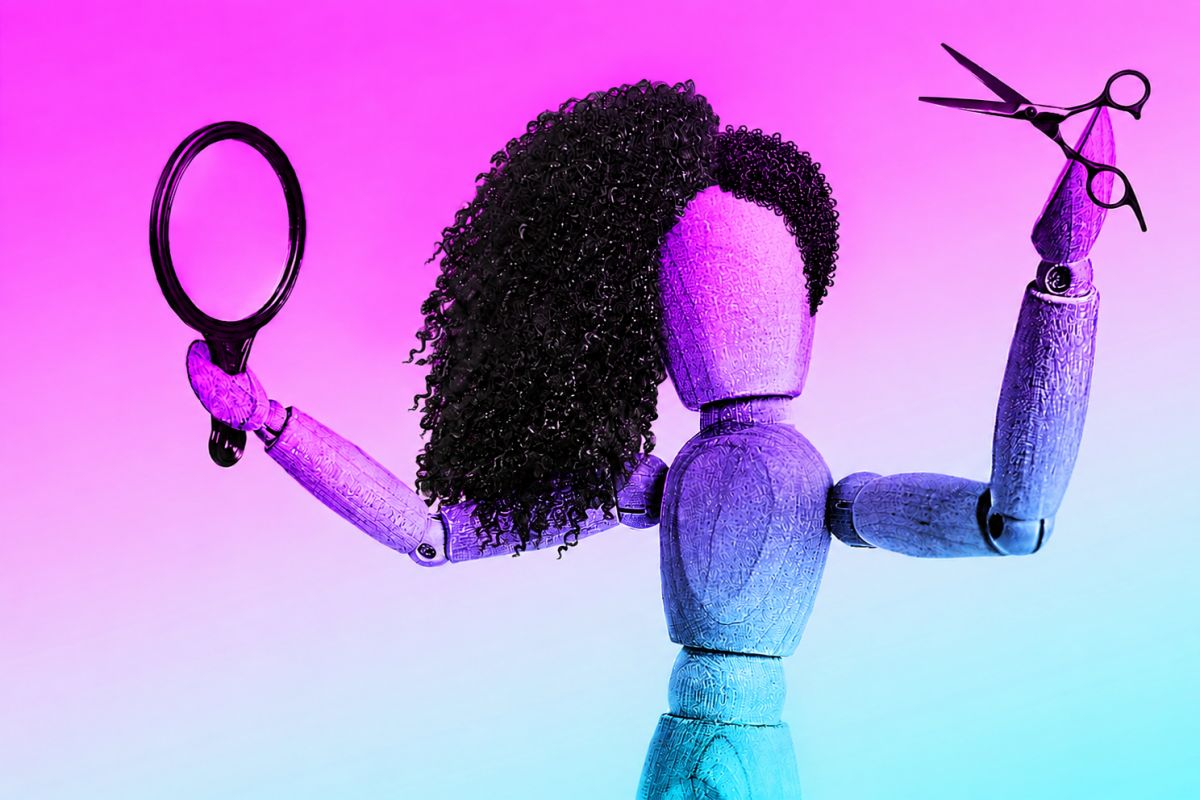
Cutting my hair off wasn’t supposed to be this radical thing.
I was desperate and hormonal, coming off nearly three years of breastfeeding and months of being touched out. I was looking forward to a blow-out that made me feel human again. Then, disaster struck. Expecting to get back a head full of kinky curls, I was instead left with a flat, matted mess that smelled burnt after a shower.
Heat damage.
This wasn’t the first time my hair had been permanently altered. I got my first relaxer at age 4, and I’d spend the next 25 years straightening the same hair that much of the world had been telling me was unruly and unkempt since birth. I’d finally go natural, but after a one-hour blow-out, eight years of coils and the volume I once ungratefully tussled with vanished.
The thinning was noticeable, and with every shower, I lost tangled clumps. Holding the second rat’s nest that I’d lost that week, a stylist told me it was breakage, that I should protect the healthy hair I had growing on my head, and I could gradually trim the losses. My hair was dead dead, with only two, maybe three, inches worth salvaging.
That’s when I decided I’d cut my hair.
At the time, I didn’t think it was that scary. I saw my friend, albeit self-consciously, rocking a gorgeous bald head after cutting her hair to raise money for cancer research. I’d seen family members and friends lose hair to actual cancer, only to gradually grow it back and look as beautiful as ever—stunningly different at every stage. I’ve seen others go through major life events, dying, cutting, and changing their hair just as drastically. What they showed me—even through tears and awkward stages—was that hair was temporary. It grew back.
This was nothing serious compared to that. Though I questioned my health and whether the heat damage was actually one of the very weird consolation prizes that come with pregnancy, postpartum, and changing hormones (I’m still not sure it wasn’t), I knew cutting my hair was a choice I got to make. I also knew I couldn’t stomach losing any more to the damage.
So, I cut it all off.
First, I warned my husband, who thought I’d go to a stylist or, at least, his barber. Little did he know, I was Googling and searching “big chops” on TikTok, and I had begun searching for cute earrings to complement my new ‘do.
Then, when home alone on a random November day, I cut off my hair in my bathroom, loosely following the guidelines I had seen on the internet, mostly snipping along the clear divide where my coily hair met limp straight strands. It kept getting shorter and shorter, until “Ta-da!” I could see my scalp on just one side. And, oh, shit! It was uneven.
I put the scissors down, and I grabbed the pile of hair from the sink. It felt heavy and soft. I dropped it into an H-E-B bag and threw it in the trash.
Then came the pit in my stomach. What did I do?
I FaceTimed my dad, who, half-asleep, barely noticed until I squealed “I cut my hair!” with deep indifference. “What?” he asked. “Are you OK?”
When my husband called during a lunch break, I told him I had done…something. He asked me to send a picture, then told me not to cut anymore. “Are you OK? Like…mentally?” (Since having babies, mental health check-ins are a fairly normal conversation). Yes, I told him, complaining about the heat damage. “I told you I was going to cut it.” It was better this way, anyway—no one else to blame for a bad cut, I told him. But this wasn’t part of the plan, he said.
When I got off the phone, I sat in my recliner, my stomach fluttering. Was I OK? I phoned some friends. One told me I was brave and squealed with delight. “You’re so brave. Do you feel free?” she asked. Um. Sort of. I didn’t know how to feel. I wanted to feel brave. I wanted to feel free.
I looked in the mirror. My hair didn’t look great. Not even good. I thought I might cry, but what could I really do now?
In the days following, I wondered about the questions about my mental health. Was this how a lion would feel without its mane? Or was this just a vain human thing? Also, free Britney!
Though my hair felt like a huge life change, the world kept spinning. The first thing I noticed was that the people who loved me still loved me. My youngest said nothing about my hair. When I asked my oldest if he liked it, he did an uncomfortable laugh, slapping his thigh, and then told me plainly, “No.” Toddlers tell the truth.
My mother, shocked, gasped in disbelief (then later said some curse words when I wasn’t around). My husband still told me I was beautiful.
At work, I’d brace everyone before a video meeting by saying I’d cut my hair. “Don’t be alarmed,” I warned. They didn’t gawk or say much at all. One person said it looked cute and I should dye it pink.
People I rarely saw didn’t recognize me, and that’s when I learned a lot about what people thought about my hair. “All that beautiful hair, gone!” they’d say. “What did you do?” “I kinda love it.” “Good thing hair grows back.”
What I gathered: I was the girl with all the hair—so much hair that on most days, I didn’t know what to do with it. I’d remember leaving the house, sometimes self-conscious of my curls, especially when they felt like a big, tangled mess. I knew they made me stand out, resulting in comments from strangers, both good and not-so-nice (a cashier once said I looked like I’d stuck my finger in a light socket). When overwhelmed, I’d often let my hair do what it wanted, but that didn’t always make me feel great, either. This haircut got me thinking: I had a lot of complicated feelings about my hair.
For a while, I felt naked with my short hair. But, most days, I worried a lot less about it. I tried braids, but my hair was far too slippery and short, so a lot of them fell out (I’ve given up—for now). “Wash and go” took on a different meaning. Drying time diminished. I could leave the house with minimal product.
Mostly, it was freeing, but I would be lying if I didn’t say some critical things about myself in my head. I noticed, though, that the critiques I had about myself, I also had with hair. My face was too round. My forehead, too big. With no hair, those thoughts felt louder. But good thoughts felt louder, too.
With less of a focus, I had a lot of reminders that I was a whole lot more than big hair, short hair, or any hair at all. I was capable, powerful, thoughtful, brave—just like my friend had said. “I Am Not My Hair” by India Arie rang true. It should have been my soundtrack.
Other things started happening. Random people kept telling me they liked my cut, even though I didn’t. I was surprised and grateful.
There were days when I’d find myself longingly admiring the beautiful but seemingly rare big fros on women I’d pass by on the street, watching as their hair floated and defied gravity. Then, I’d look at old pictures of myself and wonder why I—that girl “with all the big hair”—didn’t feel that same way about her own hair when she had it.
Showers felt like mini head massages, but in the winter, my head was freezing. I was appalled at how cold a head could get, and I empathized with short-haired people. I wore beanies in the house and sometimes covered my head with blankets. But every morning when I looked in the mirror, groggy-eyed—even when my hair looked like a lopsided mohawk—I was reminded of my aunt and my grandmother, both of whom wore their hair short and curly for most of their lives. I looked like them. It made me smile.
When I told a friend what I saw in the mirror, she deemed my rather impromptu haircut “a call to the ancestors.” Then, an artist I admired saw my cut. His first words were: “Oh, you’re evolving.” What if?
I decided to believe the good things. What could it hurt?
My hair also grew. New curls came in healthy and luscious. It wasn’t falling out. Sometimes, I’d look in the mirror, and it seemed like my locks had sprouted an inch since the last time I’d seen them. I guess growth happens that way. It’s easier to see after time has passed, but hard to see it while it’s happening.
Best of all, I learned to take care of my hair—just as it was, growing out of my head in all its kinky glory. I went to a salon, something I rarely do (my husband told me that people actually spend years learning how to do this kind of stuff professionally. What an idea!).
One trip to Salon Rose in Montrose, a place dedicated to textured hair and curly cuts, and I got the dose of confidence I needed. Surrounded by welcoming stylists and women with all sorts of textures, I got my first trim to shape my hair into an actual style (if I wanted to toot my own horn, I’d tell you the stylist said I did a decent job chopping my hair). In one session, I learned how to style my new ‘do, which products to use, and how to define my curls. I even came home and tried the same techniques out on my toddlers. It’s made all the difference.
Now, in what feels like the best hair stage yet since my big chop, I’m having more fun. I’ve been experimenting with earrings, glasses, scarves, bright colors, and different outfits—all suited to this new look. I’m no longer hiding behind hair. I can’t; it’s too short. But I’m embracing and appreciating what I’ve got.
Maybe hair is just hair. It’s true: It usually grows back. And maybe a haircut is just a haircut. Mine gutted me in ways I hadn’t expected. I’m realizing, though, that discomfort is where some of the most interesting things happen. The questioning. The contemplating. The noticing. The literal growing. The deciding. Sometimes, even, the reinventing.
I haven’t loved every version of my hair that I’ve caught in the mirror this year, but I’ve started to trust what’s coming in—kinky, curly, and entirely mine. I am not my hair. I believe that, but I also miss it sometimes. Two things can be true at once.
What I learned: Whether you love your hair or not, whether it’s falling out, growing in, or just not doing what you want it to do that day, there are lessons in the discomfort. You just have to stick around long enough to learn from them and maybe even grow into them. Still, there is much more to all of us than what’s on the outside.
Some days, growing my hair back feels like becoming. Other days it feels like waiting. I’m trying to settle into all the feelings—the same way I’m trying to love whatever’s growing out of my head, at whatever stage it’s in, no matter what I’m told it’s supposed to look like.
But next time, for certain, I’ll let a professional do it.