
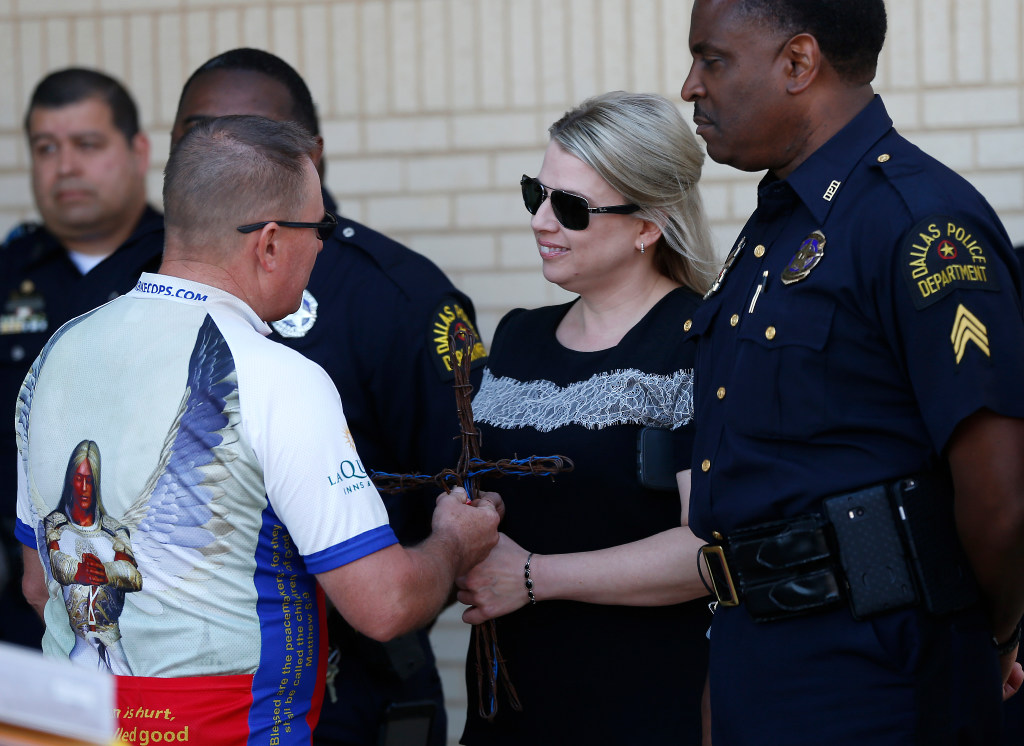
Odessa police Sgt. Dayton Neff gives a handmade memorial cross to Katrina Ahrens, the widow of fallen Senior Cpl. Lorne Ahrens, during a 2017 ceremony at Dallas police headquarters.
Jae S. Lee/Staff Photographer
CLEBURNE – In the months after her husband and four other law enforcement officers were gunned down by a sniper during a 2016 demonstration in downtown Dallas, Katrina Ahrens wrote thank you notes to every person who sent her a crocheted blanket, a card, a check — anything that acknowledged the depth of her loss.

She probably sent hundreds of handwritten notes, Ahrens said during testimony Tuesday in a Johnson County courtroom. Weeks later, she found out there were hundreds, if not thousands, more gifts, letters and checks meant for her and her family that she never received.
The items were being held by a nonprofit group associated with the Dallas Police Association, Ahrens said. City officials and representatives of the association had entered into a written agreement to have all monetary donations, cards and other gifts meant for the officers’ families sent to city offices and police headquarters to be handed over to the Assist the Officer charity, she said.
Article continues below this ad
Ahrens, who recently retired from the Dallas Police Department after more than 25 years of service, testified no one from the city or police group told her about the agreement or sought her approval. They also didn’t tell her checks made out directly to her and her family were being put into a larger pot to be divided equally among all the victims’ families, she said.
Ahrens’ testimony came Tuesday on the first day of her civil trial against the police association and an attorney who once represented her. Her lawsuit accuses attorney Bob Gorsky of engaging in a scheme with the police group to hold the donated funds “hostage” from Ahrens and the other victims’ families, and failing to disclose that he also worked for the police group.
Lawyers for the police association and Gorsky denied the allegations in their opening statements to the jury.
The defense lawyers said the city, the association and Gorsky always had the families’ best interests in mind. They were operating under extraordinary circumstances, with thousands of envelopes and packages for the families arriving at city offices in the weeks and months after the shooting.
“There was a huge outpouring of support,” said attorney Jennifer Johnson, who represents the police group. “It was unprecedented.”
Not all the letters and items received were supportive, Johnson said. Some were vile and anti-police. Officials wanted to shield the families from seeing that, and from the possibility that envelopes might contain dangerous chemicals, the lawyer said.
Article continues below this ad
Volunteers worked around the clock to open and log the items, Johnson said. Checks were deposited in the charitable organization’s bank account to be divided among the families later, she said.
“They tried to do their very best,” Gorsky’s attorney, Jim Grau, told the jury. Gorsky edited the donation agreement, but didn’t draft it, Grau said. And he would have never done anything to hurt Ahrens, whom he had known for many years, the lawyer said.
Ahrens’ husband, Senior Cpl. Lorne Ahrens, had been with the Dallas Police Department for 13 years when he was killed. The gunman was killed hours after the shooting by explosives delivered by a remote-controlled police robot.
Ahrens sued in July 2017, a year after the shooting, and filed her complaint in Johnson County, where she lives. She initially also named the City of Dallas and Assist the Officer as defendants in the suit but they settled with Ahrens out of court. The settlement with the city came earlier this year after the City Council voted to pay up to $2.8 million. The settlement amount with the charity remained private.
Ahrens testified she first became suspicious about what was happening with the donations when someone from the department sent her a picture of a big pile of gifts and cards being held in a conference room for her and asked her to pick them up. She said when she walked into the room, the items were gone.
“No one seemed to know where they went,” she said.
Article continues below this ad
Ahrens eventually learned that more than $10 million in monetary donations had been collected. She also was told the amount that donors had specifically designated for her and her two children was “substantially” higher than for the other families, likely because she was also an officer, she said.
Related: Inside the Dallas ambush memorial that nearly didn’t exist, with the librarians who saved it
Notes that she and her children would have enjoyed reading were never passed on to them, Ahrens said. An invitation from the Dr. Martin Luther King, Jr. Memorial Foundation asking her to come to an event where her husband would be honored also wasn’t turned over, she said.
Ahrens said she initially was led to believe that funds offered for specific families would go to them, while the remaining amount would be split evenly between them. But she was later told that each family would get the same amount — $2.17 million — and that the money would be placed in separate trusts for the surviving spouses and children of the victims.
The families would have no say in how the trust was handled, Ahrens said, which she opposed. She also would be required to sign an agreement to “keep quiet,” she said. A full accounting of the donations wasn’t provided despite repeated requests, she said.
Article continues below this ad
Ahrens said members of the department and the police association quickly turned on her, and published vile posts about her on social media.
“It was ostracizing. It was lonely. It was sad and it was beyond disappointing,” she said.
The only reason she stayed with the department was because she was still waiting to receive the funds and “couldn’t afford to quit,” she said.
The trial will continue Wednesday and is expected to last several days. Ahrens’ attorneys said they plan to call forensic accountants who sifted through details of the donations and determined she should receive more than $3 million from the fund.