
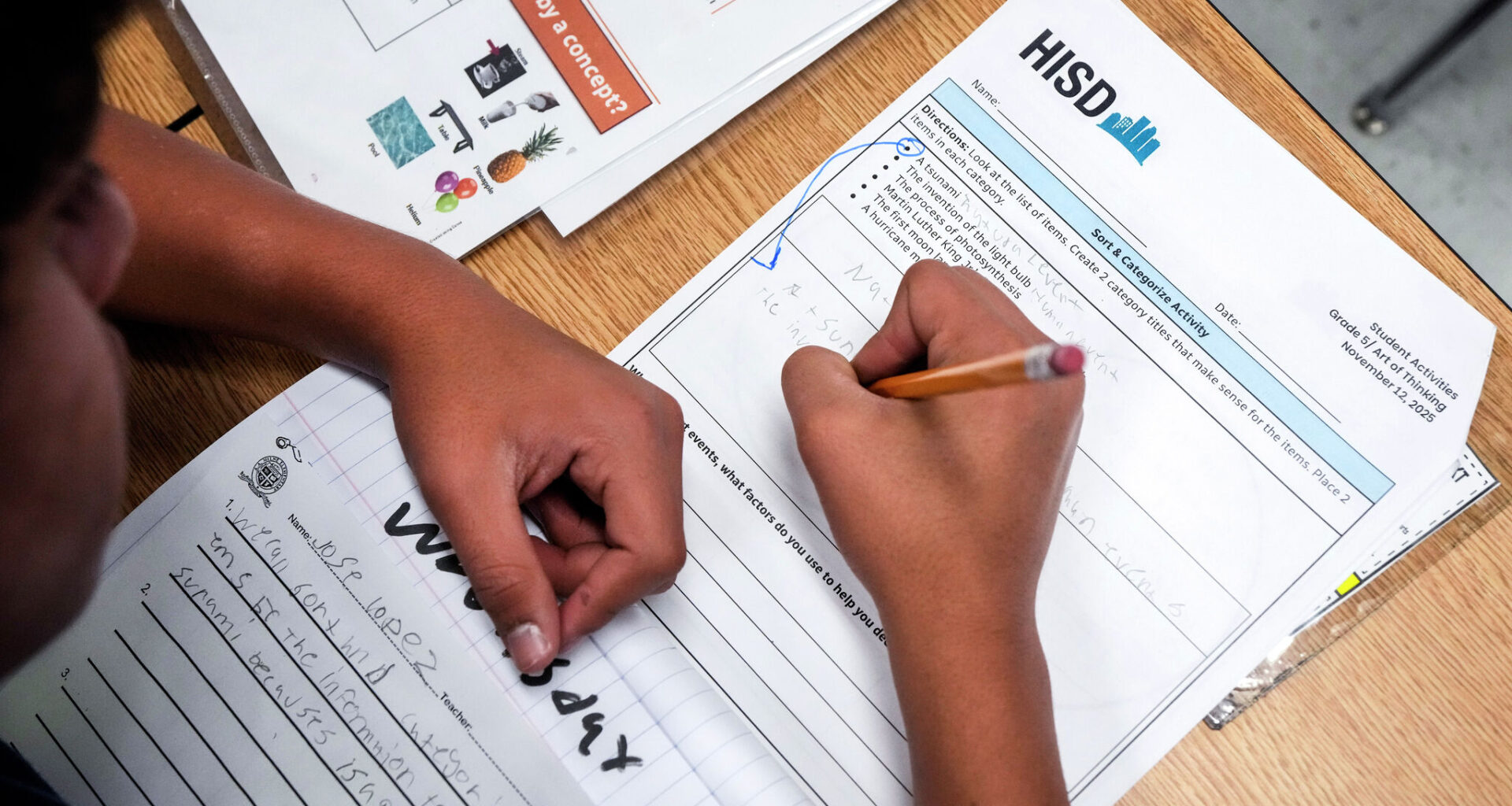
Fifth grade students work on their assignments in their Art of Thinking class at HISD’s A.A. Milne Elementary School in Houston, Wednesday, Nov. 12, 2025. HISD’s Milne Elementary School is second most improved elementary schools in the Houston area according to Children At Risk’s annual rankings.
Brett Coomer/Houston Chronicle
A lawsuit by Midland’s school board to overhaul the way Texas funds education could have been a rallying cry for districts that have long bristled at having to turn over billions of local tax dollars to the state each year.
But two weeks later, it appears Midland will have few allies.
After years of crackdowns from the state’s Republican leaders, superintendents aren’t jumping on board to challenge Gov. Greg Abbott or his education commissioner, Mike Morath. Advocacy groups are silent or oppose it. Questions have swirled around whether the litigation is intended to help Abbott’s goal of eliminating school property taxes next year.
Article continues below this ad
READ MORE: Texas district challenges state school finance system: ‘They’re using us as tax collectors’
So far, no one has joined the suit.
“I think everybody’s gun-shy,” said Josh Sanderson, executive director of Equity Center, one of the groups that led the last legal effort, which ended in 2016.
“We’re definitely not going to get involved in this one,” he said.
Article continues below this ad
The response is a dramatic change from a decade ago, when more than two-thirds of the state’s 1,200 school districts challenged the state’s byzantine school finance system at the Texas Supreme Court.
For decades, Texas has helped pay for schools by collecting property taxes from property-rich districts and redistributing excess dollars to poorer ones. The practice, nicknamed “Robin Hood,” has been the subject of multiple lawsuits by superintendents and school boards since 1994.
Midland’s lawsuit argues that recent legislation has turned the system into a statewide property tax. Morath effectively sets the property tax rates by dictating how much districts can raise and how the money is spent, leaving school districts with little discretion, the suit says. This year, the commissioner’s calculations mean Midland must levy $313 million in property taxes to pay for its daily operations, with $83 million of that sent to the state.
The district’s trustees also argued last month that the system has become warped. Midland is rich in property taxes thanks to its oil and gas operations, but its students are not.
“If Robin Hood is truly doing what it was designed to do, why would you take money out of a school district that has 60% of its students economically disadvantaged?” Midland school board President Josh Guinn said.
Article continues below this ad
Midland trustees mentioned that Grapevine-Colleyville and Carroll school districts were interested in joining, but spokespeople for both districts would not say whether they were considering it. School districts that pay the most under Robin Hood, including Austin ISD, also haven’t joined.
If successful, the lawsuit could force the Legislature to overhaul how it finances public schools — and further inflame tensions between school and state leaders after a bruising legislative session, according to public school advocates. After more than 100 school districts sued the state in 2023 over how Morath’s office calculated their school performance ratings, lawmakers responded by trying to make it harder for schools to sue the state.
Midland trustees questioned whether the district would see some blowback. The board’s lawyer, Kevin O’Hanlon, a veteran of several school district lawsuits, didn’t directly answer. But he noted that the attorney general’s office called him ahead of the meeting and suggested depositing the $83 million owed to the state in a separate account, where it would be available if the district wins its case.
“I did not call them, which was interesting,” O’Hanlon said.
School advocates and observers have also noted that the case was brought by a district in a heavily Republican area instead of the usual coalition of districts from broader parts of the state.
Article continues below this ad
Some questioned whether politics were behind the lawsuit. Abbott is campaigning on the promise of cutting school property taxes in next year’s legislative session.
“There’s lots of talk with Abbott about no property taxes,” board member Sara Burleson asked. “This doesn’t concern that at all, correct?”
The board president said it had “nothing to do with the governor.” But O’Hanlon noted that the lawsuit would bring the issue of property taxes to the forefront just as lawmakers return to Austin.
“Ideas are going to pop up,” O’Hanlon said. But he added that Abbott’s plan to completely do away with school property taxes and have the state fully fund public education instead was unrealistic.
“The state does not have the revenue stream to abolish school taxes, all right? They just don’t,” O’Hanlon said.
Article continues below this ad
Abbott’s office did not respond to emails about what he thinks of Midland’s lawsuit.
Attorney Mark Goulet, one of O’Hanlon’s colleagues who is counsel to Midland’s board, denied any outside influence.
“There’s no donor behind the curtain, or this is all orchestrated,” Goulet said. “This is the Midland board stating their truth in the lawsuit, and they’re not working with anyone else.”
Sanderson said his organization, which represents about 400 school districts, wasn’t supporting the lawsuit because they disagreed with its premise. The organization favors sharing the tax burden across richer and poorer districts.
He said Midland could raise more money for its schools by asking voters to raise property taxes through a mechanism that keeps the money out of Austin’s reach. District leaders don’t want to do that, he said.
“I get where they’re coming from,” Sanderson said. “They’re super frustrated, just like everyone’s frustrated.”