
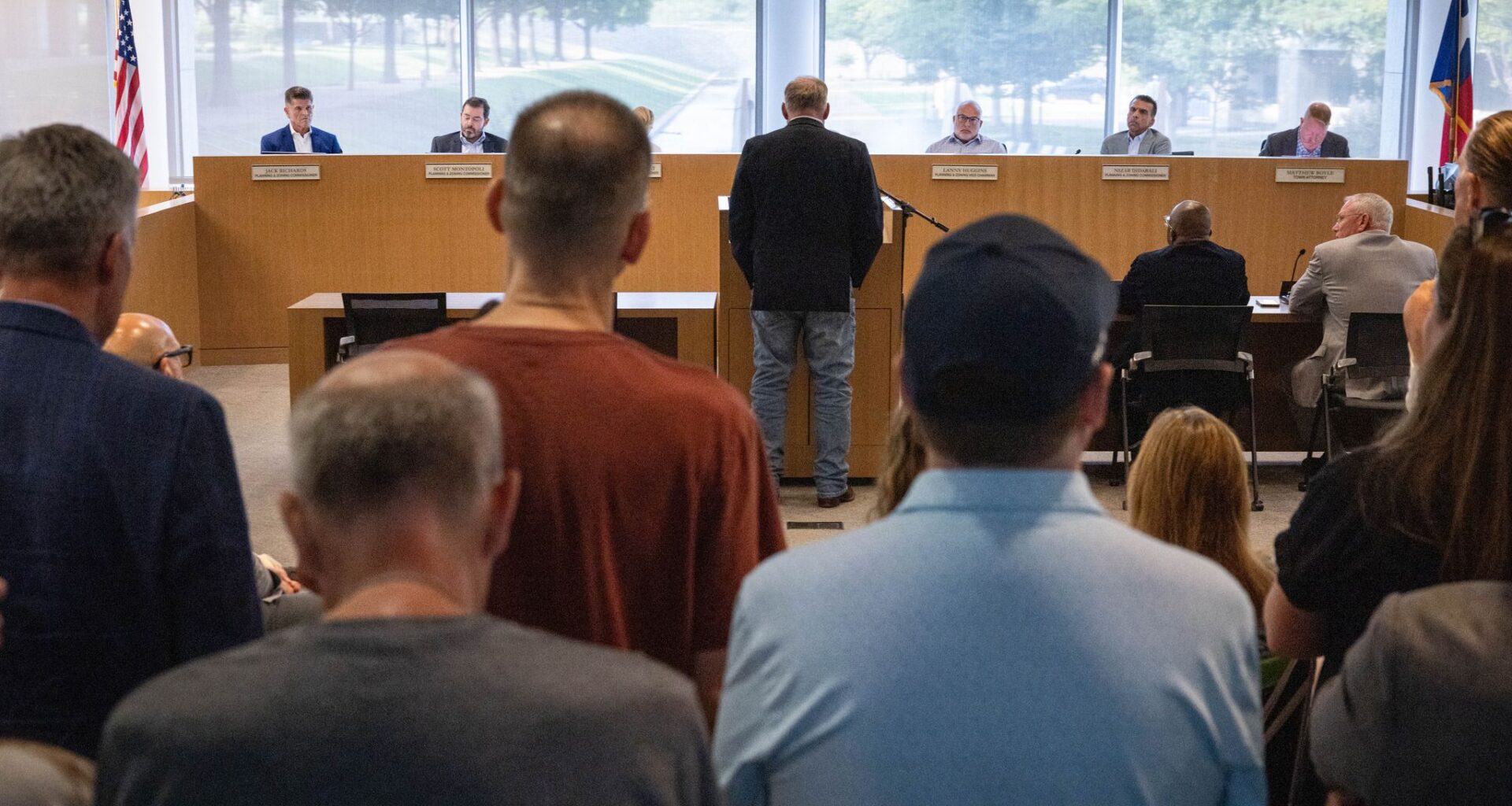
Public commenters speak out against a proposed data center at a Planning and Zoning Commission meeting in Westlake, Tuesday, Aug. 4, 2026.
Angela Piazza/The Dallas Morning News
Journalists have a phrase for hiding the most important news: burying the lead. That’s when the real story isn’t at the top, where everyone will see it. It’s tucked deep inside, where readers might never notice. The town of Westlake recently produced a textbook example.

The town newsletter opens with a story about the annual Military Heroes Run.
Next comes an item about a tree-trimming project. Only after scrolling to Page 2 do readers find the biggest news: “Inside Westlake’s Newest Development.” But even that’s not enough.
Article continues below this ad
That headline could have been much simpler—and much more honest:
Westlake announces a massive data center on its southern border.
The newsletter wraps the project in glowing language, calling it exciting, an important investment that will boost the economy and “keep money in your pocket.”
But that’s only part of the story.
Year of the data center
The Watchdog hereby proclaims 2026 “The Year of the Data Center.”
Article continues below this ad
Data center proposals are popping up like mushrooms after a Texas rainstorm.
It’s not just Westlake, Red Oak, Dallas or Fort Worth. It’s also happening across the state, even in Europe and Asia, too.
Most cities face a sudden dilemma. Do they want to trade precious land for billion-dollar plants—and gain promised property tax deductions?
Governments are so anxious not to lose projects that they wait until the last moment to make the announcement. That’s a problem in Westlake where the proposals are slammed through in a minimum number of public meetings.
This doesn’t give opponents time to organize. That’s the point. But that fuels more anger.
Article continues below this ad
Governments are so anxious for the millions even billions of dollars that it’s like grabbing the brass ring while on a merry-go-round. Nobody wants to miss out.
While city leaders often welcome data centers, many residents don’t. They see huge windowless buildings, high electricity demands, heavy water consumption, diesel backup generators, noise and traffic. They don’t want these industrial-scale facilities in their backyards.
In my next column, I’ll show you 10 strategies neighborhoods are using to fight back—and how some communities have succeeded in stopping data centers before construction ever begins.
The secrecy
The secrecy — burying the lead — has caused such non-partisan anguish that Gov. Greg Abbott went from declaring Texas as the “epicenter” of data centers to seeking a postponement of new rural projects until next year.
Article continues below this ad
That doesn’t solve the problem. Whether rural, suburban or urban, residents are mostly against.
Not every city is trying to slip these projects past the public. Fort Worth leaders have discussed proposals in public from the get-go and are working on zoning changes to protect the city and its residents and still allow the centers.
These changes allow bigger buffers, planting of trees, sound deflection and other landscape improvements. Still big, ugly buildings, no matter what.
Residents against the centers must fight not only their local leaders, but they also must stand up to the most powerful and richest companies in the world — Google, Facebook/Meta and Amazon, to name a few.
What happens if in future years new technologies make these centers obsolete? Do they become schools, housing or medical centers? These buildings are sometimes close to a mile in length.
Article continues below this ad
One fear is that national gas power plants emit tremendous amounts of greenhouse gases. But science teacher Andy Masley has made a name by claiming environment fears are overstated. He suggests that one question you ask ChatGPT is the equivalent energy-wise of running a microwave oven for one second.
There is one solution that is quite wacky. Elon Musk says if you don’t want the centers in your town, he’ll put them in space.
Next: Ten ways communities are fighting back—and what you can do if a data center is headed for your neighborhood.