
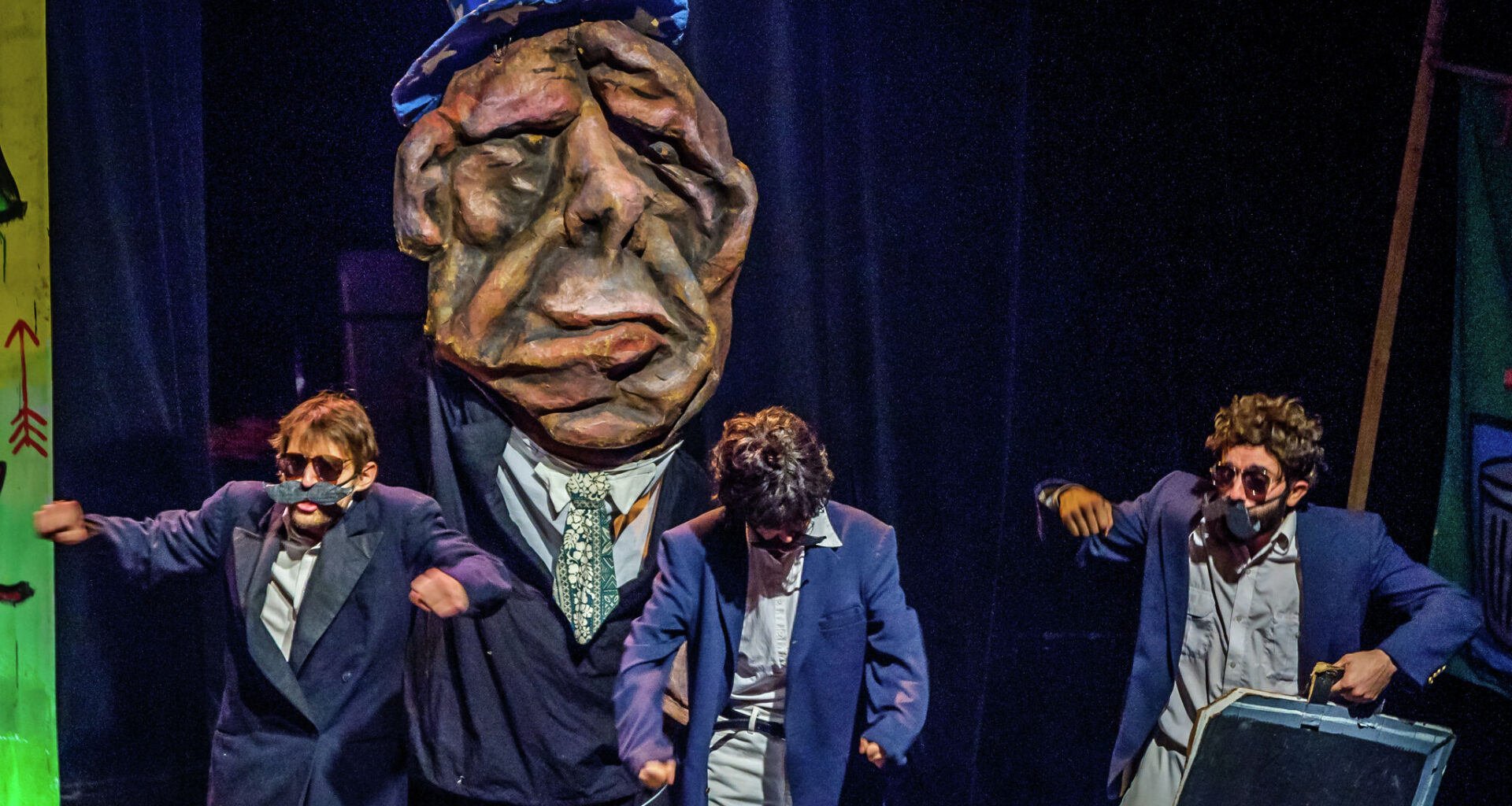
Uncle Fatso looms behind a Bread and Puppet performance in New York. A version of the satirical puppet stands at the entrance to the McNay Art Museum exhibit “A People’s History.”
Erik McGregor/LightRocket via Getty Images
“Hamilton” was on curator Remus Moore’s wish list for a new McNay Art Museum exhibit exploring how theater artists deal with U.S. history, but they weren’t sure they’d be able to get the costume designs they wanted.

That’s because designer Paul Tazewell, who won a Tony award for his work on the show, is currently the subject of a retrospective at the Griffin Museum of Science and Industry in Chicago.
Article continues below this ad
Robert Yodice’s 1976 costume design for “Ellis Island” can be seen in “A People’s History: The American Experiment on Stage” at the McNay Art Museum.
Robert L.B. Tobin
Anna Louizos’ maquette for the 2009 national tour of “In the Heights” can be seen in “A People’s History: The American Experiment on Stage” at the McNay Art Museum.
Anna Louizos
Paul Tazewell’s design for the costume for Bess for a 2005 production of “Porgy and Bess” can be seen in “A People’s History: The American Experiment on Stage” at the McNay Art Museum.
Paul Tazewell
Uncle Fatso, a giant puppet created by the Vermont-based Bread and Puppet theater company, stands at the entrance to “A People’s History: The American Experiment on Stage” at the McNay Art Museum.
Chris Stolze/Courtesy McNay Art Musseum
Graphite sketches for four of Paul Tazewell’s Tony-winning costume designs for “Hamilton” are part of “A People’s History: The American Experiment Onstage” at the McNay Art Museum.
Chris Stolze/Courtesy McNay Art Museum
Some of Robert Indiana’s costume designs for the opera “The Mother of Us All” can be seen in “A People’s History: The American Experiment on Stage” at the McNay Art Museum.
Chris Stolze/Courtesy McNay Art Museum
A giant puppet created by the Bread and Puppet political theater stands at the entrance to “A People’s History: The American Experiment Onstage” at the McNay Art Museum.
Chris Stolze/Courtesy McNay Art Museum
Happily, it all worked out. Among the many treasures of the McNay show – titled “A People’s History: The American Experiment on Stage” – are four of Tazewell’s detailed, delicate-looking graphite sketches. The quartet, grouped together on the back wall, feature looks he created for Alexander Hamilton, Thomas Jefferson and Hamilton’s sister-in-law Peggy Schuyler.
“It’s a really wonderful way to highlight such an important musical,” said Moore, the museum’s Tobin Theatre Arts Fund assistant curator.
The exhibit
What: The McNay Art Museum’s contribution to the nation’s 250th birthday celebration is “A People’s History: The American Experiment on Stage.” The exhibit explores the way that the country’s story has been told onstage via maquettes and set and costume designs from a broad range of shows, including “Hamilton,” “Hair,” “The Color Purple,” “In the Heights” and “Hairspray.”
Details: Opens Thursday. Through Nov. 8, McNay Art Museum, 6000 N. New Braunfels. Included with museum admission, $18 to $23 (discounts available), mcnayart.org.
The show
What: “Hamilton,” Lin-Manuel Miranda’s blockbuster musical, is wrapping up its two-week return to the Majestic Theatre this weekend. The show tells the story of the founding of the country through the life of Alexander Hamilton.
Details: 7:30 p.m. Wednesday and Thursday, 1 p.m. and 7:30 p.m. Friday and 2 p.m. and 8 p.m. Saturday, Majestic Theatre, 224 E. Houston. $80.73 to $331, us.atgtickets.com; $10 tickets are available via a digital lottery at hamiltonmusical.com.
ALSO SHOWING: Witte Museum’s ‘Adventures’ includes primitive cats, battles, ancient murals
Article continues below this ad
As it happens, the exhibit is opening this week, just as “Hamilton” is wrapping up its latest run at the Majestic Theatre. So ticket-holders might want to hit the museum for a peek behind the scenes before they head downtown for the show.
“A People’s History” can be found in the Lawson Print Gallery, where an enormous, eye-catching puppet dubbed Uncle Fatso stands at the entrance. The piece — a representation of Uncle Sam with a cigar clenched in one fist and a red, white and blue top hat on his head — comes from Bread and Puppet, a 63-year-old political theater based on a farm in Vermont.
“They got their start in New York City and Washington, D.C., in the late 1960s as a protest theater,” Moore said. “So they would do street parades with these huge puppets, protesting the Vietnam War, the war on drugs. Now they’ve transitioned to a more permanent location in Vermont, but they do circuses every year with puppets this size.”
The puppet is the ideal introduction to the show.
Article continues below this ad
“The idea behind this exhibit is looking at how artists have reacted to the past 250 years of American politics and how they’ve put it onstage,” Moore said. “So we have women’s rights with ‘The Mother of Us All,’ a very famous opera. We have a couple of loans from Takeshi Kata from ‘Angels in America,’ talking about the AIDS epidemic and queer rights; we have labor rights movement. We have all these different ways artists have taken what’s happening around them, putting it on stage as a way for us to all really process it, reflect on it, all of that.
“With this being the 250th anniversary of the signing of the Declaration of Independence, we thought this would be a wonderful opportunity to sort of reflect on the last 250 years and see what we want for the next 250 years.”
MORE AMERICAN HISTORY: “Tejano Legacy: Another American Origin Story” opens at the Briscoe Western Art Museum
The exhibit features costume and set designs as well as production photos. There’s also a soundtrack drawn from a slew of musicals and several maquettes. There’s one made by designer Don Hannon for a 1990 production of “Hair,” the 1960s counter-culture musical. A few feet away, visitors can take a look at Anna Louizos’ design for a 2009 tour of “In the Heights,” the musical digging into gentrification and Puerto Rican identity that Lin-Manuel Miranda wrote before “Hamilton.”
Article continues below this ad
Designer Dan Hannon’s 1990 maquette for “Hair” — made of painted wood, metal, plastic and found objects — can be seen in “A People’s History: The American Experiment on Stage” at the McNay art Museum.
Dan Hannon
San Antonio’s theater scene gets a little bit of a spotlight, too. A costume design that Margaret Mitchell created for “Where the Rivers Meet,” a Carmen Tafolla play produced in 2015, is shown along with some fabric swatches for the piece. And two sketches of Javier Sanchez’s set design for the San Pedro Playhouse’s 2025 production of “Hairspray” are displayed beside photos from the show.
“I really enjoy being able to bring in designs from our local artists,” Moore said. “It’s a really wonderful opportunity to show that not only is amazing theater happening on Broadway and in Washington, D.C., but it’s also happening here in our backyard.”
The show covers the entirety of the nation’s 250 years. That includes a big first: “The Contrast,” the first American play to receive a professional production, way back in 1787. The exhibit is showing Arch Lauterer’s patriotic-themed curtain designs for a 1947 production of the comedy.
Article continues below this ad
“ ‘The Contrast’ opens with a couple of poems,” Moore said. “One of the first opening lines is, ‘We go from the very lofty sir to the humble mister.’ So it’s this really wonderful play talking about what it means to be American, just a few years after we become America.”
The newest production featured in the exhibit is the 2025 staging of Nia Akilah Robinson’s “The Great Privation (How to flip 10 cents into a dollar).” Moore was able to get designer Meghan Raham’s maquette for the Woolly Mammoth Theatre in Washington, D.C.
Moore caught that particular production. The play is set in a campground built on what had been a cemetery in 1806.
“There’s this interplay between racial tensions in the early 1800s and how bodies were used for medical experimentation and how racial tensions are still something to be puzzled over and how a lot of people of color feel very isolated from their heritage,” Moore said. “One of the most striking parts about the production is this ground covering, which is about six inches of mulch. And so the entire theater was filled with this wet, woody smell the entire time. It was this really wonderful, multi-sensory experience.”
Article continues below this ad
Those who peer closely into the maquette may spot a tiny tree stump suspended over the set. Raham’s fully realized design included the real deal: A stump that measured 12 feet in diameter.
Raham passed the stump often on her drive to work, and it captured her imagination, Moore said. Eventually, she went to the manager of the park where the stump stood and asked if she could have it for the show
“And they’re like, ‘We’re not moving it, but if you want it, have at it,’” they said. “So it is this amazing, gigantic tree stump suspended over the stage, lit with these blood red lights at points, or just party lights instead, depending on the vibe, because there is ghostly possession at one point. It’s creepy, but it’s great.”
Article continues below this ad
The designer offered Moore the stump for the exhibit, but they had to say no: “At least we get this model version, and that is wonderful.”