
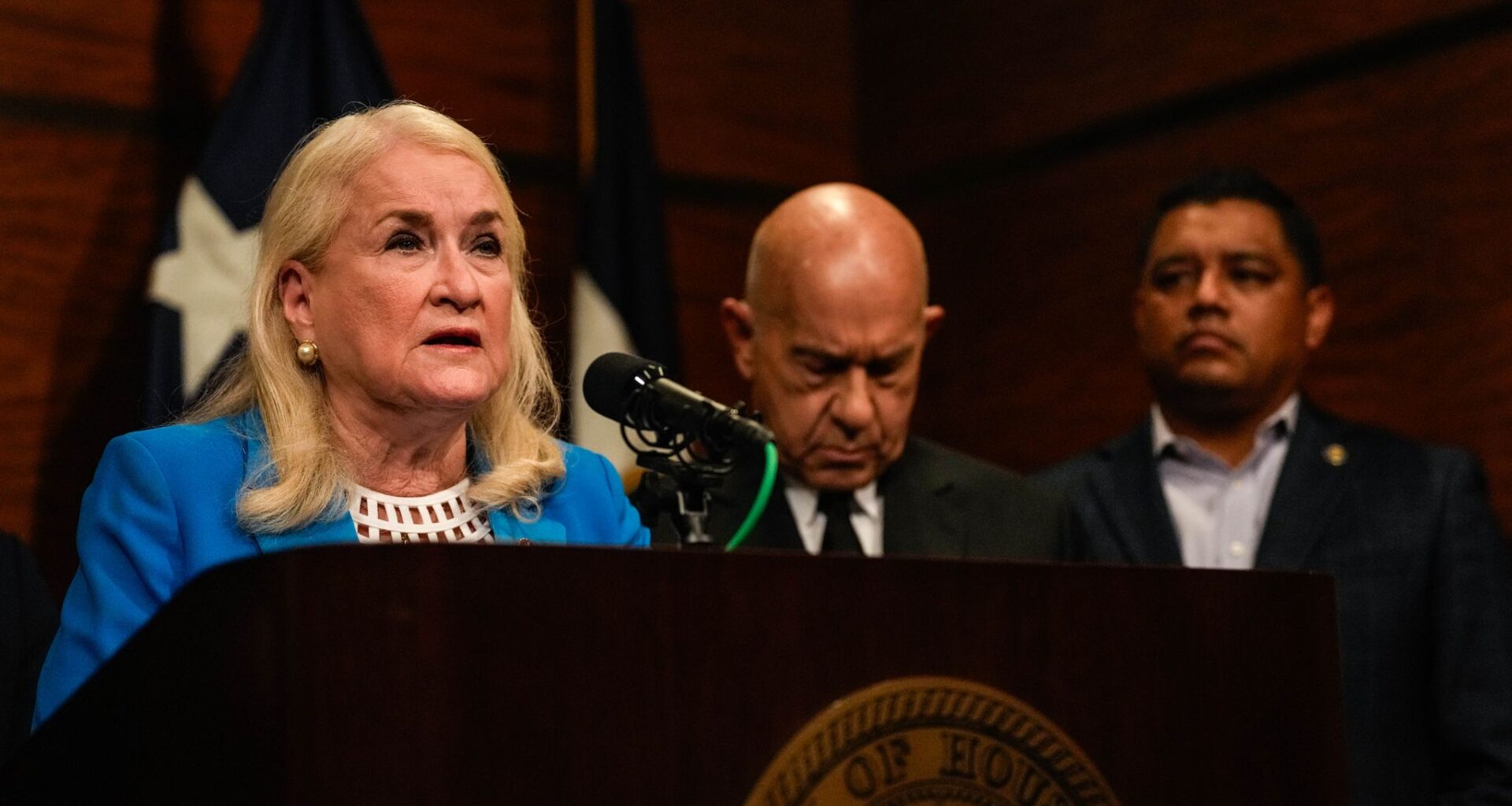
U.S. Rep. Sylvia Garcia speaks during a news conference at Houston City Hall in Houston on Friday, July 10, 2026, regarding the officer-involved shooting of Lorenzo Salgado Araujo during a federal immigration enforcement operation and the detention of the two passengers who were in the vehicle with him.
Raquel Natalicchio/Houston Chronicle
U.S. Rep. Sylvia Garcia, D-Houston, said Wednesday that she disagrees with some of the ways Mayor John Whitmire has responded to the presence of immigration agents in Houston during President Donald Trump’s second term.
Houston police officers’ limited cooperation with U.S. Immigration and Customs Enforcement agents, coupled with the recent ICE killing of Lorenzo Salgado Araujo, have made immigration enforcement one of the defining issues of Whitmire’s tenure and tested the broad supporter base he has developed over five decades in Houston politics.
Garcia, a longtime ally of Whitmire’s, told the Houston Chronicle editorial board that while Whitmire has been “very supportive” in the wake of Salgado’s death, she disapproves of the city’s approach to ICE administrative warrants, which are not issued for criminal charges and are not signed by a judge.
Article continues below this ad
READ MORE: Inside the collapse of Houston’s ICE policy
Houston police have encountered hundreds of people with such warrants since the start of Trump’s term and alerted ICE to their presence, which Whitmire has argued is an unfortunate necessity, as state laws prohibit cities from adopting policies that ban cooperation with ICE.
Between April and June alone, Houston police called ICE on over 100 people with administrative warrants, nearly half of whom were encountered during a traffic stop, according to an HPD report. Nineteen of those people were turned over to ICE agents.
“When he says ‘we’re not cooperating with ICE,’ he means (Houston police) aren’t out there enforcing and doing operational issues,” Garcia told the editorial board. “In my view, he’s not talking about the traffic stops, and he’s doing the traffic stop thing and I disagree with him and we’ve all talked to him about it.”
Article continues below this ad
Whitmire said in a statement that he is committed to working with Garcia and rest of the congressional delegation “to ensure there is a thorough and transparent investigation into the fatal shooting of Lorenzo Salgado. The public deserves answers, and accountability must follow the facts.”
Senate Bill 4 a sticking point
The mayor repeatedly has said the city is hamstrung by Senate Bill 4, the 2017 state law that bans cities from explicitly prohibiting cooperation with ICE.
The debate over the city’s response came to a head in April, when City Council passed an ordinance requiring officers to detain someone only “as long as reasonably necessary to complete the legitimate purpose of the initial stop or investigation,” without regard for any non-criminal immigration warrants they might have.
Whitmire voted in favor, but then led the effort to reverse it two weeks later after Gov. Greg Abbott threatened to pull $114 million public safety funds from the city. Houston police have now reverted to their previous policy of waiting a “reasonable” amount of time for ICE agents to pick up their targets.
Article continues below this ad
Garcia told the editorial board she understands the “big stick” that Abbott and Trump wield over cities like Houston, and filed a bill earlier this year to repeal a federal law that requires local governments to let police share people’s immigration status with federal authorities.
She said she disagreed with the city’s interpretation of SB4, however. Austin and Dallas also amended their policies on administrative warrants under pressure from the governor, but retained more flexible language. Austin’s updated policy still makes clear that officers cannot detain someone on an administrative warrant alone, while Dallas’ simply does not prohibit officers from calling ICE.
“I debated that issue with the city attorney,” Garcia said. “I think it’s just (different) interpretations by different cities, but SB4 should be repealed, period.”
Whitmire noted that he voted against SB4 when he was in the Legislature, but said the city legal department has “conducted a thorough review of the statute and has concluded that the city of Houston is complying with the law as it currently stands.”
“My administration will continue to follow the law while advocating for policies that reflect our values and protect the people of Houston,” the mayor said.
Article continues below this ad
TIMELINE: How Houston police’s ICE policy fight unfolded, from Whitmire’s promises to Abbott’s threats
Among Garcia’s top concerns is the time HPD spends on calls involving people with administrative warrants. A recent Chronicle investigation found calls involving ICE tie up officers far longer than an average traffic stop.
One man, who was deported to Honduras after Houston police turned him over to ICE in June, sued HPD this week for allegedly detaining him for two hours, in violation of his Fourth Amendment rights. He had only a civil immigration warrant and allegedly faced no criminal charges.
“To me that’s just a really bad use of police officer time, especially if it’s on an (immigration) detainer and not a freaking (criminal) warrant,” Garcia said.
Still, Garcia told the editorial board that Whitmire has been “aggressive, staying in touch and supportive” as she helps lead efforts to get answers about Salgado’s death, and that “big city mayors” will always take heat on major issues because it’s “the one place where people look.”
Article continues below this ad
City Council chambers have been consistently packed with protestors denouncing the city’s approach to ICE since the Chronicle revealed HPD’s policy on administrative warrants, which Garcia characterized as people “exercising their First Amendment rights.”
“Anytime anything happens in a city … the mayor gets blamed,” Garcia said. “But it’s there, especially because there was an ordinance and he didn’t support it, so there’s a reason to go there.”