
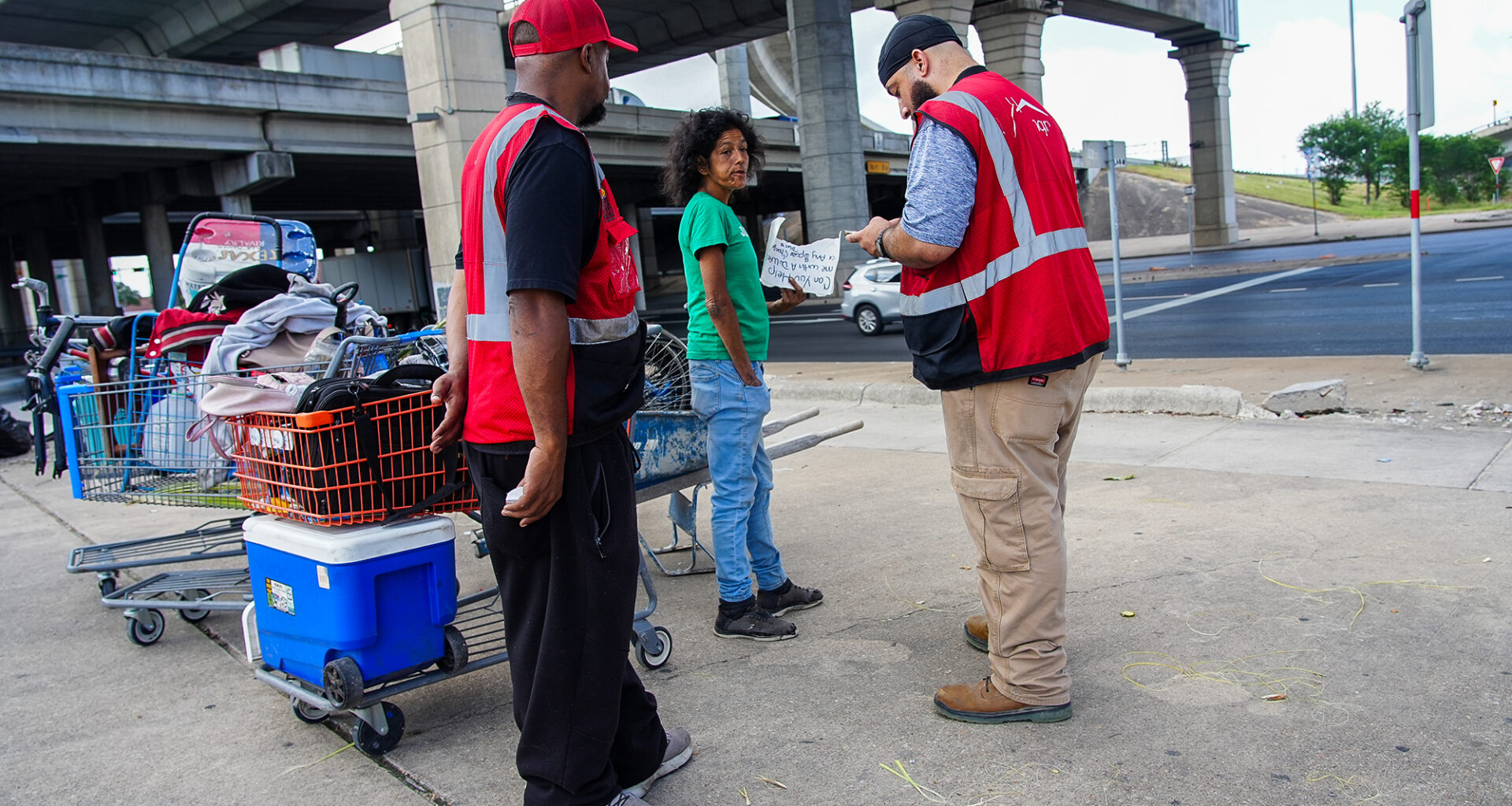
A woman who identifies as Monique speaks with Brian Caldwell, a Level 4 Community Ambassador, and Eugene Ewers, an outreach practitioner for Hungry Hill, after receiving food, water, and information on June 26, 2025. The Hungry Hill Foundation, founded by ex-convict Chase Wright in 2022, combats homelessness in East Austin by providing job training, food, transitional housing, and outreach services across seven zip codes.
Ricardo B. Brazziell/Austin American-StatesmanAustin discovered $4.7 million in unexpected property tax revenue days before finalizing next year’s budget.City Council members are divided over whether to use the new funds to restore social service cuts, fund housing vouchers or reserve the money until contract performance is reviewed.An internal audit found that 19 of 25 nonprofits with city contracts missed at least one performance target but were still paid in full.
As Austin faces a projected multimillion-dollar deficit that is expected to balloon in the coming years, one of the biggest tactics City Manager T.C. Broadnax has pushed to balance the books is deep cuts to social service contracts with a more than $5 million proposed reduction in the next budget.

The effort has been bolstered by several findings suggesting Austin’s funding and oversight of those services are unsustainable. A city analysis found Austin relies far more heavily than peer cities on its general fund to pay for social services, while a more recent audit found nonprofits missed nearly half of the performance goals reviewed.
Article continues below this ad
Donnavan Billings adjusts an umbrella to shade his dog, Creature, while panhandling on East Ben White Boulevard on a hot afternoon in Austin on Wednesday, July 8, 2026, when temperatures reached the mid-90s. Billings, who said he is homeless after losing everything in a fire, also provided Creature with a wet towel and water and said he uses some of the money he collects to buy higher-quality dog food.
Jay Janner/Austin American-Statesman
But Friday’s discovery of $4.7 million in additional property tax revenue has upended the plan days before the City Council begins adopting next year’s budget. A supermajority of council members now supports restoring at least some of the proposed cuts, prompting a debate over whether the money should preserve services, fund housing vouchers or be held until the city can determine which contracts are producing results.
The council is expected to confront that question Thursday, when city staff will present a proposal to reserve the additional revenue for possible social service spending.
How Austin got here
Broadnax zeroed in on social services late last year shortly after Austin voters rejected Proposition Q, a council-backed plan to raise property taxes by more than 20% to fund social services and other city programs. He made the first cuts in December, slashing $5.28 million from the social services budget and promising nearly $17 million more would follow.
Article continues below this ad
Council then created a rubric for distributing the cuts that weighed factors like whether a contracted service provides essential programs, prevents costs elsewhere in the city, delivers a return on investment and meets its contract goals.
At the end of February, council approved the rubric and directed Broadnax to use it in recommending cuts.
When Broadnax released a proposed budget in July, staff recommended spreading the remaining $16.8 million in reductions over two years, leaving about $5 million in direct social service cuts this year.
That would ease the burden on nonprofits that have relied on city funding for years.
Article continues below this ad
As budget discussions began in earnest last month, an internal audit flagged that 19 out of 25 reviewed nonprofits had missed at least one performance target but were still paid in full.
The audit examined 25 contracts worth roughly $30 million across multiple departments. Notably, the report did not identify the nonprofits that failed to meet their targets.
At a July 20 meeting, Council Member Ryan Alter said council should look at provider performance when deciding who to fund while saying the city should be careful not to condemn every nonprofit.
“When we are trying to decide who is worthy of funding and who is not, I think we need to start that conversation with those who are not meeting the expectation,” he said.
Article continues below this ad
Save Austin Now, a conservative political action committee and frequent city critics, called for the names to be released.
“City leaders have said they will not release the list, which only deepens distrust between taxpayers and City Hall,” the PAC wrote in a press release.
But City Auditor Jason Hadavi said the review assessed the city’s contract management rather than the nonprofits themselves.
“Since the nonprofits were selected randomly and the focus of the project was the city’s practices, we do not believe it is appropriate to publicize their names,” he said.
Article continues below this ad
If the audit had focused on the nonprofits themselves, he added, his office would have named them publicly.
The city also declined the American-Statesman’s open records request for the names, citing an exemption for audit working papers under Texas public records law.
Just over a week after the audit’s release, another list of nonprofits emerged.
On July 29, Broadnax released his recommended cuts to individual providers, giving council just over a week to review them before the budget adoption process begins on Aug. 12.
Article continues below this ad
That same day, the budget office announced certified property values added $3.3 billion to Austin’s tax base — slightly more than the $3.2 billion increase assumed in the proposed budget. Together with a small property tax rate adjustment, that gave the City Council an additional $4.7 million to play with.
The unexpected revenue quickly prompted competing proposals for how to spend the money. City staff recommended putting it into two housing assistance funds. Alter backed that approach, arguing the city could later use other housing money to restore social service contracts after reviewing provider performance.
The rest of the council had other ideas.
Council Member Vanessa Fuentes, backed by Council Members Natasha Harper-Madison, Mike Siegel, Paige Ellis and Zo Qadri, proposed using the entire $4.7 million to restore nonprofit funding.
Article continues below this ad
“Understanding that we may receive additional insights on the evaluation and performance of existing contracts, my hope is that we maintain and prioritize the highest level of social services,” Fuentes and her subquorum wrote in a message to the council last Thursday.
Mayor Kirk Watson last Monday proposed reserving $2.2 million of the money for contracts involving children and family services. He said that would give the city time to resolve performance issues and allow Broadnax to explain each proposed cut, identify documented concerns and describe its expected impacts.
Council Members Chito Vela and Krista Laine said they supported the mayor’s approach but called for extending the pause to every social service category.
A possible compromise
Amid the jockeying, Watson has sought a compromise. Late Tuesday, he said he had been working with city finance staff to “create a mechanism” for using the $4.7 million for social services while establishing a dedicated funding source for housing vouchers.
Article continues below this ad
Watson said staff would present a proposal Thursday, though how its reception remains uncertain.
Fuentes, who leads the five-member coalition seeking to restore the cuts, said Tuesday that council has not had enough time to decide which programs should lose funding.