
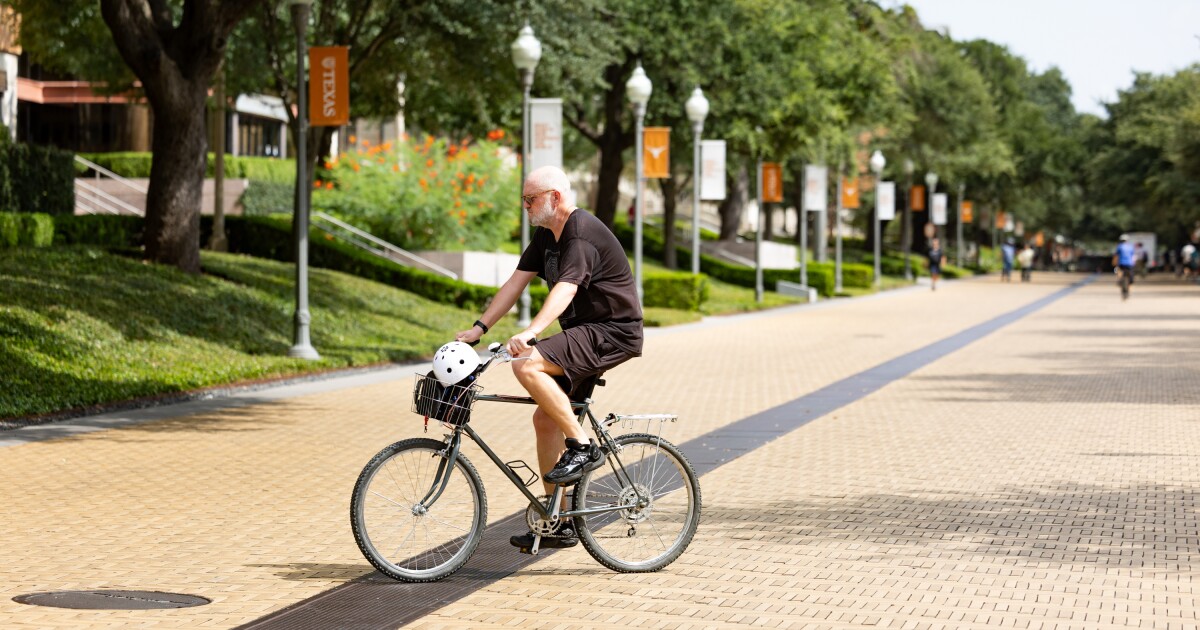
After signs asking people to walk their bikes and scooters appeared on the University of Texas at Austin’s campus, students and advocates worried the university was moving toward banning cycling. UT officials told KUT that’s not the case, and they will soon announce the details of a new mobility plan.
Last week, UT student Eddy Diaz saw the university had published new regulations online, including a “dismount zone map.” Diaz and many other Austinites understood that people using bikes or scooters would have to get off and walk through sections of campus. The information has since been removed from UT’s website, but an archived version shows the map encompassed some of the busiest streets, including the Speedway Pedestrian Mall.
Diaz, who bikes to class and to work in East Austin, said he was disappointed that there was no further information or community engagement around the potential change.
“I was very surprised to see this basically popped up overnight,” Diaz said. “There was no official announcement. It just popped up on the website, and then the signs went up on Speedway.”
While the proposed changes and maps have been removed from UT’s website, the university put up signs that suggest people should walk their bikes and scooters on sections of Speedway. That raised bigger concerns among advocates on social media, who asked the university for answers.
A new plan is coming
A UT Austin spokesperson told KUT News the university is working on a new plan that will be shared soon, and that changes will not impact manually operated bicycles.
“On Monday we will begin to make our campus aware of new mobility expectations that will build a shared culture of safety and encourage everyone to do their part to create a safe and welcoming campus experience,” the spokesperson said. “The University has been working throughout the past year on a series of mobility updates designed to enhance safety, accessibility, and the overall campus experience.”
UT’s spokesperson said the signs that have been posted so far “do not constitute the complete picture,” and that university officials are making sure they deliver a more detailed message to their community through “more signage, more language and through different channels.”
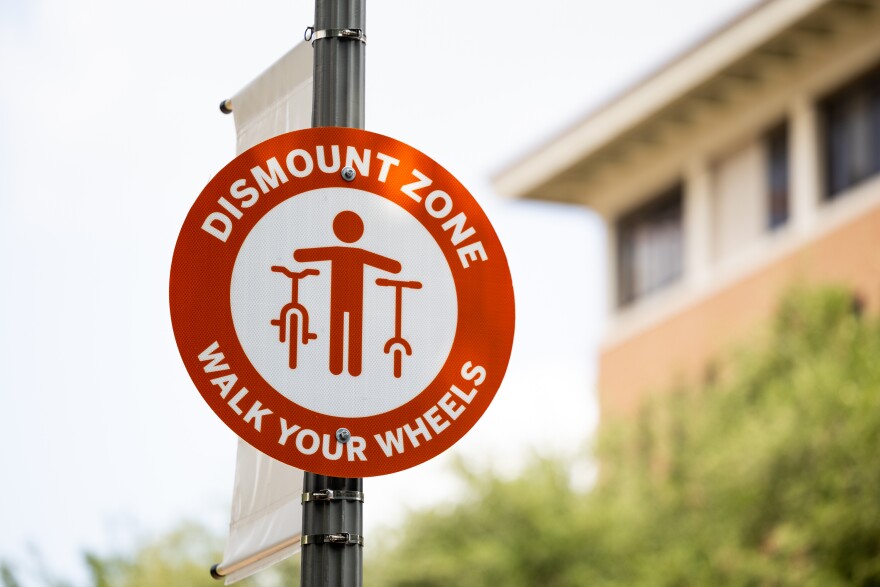
New signage has been posted on Speedway Mall, although its enforcement still remains unclear.
However, the signs do not indicate that the dismount zone is for electric bicycles or scooters, which was one of the factors that led to the assumptions that cyclists would also have to dismount.
Diaz said he felt better knowing that regular bicycles won’t be banned from campus, and he understood people tend to ride electric bikes or scooters at high speeds. But he said he still worries how the changes will affect people who rely on electric bikes, and he is curious about other changes UT might make.
“I feel like this is just going to affect the people who maybe can’t ride a manual bike for really long distances the most,” Diaz said. “And that makes me wonder about, you know, mobility scooters for people with disabilities.”
He said that if speed is the issue, the university should make sure speed limits are enforced. For years, students have asked the university to increase the number of bike lanes around campus in an effort to improve safety. In 2016, the university turned the Speedway Mall into a pedestrian corridor that thousands of students, faculty and staff use every day to get around. Bikes and scooters are allowed, but they must yield to pedestrians.
Alejandro De La Vega, chair of the Bicycle Advisory Council of the City of Austin, said any changes to regulations on the UT campus would also disrupt commutes for the rest of the city, since many people that have no affiliation with the university ride their bikes on Speedway.
“A lot of people that have to commute through the area look forward to using it, even when it’s not necessarily class time,” he said. “Maybe it’s on the weekend, or maybe it is at night, but it’s an area that people know that they can be safe.”
Advocates and students like Diaz said drastic changes would push people to ride on busier roadways like Dean Keaton and Guadalupe streets or San Jacinto Boulevard, exposing themselves to fast-moving cars. Guadalupe Street and San Jacinto Boulevard are both included in the Austin High-Injury Network, a city-run tool that maps streets with high numbers of serious injuries or fatal crashes.
Lack of communication
Michael Haertel is one of the Austin cyclists who uses Speedway to get from North Austin to downtown. He is also concerned the measure will impact people’s ability to move around the city if they have an e-bike or a similar device that UT might not allow on campus. He also raised concerns about how CapMetro’s Bikeshare program would fit in, since it has a station of electric-assist bikes on Speedway.
“It’s kind of silly to have a e-bike stand in the middle of a zone you’re not allowing e-bikes on,” Haertel said.
Haertel said even though UT took the website down and has now said the changes won’t impact manually operated bikes, the lack of transparency is concerning, especially as signs are being put up in the middle of the summer when most students are off campus.
“If there was any analysis or research done before this decision was put through, there’s just no information being provided to the public,” Haertel said. “This is not how state government’s supposed to work. The residents of Austin are stakeholders in [the] University of Texas.”
For days, advocates and students were left wondering what the signage and deleted information actually meant and if the university would make a formal announcement. Now, having one more piece of the puzzle, Diaz said he still wishes the university had shared information instead of letting people come to their own conclusions.
“That just leaves me with more questions than it does answer anything,” Diaz said. “It’s so confusing the way that they’re going about this. There’s no consistent communication at all.”
Haertel and Diaz said they wish UT had asked for community input. The UT Campus Master Plan calls for adding a separate bike path to San Jacinto Boulevard and two-way bike lanes along Guadalupe and Dean Keaton streets. The university has begun the process of updating the plan for the first time since its adoption in 2013, including conducting a survey of the campus community to identify its needs.
Haertel said he hopes good changes are on the way.
“I hope this opens more discussion about how to deal with whatever conflict exists on Speedway,” he said. “Adding a designated bike lane and pedestrian path in both directions by simply painting lines on the brick would help smooth out the flow of traffic.”