
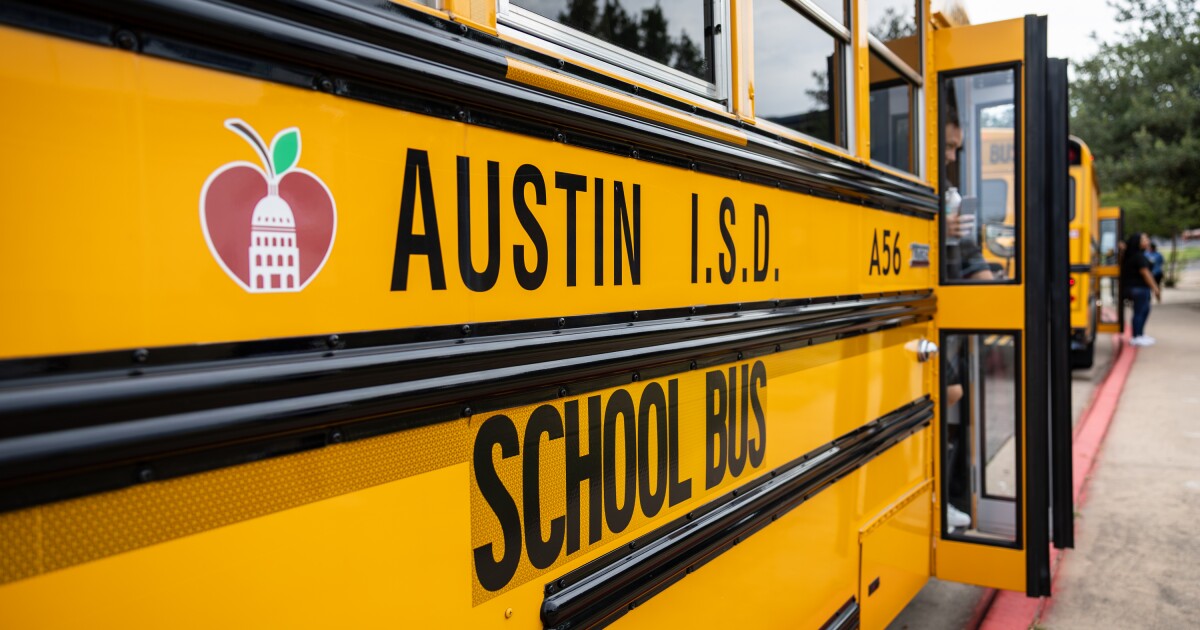
With less than two weeks till the start of school, the Austin Independent School District is still adjusting how transportation will work for middle and high school students. District officials said they eliminated 27 bus routes that will help them save $5.2 million.
The district said it would scale back transportation services as part of the $205 million in cuts made to adopt a balanced budget for the 2026-27 school year. School buses will no longer go into neighborhoods to pick up middle school and high school students. Instead, those students will be picked up and dropped off at a community hub stop, including nearby elementary schools, Austin Community College campuses and CapMetro stops. District officials have said this hub model will increase route efficiency and shorten ride times for students.
Kris Hafezizadeh, AISD’s executive director of transportation and vehicle services, said Thursday the district hopes to add hubs as families give input. He said district officials know the plan will be disruptive for some families, but they are hoping the community will come together to make sure students are getting to the hubs safely.
“I cannot guarantee we will add hubs and stops everywhere, but we will consider the suggestions,” he said. “I do ask our families and our community members to help our students if there is a need to and from the hubs.”
On Monday, AISD shared a tool to find the closest hub stop. Hafezizadeh said the district has already added more than 50 hub stops based on community feedback, with a total of 254 hubs by Thursday afternoon.
The average distance to a hub from a student’s homes is 2 to 2.5 miles with the maximum distance being 3 miles. He said the district carried out a risk assessment, but there are still areas where students’ paths may include areas “no one walks in.”
Families impacted by the changes
Some families have said they are not able to drive their kids to the hubs at certain hours because of their own work schedules. Katherine Lengieza Gross’ son is a student at Murchison Middle School and has been assigned to Davis Elementary as his hub. Lengieza Gross said dropping him off in the morning wouldn’t be a problem because her younger son goes to Davis, but the end of the school day presents a problem because of different end times. Lengieza Gross said she and her husband are scrambling to figure out how to get her eldest son home.
“A parent would need to go and pick him up there, or we need to figure out a carpool situation with other parents,” Lengieza Gross said. “The parents that we are friends with in the neighborhood, they all work, so it would just be a little bit of a juggling act.”
Lengieza Gross’ family has considered letting her seventh grader walk or bike to the hub. But the 1.7-mile route would take 10 to 30 minutes if he bikes or walks. If he rode his bike, Lengieza Gross said he would have to travel on high-speed roads without bike lanes, under U.S. Highway 183 and through busy intersections.
“I worry about him getting hit by a car,” Lengieza Gross said. “I think that it is dangerous enough that we, as a family, would need to find an alternative solution because I do not think it is safe for him to bike on these streets.”
Lengieza Gross said she’s a big supporter of public education and that she understands the district is in a budget crunch due to state funding, but she still wishes the district would put students’ safety in the forefront of this decision.
Hafezizadeh said families can share feedback until Aug. 17 through a survey.
Lengieza Gross said she submitted feedback but has not heard back on whether the district can add another hub to prevent her son from traveling under a major highway.
Savings through transportation cuts
In an email to families in June, officials acknowledged the changes will have an impact on students and families but highlighted the economic strain the district is under. They said transportation has become more expensive because of “stagnant state funding for transportation and rising fuel costs.”
Hafezizadeh said with other transportations reductions, the district is saving around $7 million. He said he eliminated nine full-time positions and other vacant positions. The district will also get rid of its Sunset Valley transportation base sometime next year.
Hafezizadeh said he is open to adding more bus routes only “if there’s a justification” because he has to be mindful of the district’s budget deficit.