
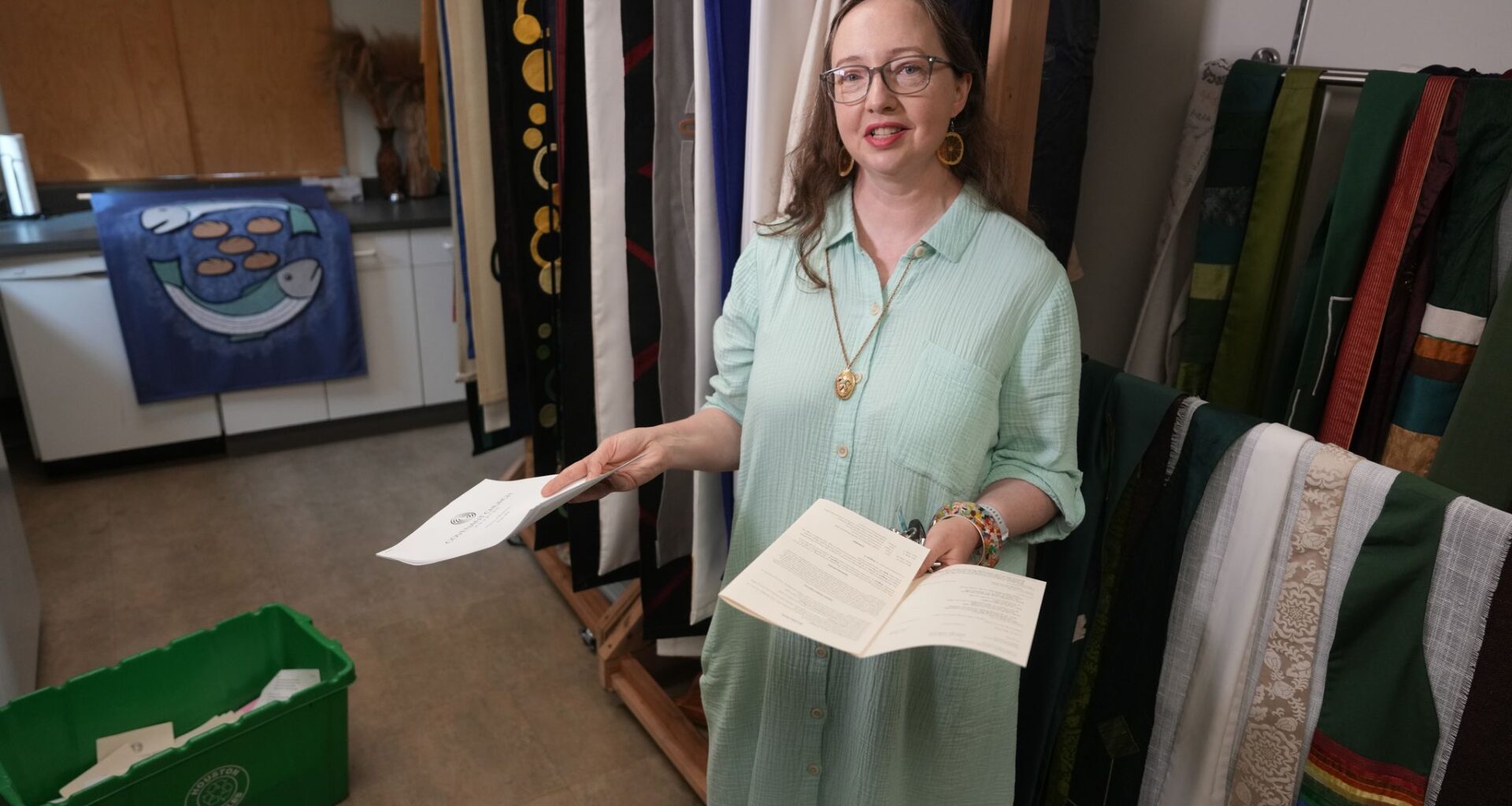
Heather Laureles, director of administration and communications at Covenant Church, holds church service bulletins as she discusses their importance and the volume of paper the church uses in Houston on Thursday, July 30, 2026. After the City of Houston discontinued its business recycling program, the environmentally conscious church began asking volunteers to take recyclable materials home for recycling.
Melissa Phillip/Houston Chronicle
Heather Laureles, director of administration and communications at Covenant Church, speaks in the church’s sanctuary, which features an organ built by Hook & Hastings in 1893, in Houston Thursday, July 30, 2026. After the City of Houston discontinued its business recycling program, the environmentally conscious church began asking volunteers to take recyclable materials home for recycling.
Melissa Phillip/Houston Chronicle
Heather Laureles, director of administration and communications at Covenant Church, holds church service bulletins as she discusses their importance and the volume of paper the church uses in Houston on Thursday, July 30, 2026. After the City of Houston discontinued its business recycling program, the environmentally conscious church began asking volunteers to take recyclable materials home for recycling.
Melissa Phillip/Houston Chronicle
Heather Laureles, director of administration and communications at Covenant Church, holds church service bulletins as she discusses their importance and the volume of paper the church uses in Houston on Thursday, July 30, 2026. After the City of Houston discontinued its business recycling program, the environmentally conscious church began asking volunteers to take recyclable materials home for recycling.
Melissa Phillip/Houston Chronicle
Heather Laureles, director of administration and communications at Covenant Church, speaks in the church’s sanctuary, which features an organ built by Hook & Hastings in 1893, in Houston Thursday, July 30, 2026. After the City of Houston discontinued its business recycling program, the environmentally conscious church began asking volunteers to take recyclable materials home for recycling.
Melissa Phillip/Houston Chronicle
Houston quietly ended a recycling program for businesses late last year, leaving organizations that chose to recycle with one less way to do so in a city that already recycles less of its waste than other major Texas cities.
Some of the several hundred organizations that relied on the program only learned the initiative had ended this summer when city crews abruptly took their green bins away – even as Mayor John Whitmire proposed a new $5 monthly trash fee that officials say will stabilize the long-troubled Solid Waste Management Department and improve trash and recycling pickup and other services.
MORE: Houston lags behind other major Texas cities in recycling. Will the new trash fee improve that?
Article continues below this ad
City officials did not commit to bringing back recycling service for businesses, some of which have turned to more expensive private service, shared dumpsters with neighbors or asked employees to haul recyclables home themselves.
Among those caught off guard was the staff of Covenant Church in the Museum District, where the recycling program helped support the congregation’s commitment to protecting the environment.
“Our church was shocked when they took our bin away,” said Heather Laureles of Covenant Church. “We have to recycle. It’s part of our Christian identity to care about social justice and be good stewards of the Earth.”
Randy Macchi, the director of Houston Public Works who now also oversees the solid waste department, said the city ended the program in order to focus resources on residential trash and recycling services, which Houston has long struggled to deliver.
Article continues below this ad
MORE: Houston struggles with trash pickup more than other Texas cities. Here’s what 311 data shows
“Many participating businesses have since transitioned to private or self-managed recycling solutions that better meet their needs,” Macci said in a statement. “Today, the city is making significant progress in improving residential recycling and solid waste operations, with more consistent and timely service for Houston residents.”
Macchi also said business recycling was never intended to operate as a long-term service. But records show about 230 locations participated in the program at some point over a span of at least eight years
“As these improvements continue and resources become available, the city will evaluate future opportunities to support business recycling in a way that is sustainable and effective,” Macchi said.
Article continues below this ad
Houston’s recycling contractor told city council earlier this year that 42% of the materials residents place in their green bins can’t be recycled. Other major Texas cities like Austin and San Antonio report contamination rates roughly half that high.
Macchi told city council at a May budget hearing that he would return later this summer with “a much more refined set” of performance measures for waste services, but has not yet done so.
‘It was a complete surprise’
The city never publicly announced the program’s elimination, and it continues to be referenced on parts of the solid waste department’s website, though many of the links are broken.
At least some participants received letters saying the program had been discontinued on Nov. 15, 2025, and that their contracts would not be renewed, though some received that notice as late as this summer.
Article continues below this ad
Several businesses said they first learned the program had ended only after city crews took their bins away.
CITY HALL: Houston could soon require air conditioning in all rental units
“Not only was it a surprise but it was a huge hindrance,” said Joanna Covington of Believe in Dog, a pet training business in the Heights. “Because at that point going forward, we couldn’t put our recycling anywhere. All of a sudden, we had a lot of pile up.”
Believe in Dog is on a residential street and depended on the city’s curbside recycling service because it couldn’t accommodate a commercial dumpster. After the city took the shop’s recycling bin, Covington contacted 10 private recycling companies before finding one willing to provide curbside pickup — at roughly four times the cost of the city’s program.
Businesses paid the city based on the number of bins they used, records show, with many paying about $250 per year and most of the rest paying between $370 and $760 per year.
Article continues below this ad
Workers at Cutloose Hair in Montrose also were surprised when the city came to take their recycling bin. There is an apartment above the shop, but because a registered business is on the ground floor, it couldn’t qualify for a recycling bin, said manager Alexa Navarro.
“We used to recycle at least four bins worth of cardboard and paper, just for the business alone,” Navarro said. “We started to combine efforts with our next-door neighbor who has a dumpster, so now we pay him for his private company.”
Every Sunday, Covenant Church printed large-print bulletins for congregants with impaired vision and placed a recycling tray near the sanctuary doors so used bulletins could be collected after services.
Printed materials, including church service bulletins, sit in a City of Houston recycling bin at Covenant Church in Houston on Thursday, July 30, 2026. After the City of Houston discontinued its business recycling program, the environmentally conscious church began asking volunteers to take recyclable materials home for recycling.
Melissa Phillip/Houston Chronicle
Now, the church has to cut back on the amount of paper it uses and, to ensure their materials are recycled, staff began loading their cars with recyclable material to put in their green bins at home.
Recycling for the church isn’t just a service — it’s a spiritual obligation.
“When we reduce our consumption, recycle, focus on renewable resources, work for safe and life-giving living conditions for all, and many other forms of ecojustice, we are doing the work of God in the world: the work of loving, tending, caring, stewarding,” said Senior Minister Laura Mayo. “Caring for the Earth is deeply spiritual.”