

A research team led by Texas Tech’s Lauren Locklear explores how gratitude spreads
from leaders and impacts the workplace culture.
CREATORS

A little gratitude can go a long way.
Just how far workplace gratitude can go is at the center of a new paper by Lauren Locklear, assistant professor of management at the Jerry S. Rawls College of Business at Texas Tech University.
Locklear co-wrote the paper with Meghan Kane, her former mentee who is at Temple University,
and Mark Ehrhart, her former mentor who is at University of Central Florida.
“We call ourselves “Team Gratitude,” Locklear proudly said.
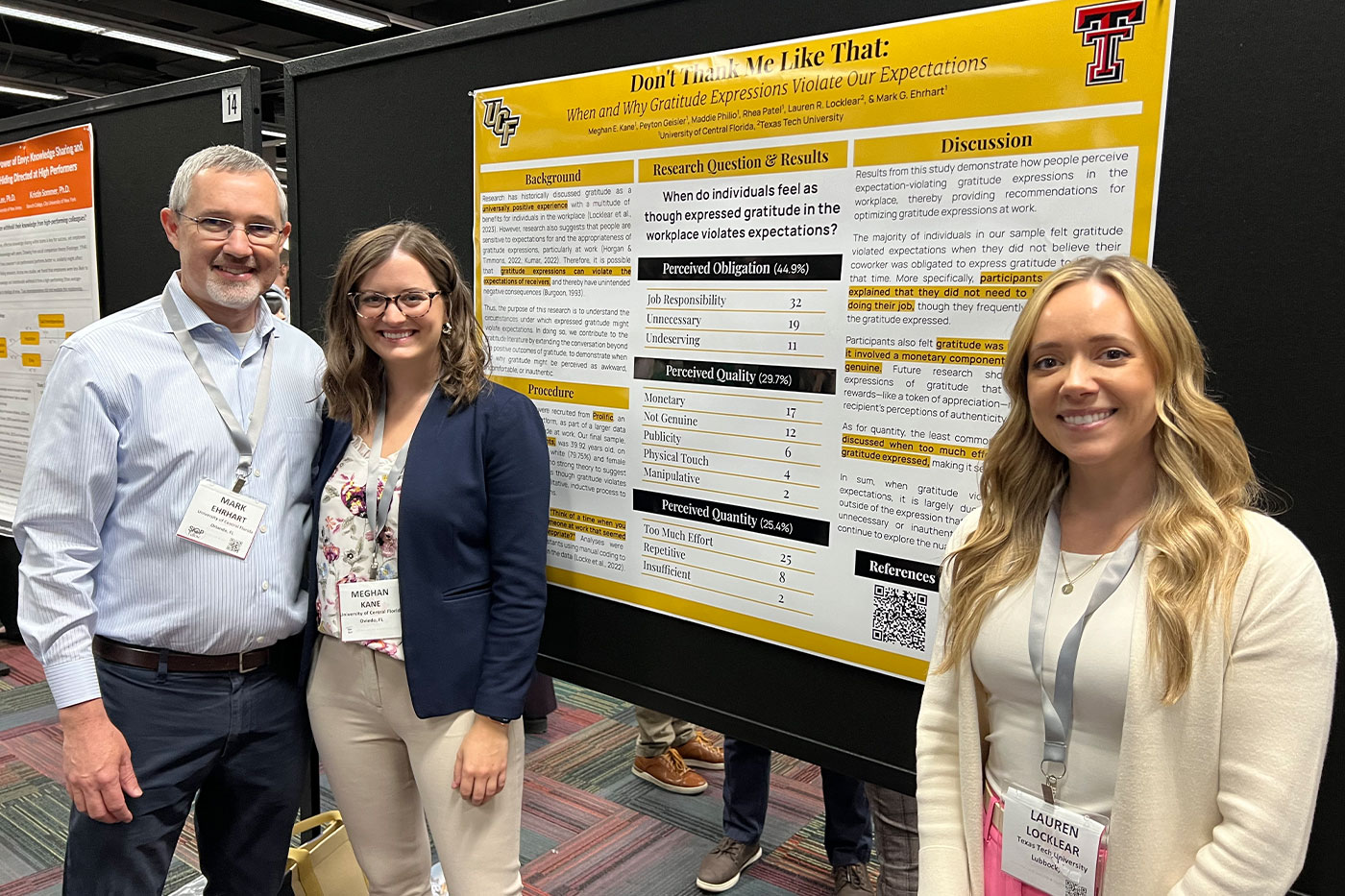 Mark Ehrhart, Meghan Kane and Lauren Locklear
The article is titled “Grateful Leaders and Attentive Followers: How Grateful Attention Transmits the Cascade
of Gratitude Expressions to Strengthen Coworker Relationships,” and it appears in a recent issue of the Journal of Applied Psychology.
Over the course of three studies, the team examines and demonstrates how an act of
gratitude from a leader can inspire a middle manager to express an act of gratitude
to a subordinate.
“Gratitude has a more systemic impact compared to workplace rudeness,” she said. “It
can also act as a kind of antidote to uncivil, gossiping or ostracizing work behaviors.”
Impactful Gratitude
Locklear said the team’s goal with this research was to demonstrate how gratitude
spreads differently than other leader behaviors or expressions.
The team surveyed a sample of leaders and followers in the first two field studies.
In study one, leaders and their direct followers completed a survey every other week
for six weeks. Middle managers reported on their leaders’ behaviors and their own
expressions of gratitude.
In study two, administrative employees from a large southern university were surveyed,
and they reported on their leaders’ expressions of gratitude and their own feelings
and expressions of gratitude.
Locklear said this one-two combination allowed the team to see the cascading effect
of gratitude in study one and then focus on how gratitude spreads in study two.
Locklear and the team has termed this effect “grateful attention,” a phenomenon where
leaders’ gratitude tells employees what to pay attention to in the workplace.
Grateful attention also helps employees see positive behaviors in their work environment,
providing more opportunities for them to express their own gratitude.
The team then ran an experiment for study three that simulated the leader-follower
relationship. This would help demonstrate the impact of grateful attention across
three levels in a controlled environment.
A group of participants who were currently employed in management roles were designated
“leaders” and read an email from their hypothetical manager. The email was written
as either neutral or grateful in tone. The leaders then wrote an email to their hypothetical
follower.
The team found that when leaders received messages with gratitude, their messages
to followers were more likely to contain gratitude.
Those messages were then randomly assigned to a group of employees who acted as “followers”
who then wrote their own follow-up emails.
The same pattern of gratitude expressions begetting gratitude expressions appeared
once again.
“There’s this cognitive element of gratitude that we unpack,” she said. “In the workplace,
our attention is being pulled in many directions, so gratitude allows a spotlight
to be put on the generosity of others at work. Instead of seeing someone helping you
just as them doing their job, you suddenly see it as something to be grateful for.”
 Lauren Locklear (Photo Credit: Bryce Hutson, Rawls College of Business)
Authentic Gratitude
For leaders looking to foster grateful attention in their workplace, Locklear suggests
they keep things simple.
For example, prioritize the “you” in “thank you.”
“A good way of doing that is expressing a thank you that explains exactly what that
person did as opposed to how it helped you,” she said. “It’s not just like, ‘Hey,
thanks for your help on that task; it saved me three hours in Excel.’ It’s, ‘Thank
you for sharing your Excel knowledge with me. I really appreciate you taking that
time.’”
Leaders should be intentional about setting time aside to express their gratitude.
They could block out time in their individual schedule or set aside time for gratitude
within already established meetings.
Leaders also need to ensure grateful expressions are done in a timely manner.
“If you tell someone thank you for a small favor three weeks later, it might fall
flat,” she said. “You want to make sure it’s done pretty quickly after the event.
We want to make sure we’re being perceived as authentic.”
Locklear stressed that being authentic doesn’t necessarily mean the grateful expressions
are done privately or in a one-on-one setting. Quite the opposite: They may have more
impact if expressed publicly, be it during team meetings, through team instant messaging
channels or simply having a gratitude board to which leaders and followers can attach
sticky notes.
As more people witness grateful expressions, the likelier it is that gratitude spreads
to other places and aspects of the organization.
What is perhaps most exciting is that Locklear is seeing grateful attention transcend
the workplace.
“I have some other in-progress work that shows when we have these grateful experiences,
we’re taking that home with us to our personal relationships,” she said. “We’re more
able to see how our family members and our partner are helpful to us and are doing
things for us. We’re then more likely to express our gratitude to them, and then our
gratitude spreads to them.”
In her own workplace, Locklear sees moments like Texas Tech’s Sharing Gratitude series
as an example of making physical space for authentic gratitude.
“By displaying the notes publicly, the gratitude board was a physical reminder and
nudge to those who passed it to think about the things they are grateful for. I think
this exercise allows for authentic gratitude because it is an opt-in model,” she said.
“In this way, the board helped to reinforce gratitude as an important aspect of Texas
Tech’s culture.”
Of course, Locklear was not shy about expressing her own gratitude for Texas Tech
and Rawls College.
“I wouldn’t be able to do this work and research without the support of Texas Tech,”
she said. “From here, it’s possible for me to ask research questions and chase interesting
topics I find inspiring.”