
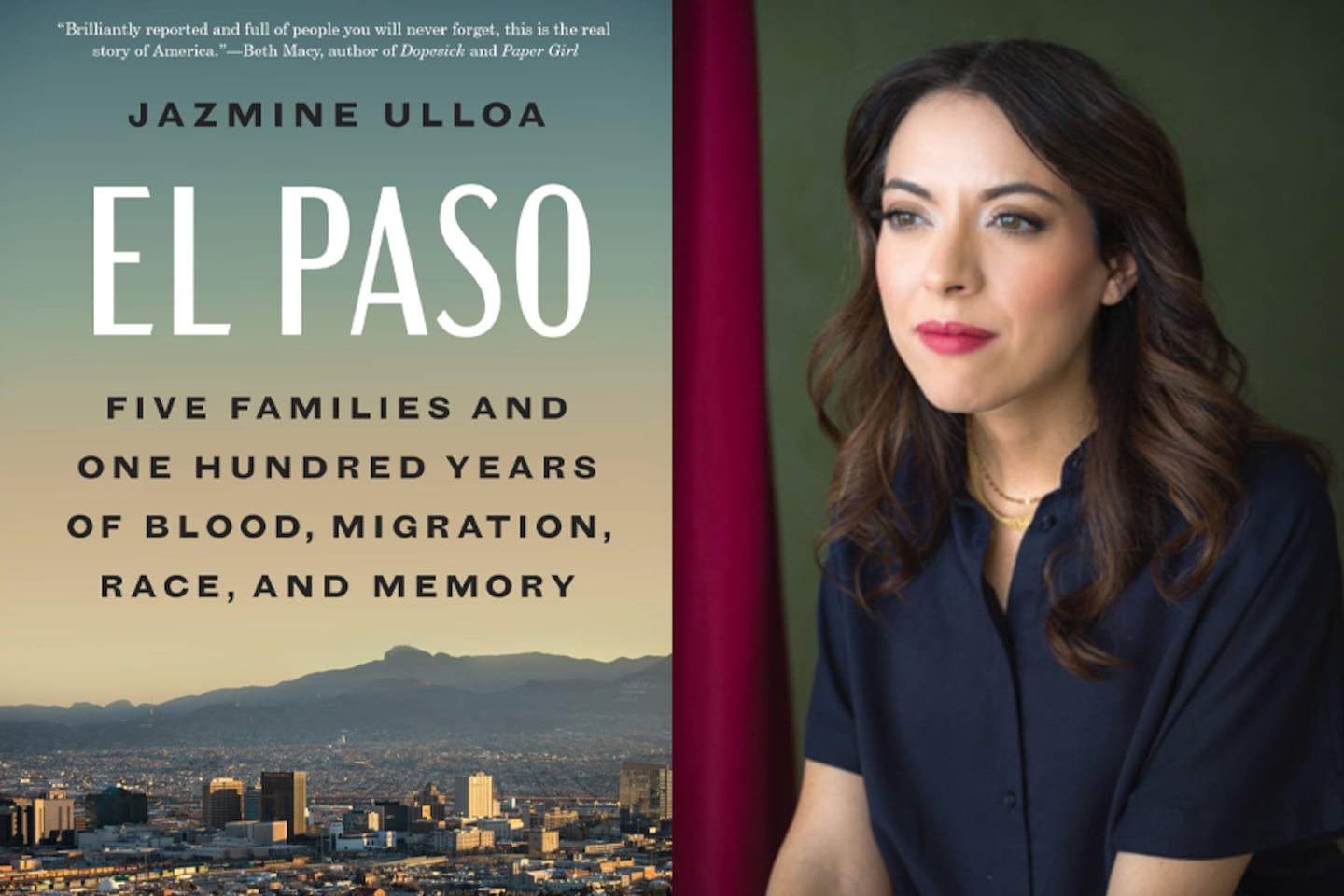
That meditation became the seed of Ulloa’s “El Paso: Five Families and One Hundred Years of Blood, Migration, Race, and Memory,” published this spring by Dutton. The book follows five families from various immigrant ancestries across a century — the Chews, the Martinezes, the Holguins, the Rubios, and the Mura’ls — to argue that El Paso, not Ellis Island, is the country’s true immigration gateway, and that the nativism behind the 2019 massacre was never an aberration but a through-line in how the US has written its immigration laws.
Ulloa’s book has earned strong reviews, including from Julia Preston, one of the most authoritative American writers on immigration. In The New York Review, Preston called the book “a panoramic, abundantly detailed history of a century of turmoil and restless migratory movements gravitating around El Paso.”
I spoke with Ulloa, now a national immigration reporter at the New York Times, about the book, how it’s been received, and why El Paso keeps resurfacing in the news without the history to explain it. Our conversation has been edited for length and clarity.
In the book, you write about how the country never fully contextualized the El Paso Walmart shooting. Do Americans understand what happened any better now?
Sadly, I don’t think we’ve fully contextualized that shooting. That was part of what I was trying to do with the book: resurface it and study it from a much longer lens of time.
The shooter’s manifesto used the word “invasion.” That language has become almost standard in political rhetoric. What’s it like watching words that incited a mass shooting in your hometown become so normalized?
When I was reporting on the book, that language was already becoming a common refrain, not only in political speeches out on the campaign trail, but in the halls of Congress and in state legislatures. I wanted to understand the origins of that rhetoric. Historians reminded me that this type of nativism has been central to how we’ve shaped immigration policy. Historian Erika Lee’s work in particular has been instrumental in bringing that history to light.
What strikes me isn’t just how normalized this language has become in everyday political speech, it’s how far back it stems. I found newspaper clippings of politicians decrying an “invasion” as far back as the late nineteenth century, when the US was excluding Chinese laborers under the first law in this country explicitly based on race.
What’s the one piece of history you wish every reader would carry out of the book?
I’ve been struck by how little people know about the repatriations of the 1930s, which were the first mass removals of Mexicans and Mexican Americans in the US. One chapter that I think illustrates how nativism has been integral to immigration policy goes back even earlier, to the 1920s, when border stations were retrofitted to delouse Mexican laborers. They were forced to strip down and sprayed with chemicals because they were seen as dirty, unclean, as disease carriers.
Why do you think the national immigration story is so durably attached to Ellis Island, and not to the border, specifically El Paso?
El Paso is the American city that most tells us about our nation’s immigration battles today. But it’s also become a political backdrop to those battles. We’ve had this distortion of the border for so long: if you see the border as a scary, dystopian place, it’s easier to ignore the waves of blue-collar workers, many of them Mexican and Latino, who’ve crossed for generations and helped build this country and forge the American Southwest as we know it.
You’re a former Boston Globe intern and reporter. What did working in Boston teach you about El Paso, and vice versa?
Boston is itself a hub of American immigration history — whether it’s the waves of Irish, Italian, Russian and Jewish immigration, and now Latin American immigration. During the George Floyd protests there was a lot of debate happening there about how we tell stories and who gets to tell them. That got me thinking about how I was telling the history of the border, and it encouraged me to explore my own blind spots, because we tend to think of the border only as Latino history, or Mexican history, and we overlook the diversity within that Mexicanness: its Mexican, Spanish and Indigenous origins, and its Chinese origins too.
You self-identify as a fronteriza — a word that doesn’t really translate into English. What does it mean beyond the literal, and what are we missing without an English word for that identity?
I think it describes a person who grows up between two worlds, two languages, two cultures; someone who can move back and forth easily and blend and coexist within both. Not having a word for that in English contributes to erasure, and it contributes to the lack of understanding we have about that part of the country — that we don’t see our southern borderlands as what they’ve always been: a rich, multiracial, multiethnic stomping ground where forces of white supremacy and resistance have always been at odds, and where identities can collide and collapse into each other and form new kinds of culture.
This is an excerpt from ¡Mira!, a Globe Opinion newsletter from columnist Marcela García. Sign up to get ¡Mira! in your inbox each week.
Marcela García is a Globe columnist. She can be reached at marcela.garcia@globe.com. Follow her on X @marcela_elisa and on Instagram @marcela_elisa.