
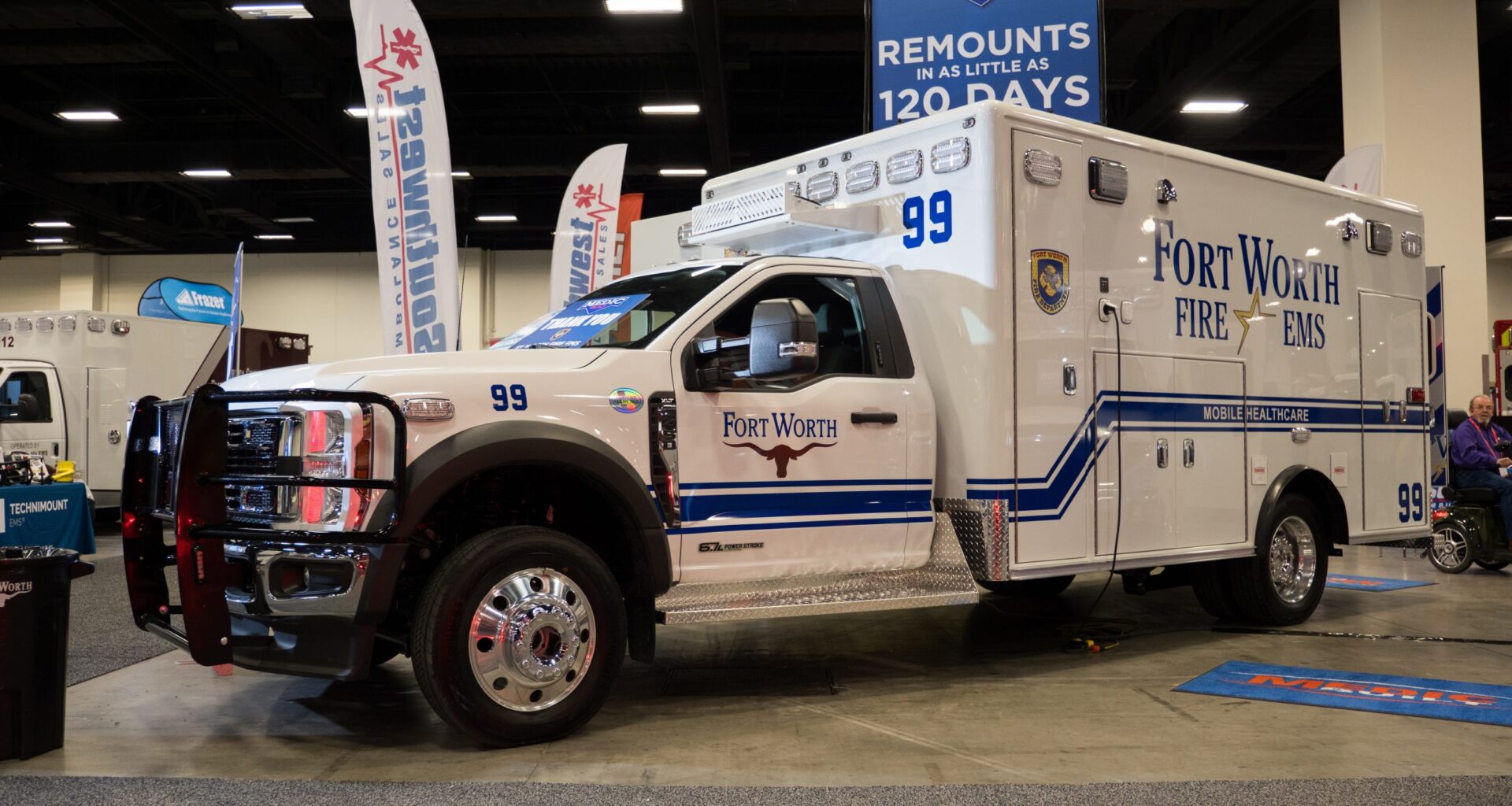
In its first year of operation as part of the Fort Worth Fire Department, the city’s emergency medical services system is operating within budget expectations, delivering consistent medical outcomes and starting to improve ambulance travel times.
Records obtained by the Fort Worth Report, which were restated at a July 16 quarterly EMS Advisory Board meeting, initially showed ambulance travel times rise dramatically during the first nine months of operation compared to MedStar.
However, over the past three months, travel times have dropped significantly, a trend officials think will continue.
Results for patients in most need of EMS resources, such as those experiencing cardiac or respiratory events, have also improved or held steady.
July 1 marked the first anniversary of the city moving EMS services from MedStar to the fire department, under an agreement with 14 other member cities.
This change was put in motion by Fort Worth City Council after the MedStar model was deemed unsustainable financially.
Travel time challenges and improvements
When the city approved the transition in May 2024, it set a goal for the new service to respond to 90% of all emergency calls within 8 minutes or less from when an ambulance starts its run until it arrives on scene.
In the first nine months after the transition, average travel time slowed to well over 11 minutes, according to data presented at the July meeting by Whitney Burr, business process manager for the Fort Worth Fire Department.
However, a significant decrease — to 8 minutes, 55 seconds — was achieved between April and June.
Burr credits a change to a 24-hour on, 48-hour off shift schedule as a key enabler of the improved performance. Previously, EMS crews operated on a schedule of seven 12-hour shifts over a 14-day period.
“The March 7 transition to the 24-48 shifts allowed us to use the number of available personnel, push them together and increase the peak-level units that are available to the system,” Burr said.
The change aligns with the schedule used for decades by the department for firefighters.
“We also had an enormous amount of recruits that were able to come out of our training program to fill that system further,” she added.
Burr said travel-time targets are within reach. “(Times) are becoming rapidly achievable, and we’re going to keep striving to meet that goal.”
Medical performance
Of the many EMS performance metrics collected by the city, three in particular are considered key to treating cardiac and respiratory emergencies.
Sustained return of spontaneous circulation, or ROSC, measures the success rate of restoring a productive heartbeat in a patient who experienced a heart attack or cardiac arrest. Data obtained by the Report shows EMS achieved 2% higher ROSC success rates than MedStar posted during its final year of operation.
Another statistic, called first-pass intubation success, measures how often emergency personnel achieve the proper insertion of a breathing tube on the first attempt. The fire department EMS team has a success rate in excess of 84%, which is equivalent to MedStar’s final-year performance.
Finally, Utstein survival rate measures the percentage of patients who experienced a cardiac arrest, had heart rhythm restored in the field and survived up to being discharged from a hospital.
Dr. Jeffrey Jarvis, the city’s EMS medical director, focused on the Utstein metric in his presentation to the EMS Advisory Board.
“This was the first time our system was above 40% in 10 to 15 years,” Jarvis said, referring to the 2025 calendar year rate. “It was a substantial accomplishment based on the amazing work that all the men and the women in the field are doing.”
Jarvis said that tracking this metric over the course of a year is necessary because of the low number of patients per month that fall into this category.
Looking at a full year of data “gives us a better idea of where we were,” he said.
EMS staffing and turnover
Shaun Curtis, the fire department’s deputy EMS officer, said the service currently employs 415 people and has 30 staff vacancies.
Over the last year, EMS experienced a turnover rate of 19%, which is lower than the national average. A 2022 study conducted by the American Ambulance Association cited a turnover rate of between 20% to 36% for EMTs and paramedics.
Curtis said the city recently hosted a lateral paramedic entry program for applicants who are already licensed and experienced, to keep pace with the turnover rate.
“We had 16 folks show up to take that test, so hopefully we can get those folks on board quickly,” he said.
Financial performance
Emily Vinson, the fire department’s EMS manager, said EMS expenditures will exceed revenues this fiscal year by $22.8 million. The shortfall will be covered by public funding from the member cities.
Because revenue collection has been better than anticipated, Vinson predicted the funding gap will be $1.7 million less than budgeted.
As the largest user, Fort Worth will contribute $18.7 million and the remaining $2.3 million will be allocated to the 14 member cities, prorated by the level of each city’s usage of emergency medical services. Final allocations will be calculated at the end of the fiscal year in September.
Fort Worth’s portion will be allocated to the city’s general fund.
EMS member cities
In addition to Fort Worth, member cities served include:
Blue Mound
Edgecliff Village
Forrest Hill
Haltom City
Haslet
Lake Worth
Lakeside
Richland Hills
River Oaks
Saginaw
Sansom Park
Westover Hills
Westworth Village
White Settlement
In other business, interim fire chief and board chair Raymond Hill led a vote to accept the withdrawal of Lakeside from the list of EMS member cities effective Sept. 30. The action was unanimously approved. Hill did not mention how Lakeside will receive EMS service going forward.
Doug Wilhelm is a member of the Fort Worth Report Documenters crew and a freelance writer.
At the Fort Worth Report, news decisions are made independently of our board members and financial supporters. Read more about our editorial independence policy here.
This <a target=”_blank” href=”https://fortworthreport.org/2026/08/07/a-year-in-fort-worth-ems-shows-improving-response-times-steady-performance/”>article</a> first appeared on <a target=”_blank” href=”https://fortworthreport.org”>Fort Worth Report</a> and is republished here under a <a target=”_blank” href=”https://creativecommons.org/licenses/by-nd/4.0/”>Creative Commons Attribution-NoDerivatives 4.0 International License</a>.<img src=”https://i0.wp.com/fortworthreport.org/wp-content/uploads/2021/04/cropped-favicon.png?resize=150%2C150&ssl=1″ style=”width:1em;height:1em;margin-left:10px;”>
<img id=”republication-tracker-tool-source” src=”https://fortworthreport.org/?republication-pixel=true&post=716088&ga4=2820184429″ style=”width:1px;height:1px;”><script> PARSELY = { autotrack: false, onload: function() { PARSELY.beacon.trackPageView({ url: “https://fortworthreport.org/2026/08/07/a-year-in-fort-worth-ems-shows-improving-response-times-steady-performance/”, urlref: window.location.href }); } } </script> <script id=”parsely-cfg” src=”//cdn.parsely.com/keys/fortworthreport.org/p.js”></script>