
At the Fall 2025 Coogs for Energy Hackathon, Team Energy Drinkers, comprising Cindy
Yang, Harper Jones, Elijah Clark, Emily Perez, Noah Hawver, and Jonathan Cummins,
received the $3,000 second-place prize for their proposal addressing the problem statement
“Green Corridor Transit Hub Innovation.” Presented by the FIFA World Cup 2026 Houston
Host Committee’s Sustainability team, the problem statement challenged the students
to redesign Houston’s transit hubs along the Green Corridor that links NRG Stadium,
Downtown, and EaDo. The aim was to improve comfort by regulating temperatures and
reduce environmental impact. This will be crucial as the city gets set to welcome
soccer fans from all over the world in 2026.
Recognizing the corridor’s vulnerability to heat, inadequate shading, and insufficient
waste diversion, the team developed a thoughtful, integrated concept to transform
high-traffic public spaces into energy-efficient and culturally engaging community
assets that will continue to serve Houstonians for years to come.
The Energy Drinkers proposed a set of practical and scalable solutions centered on
sustainable energy, cooling, circularity, and community storytelling. They featured
hybrid-powered outlets and display stands at stations along the transit hub, which
will provide both functional power and long-term value.
To combat heat exposure, they proposed incorporating relatively low-cost water stations
and cooling fans at stations. To tackle Houston’s flooding challenges, the team added
nature-based solutions such as wildflower beds and bioswales, expected to be both
visually appealing and economical, in their proposed design. Their plan also included
using murals by local artists along the transit hub to provide community identity.
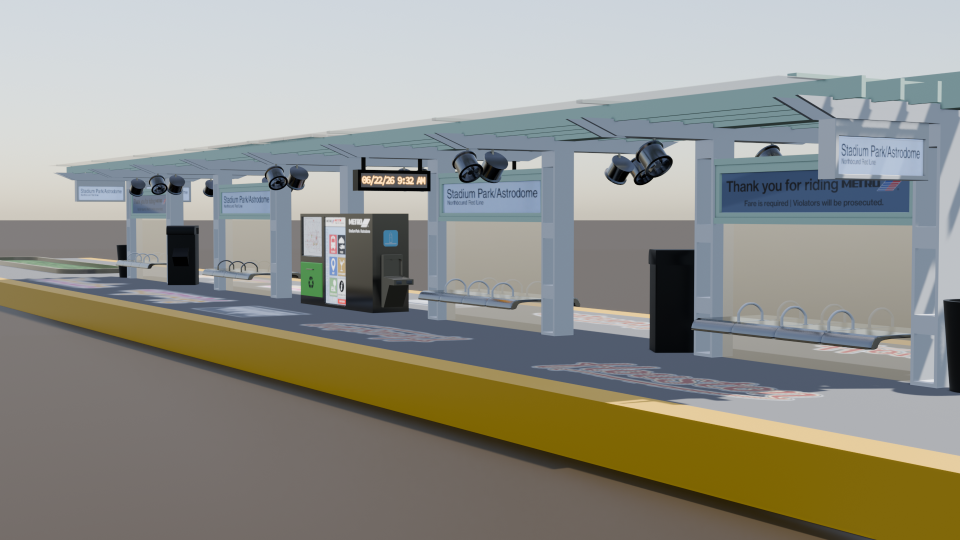
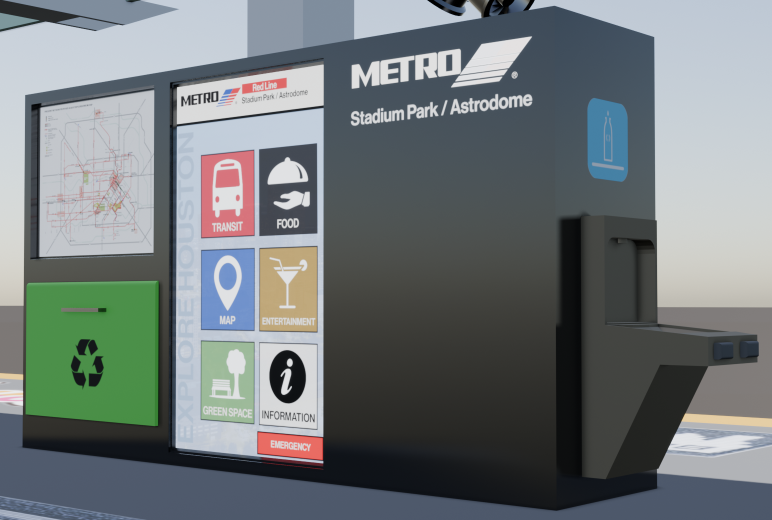
Energy Drinkers’ Digital Prototype of Revamped Stadium Park Station and State-of-the-Art
Info Board
The team’s prototype brought their vision for a re-energized transit hub to life.
They showcased a digital model of a fully upgraded Stadium Park Station featuring
cooling fans, water stations, Houston-inspired murals, wildflower beds, LED information
boards, and recycling infrastructure. Their business model outlined a plan to fund
the upgrades through a mix of city support, advertising revenue, and excess solar
power sales.
Speaking on his team’s win, Jonathan Cummins, an undergraduate student in computer
science said, “We’re extremely proud of the work we’ve done. Hearing the feedback
from the panel saying that they were excited to see [our project] implemented as we
go forward towards the World Cup really means a lot.”