
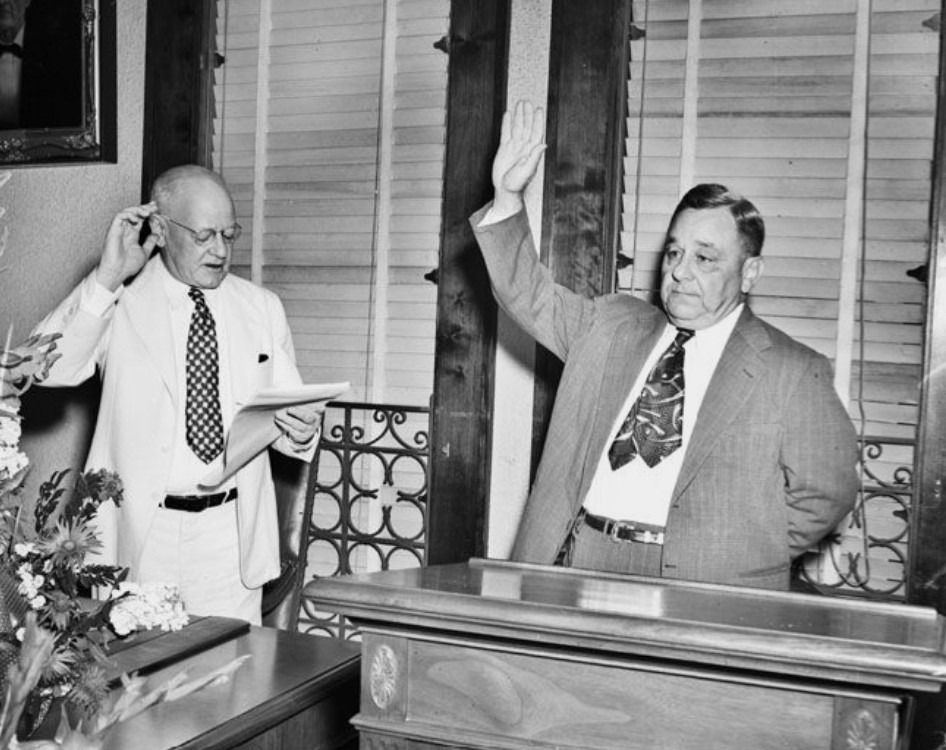
Judge R.W.B. Terrell (left) administers the oath of office to San Antonio Mayor Alfred Callaghan on June 1, 1947, in the Council Chamber at City Hall. For more than 20 years, Terrell presided over the 73rd and later 37th District Court in Bexar County, handling both civil and criminal cases.
UTSA Special Collections
R.W.B. “Bob” Terrell, his wife Constance and their son, Robert Jr., enjoyed a vacation in July 1939 at Port Aransas. This was the year before Mrs. Terrell filed for divorce.
UTSA Special Collections
District Court Judge R.W.B. Terrell is seated in his courtroom. He was a judge from 1920 until his death in 1948, with a few years out for private practice.
UTSA Special Collections
In this undated photograph, Judge R.W.B. Terrell was in his office in the Bexar County Courthouse.
UTSA Special Collections
I’m a grandson of Constance Ball Terrell, who died in the 1950s. At the end of her life, she lived in Terrell Hills, but I have no knowledge of which Terrell was her spouse and how she and he fit in with the rest of the Terrells, of which there seem to be many. My vague recollection is that divorce may have interfered with any camaraderie with the extended Terrells. Any sources you could offer would be helpful.
– James B. Smith Jr.

Since a couple of columns about the history of the Terrell Heights neighborhood appeared June 27 and July 4, readers have sent queries about other people and places associated with that prominent family.
Article continues below this ad
Your grandparents were Robert Weakley Brahan Terrell (1889-1948) and Elizabeth Constance Ball (1896-1962). In public life, he styled himself R.W.B. Terrell; while she always went by her middle name. They were married from 1922 until 1944, and shared a son, R.W.B. Terrell Jr., and a daughter, Constance Ball Terrell (later Smith).
About those “extended Terrells”…they covered the Earth, at least in the American South.
According to Terrell Genealogy by Emma Dicken, published in 1952 by the Naylor Co. of San Antonio, the first of their line was Anterior, King of Cimmerians, “a people inhabiting the shores of the Sea of Asao, now known as the Crimea. Lived before Christ, year 443.”
The surname emerged around the year 1000 in Amiens, France, with nobleman Ralf de Tirel. Some 150 years later, the family turns up in England as Tyrrell. Many are knighted; there are descendants of Charlemagne and intermarriage with the Plantagenets, an English royal house.
Article continues below this ad
The first to arrive in what became the United States was Richmond Terrell in 1656 at New Kent, Virginia. The family gets a strong foothold there; fruitful and prosperous, they practically aerosolize their DNA throughout the American South.
As the genealogy says, “There are now numerous Terrell families scattered throughout almost every state in the union. We find a number of towns and some counties bearing the name, which suggests that the men from whom they were named were honored citizens of the communities in which they lived.”
Most Terrell men seem to have been community kingpins – Army officers, clergy, doctors, judges, merchants, legislators and other government officials.
The Terrells most relevant to you and to San Antonio history are those who had migrated from Kentucky to Indiana before descending on San Antonio.
Article continues below this ad
The first was Charles Milton Terrell (1832-1904). Originally from Columbus, Indiana, C.M., as he was known, was a career Army officer. He served as a paymaster through the Civil War and was ordered to Fort Sam Houston in 1868. After assignments elsewhere, Terrell returned to live in San Antonio, where he invested in real estate. According to his obituary in the San Antonio Express, Nov. 23, 1904, he “left a comfortable fortune to his widow.”
C.M. Terrell and his wife Sallie Speake had four children, including Dr. Frederick Terrell, namesake of Terrell Hills, the north-of-downtown municipality, and Terrell Wells, the South Side community. Another son was Judge Henry Terrell (1860-1931), who had three children with his wife Kate Rivers Brahan, including Robert W.B. Terrell.
“Bob,” as he was called, was a district court judge apart from some time as an attorney in private practice. He first was elected in 1920 – at 31, one of the state’s youngest judges – and married Constance Ball, then 24, on July 5, 1922.
Article continues below this ad
His bride was the daughter of attorney/banker Robert Lee Ball, board chairman of the National Bank of Commerce at the time of the young couple’s engagement announcement in the Express, April 30, 1922.
Constance had made her debut in 1916 “at one of the most elaborate functions ever given in this city,” says the San Antonio Evening News, Jan. 22, 1919. She served as athletic director of the Ogontz School near Philadelphia – a finishing school she had attended – for the second half of the 1918-1919 school year. As of the 1920 U.S. Census, she was living with her parents at 340 West Kings Highway; no occupation recorded.
R.W.B. Terrell presided over many divorce cases during his judicial career. From the 1920s through the ’40s, divorce became more common. Along with other jurists, Terrell often was asked by newspaper reporters what couples should do to avoid it. He cautioned against marrying too young or without enough money, or before getting well-acquainted with each other. He advised readers of the San Antonio Light, July 21, 1946, that “most couples could solve a lot of problems if they would join a church and become Christians” and avoid alcohol.
By that time, the judge himself was divorced. He and Constance were still reported as living together in the 1940 census, but her divorce petition, filed in 1944, said they had been separated for four years. The couple had reached a property agreement and agreed that Mrs. Terrell would be guardian of their children, Constance, 19, and Robert, 16.
Article continues below this ad
Shortly after their divorce became final, R.W.B. Terrell remarried Ilse Staffel Meyer, ex-wife of George Meyer, a beer salesman.
RELATED: Terrell Hills Chittim estate
Terrell was in the middle of a re-election bid when he died July 22, 1948, having suffered from cirrhosis of the liver. The judge had collapsed at a campaign function in Comanche Park in April 1948, took two weeks off, “then returned to the courthouse … fighting off ill health,” says the Express, July 23, 1948.
He then “went ‘on vacation’ in recent weeks, appearing at his court periodically to carry on essential duties.” Terrell’s condition worsened, “relatives” told the paper, “until he could neither eat or sleep.”
Article continues below this ad
His will was filed for probate July 27, 1948. The estate was estimated at $25,000, with half to go to the widow, Ilse Staffel Terrell, and the rest to be divided between the Terrell children. The executor was Ilse’s brother, Heino Staffel. The deceased’s brother, Gen. Henry Terrell, waived his right as coexecutor.
As of the 1950 census, Constance B. Terrell, was living at 530 Garraty Road in Terrell Hills and working 42 hours a week as a hospital bookkeeper. She worked first for M&S (Medical and Surgical) Hospital and later for Grace Lutheran Hospital (covered here July 27, 2024).
Constance Terrell, who never remarried, died at age 66 at Grace Lutheran Sanitarium. Her cause of death was malnutrition, which probably means she had a serious illness not listed on the death certificate.
Her funeral, like her ex-husband’s, was held at Christ Episcopal Church.
Article continues below this ad
The second Mrs. Terrell remarried and became Ilse Staffel Kimberley not long after Judge Terrell’s death, but it doesn’t seem to have lasted — she went by Ilse Staffel Terrell by the time she died in 1983.
historycolumn@yahoo.com | X: @sahistorycolumn | Facebook: SanAntoniohistorycolumn