

President Donald Trump has criticized Texas Governor Greg Abbott’s decision to pause approvals for new data centers, calling the move a “mistake” as the state weighs concerns over the industry’s growing demands for electricity and water.
The president made the comments in a nearly hourlong interview with Punchbowl News released Friday, just days after the Republican governor ordered a pause on approvals for data centers seeking connections to the Texas electric grid, as reported by The Texas Tribune.
“I saw Texas the other day sort of is against data centers,” Trump said. “I think it’s a mistake. And I’m not taking positions, I just think it’s a mistake, because there are other communities that want it. When a community wants it, it means a lot of money is going to come into that community.”
Read More on Politics
He later described data centers as “tremendously important for the economics,” adding that the industry “could be bigger than oil” for Texas.
Data centers have become a growing source of concern in communities across the country. Facilities supporting cloud computing and artificial intelligence (AI) require large amounts of electricity and often significant quantities of water for cooling. Critics have also raised concerns about noise, pressure on power grids, rising electricity costs, and the environmental impacts associated with meeting growing energy demand.
Newsweek contacted Abbott on Saturday via email for comment.
Abbott Orders Data Center Audit
On Monday, Abbott announced that Texas would halt approvals for proposed data centers seeking connections to the state grid while regulators conduct a comprehensive audit. The review will examine developers’ expected electricity and water consumption, cooling systems, tax incentives, ownership and efforts to mitigate impacts on surrounding communities.
Abbott said projects that fail to meet the state’s requirements should be denied connections to the grid.
Abbott’s press secretary Andrew Mahaleris told Newsweek in an emailed statement on Friday that the governor’s pause was aimed at protecting Texas’ power grid and water supply amid surging demand.
“Governor Abbott’s top priority is to protect Texans’ safety and quality of life and ensure the integrity of our power grid and water supply. Many are unaware that ERCOT [Electric Reliability Council of Texas] is tracking a more than 500 percent increase in peak electricity demand. This unprecedented growth could endanger the reliability and stability of the Texas electric grid,” Mahaleris said.
He said Texas law requires data centers to report their power and water usage, but fewer than 10 percent were in compliance.
“The Governor’s pause requires data centers to provide PUCT [Public Utility Commission of Texas] and ERCOT with the required information for them to make fully informed decisions. Simply put, Texans must come first,” Mahaleris said.
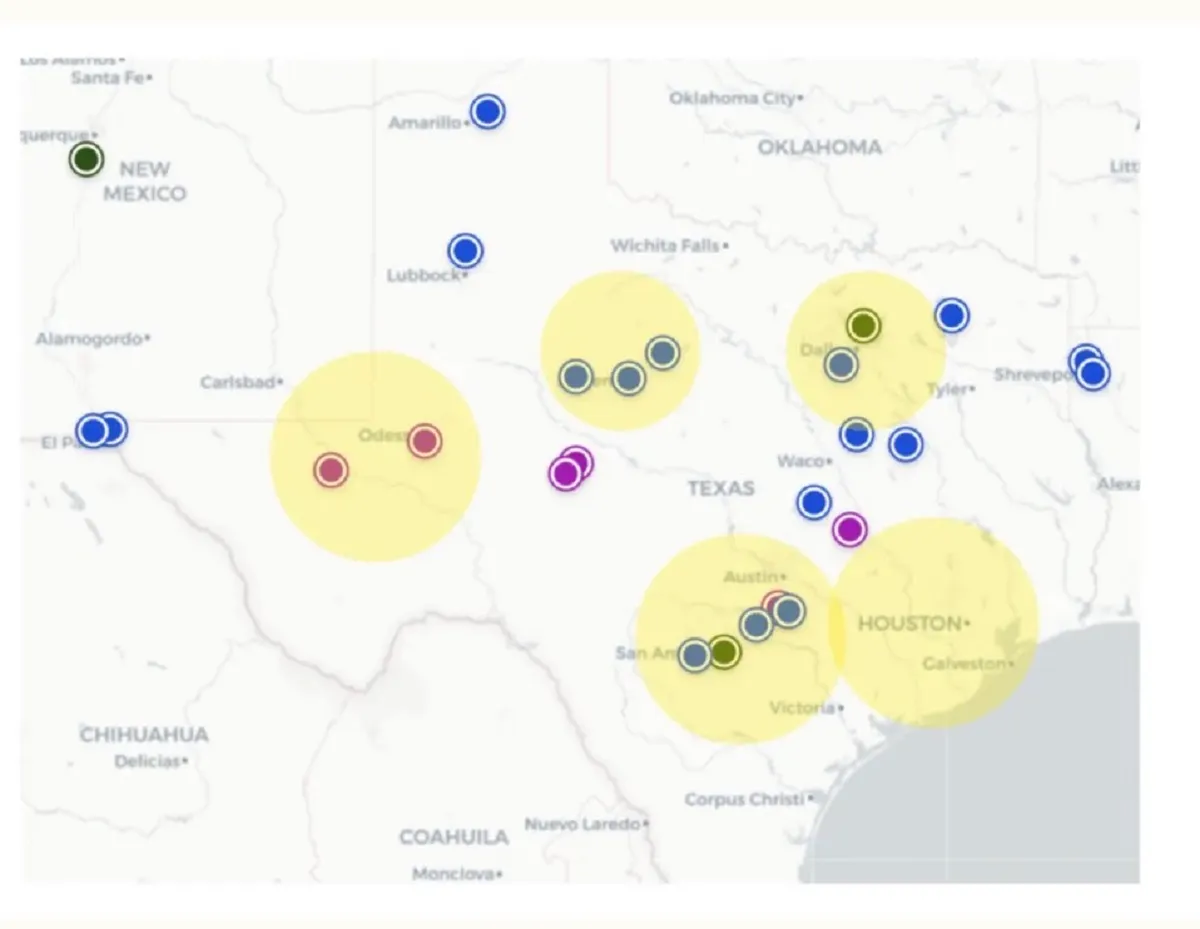 Texas Data Center Demand Surges
Texas is at the center of the AI infrastructure boom.
ERCOT’s long-term planning documents show unprecedented growth in projected electricity demand, with much of the increase linked to large-load customers such as hyperscale data centers. The grid operator has identified data centers as a major driver of future load growth, and ERCOT told Texas lawmakers in July that about 90 percent of the 474 gigawatts of large-load interconnection requests currently under review are from data center projects—which is “more than five times Texas’ record peak electricity demand for ERCOT,” Abbott wrote in his Monday letter to regulators.
Utility-submitted forecasts show large-load requests increasing from roughly five gigawatts in 2026 to more than 109 gigawatts by 2032.
For comparison, ERCOT’s all-time peak demand record is currently about 85.5 gigawatts, according to available data from the PUCT, underscoring the scale of future power needs contemplated by grid planners.
ERCOT’s latest forecasts indicate that Oncor’s service territory, which covers much of Dallas-Fort Worth, accounts for the largest concentration of projected large-load growth.
Counties including Dallas, Collin, Denton, Tarrant, and Ellis have become magnets for hyperscale campuses because of their access to transmission infrastructure, fiber networks, and available land.
Texas is also home to the proposed $1.1 billion Fort Worth Data Center Project in the Veale Ranch area. The project has already faced scrutiny from residents concerned about power consumption, water use and infrastructure impacts. City officials previously delayed consideration of a tax incentive package following public opposition.
Competing Priorities Over Infrastructure
Trump’s comments put him at odds with Abbott over how Texas should handle the industry’s expansion, despite the governor being keen that many companies were seeking to build the facilities in the state. In November, Abbott called Texas “the epicenter of AI development” when he announced that Google made a $40 billion investment in cloud and AI infrastructure in the state.
However, the governor’s pause does not amount to a blanket ban on all data centers in Texas. It primarily affects proposed facilities seeking connections through the state’s electric grid, while some projects with their own power generation may be able to avoid the traditional grid-connection process.
During an interview with Fox News’ Night with Trace Gallagher that aired earlier this week, Trump said that “any community that turns down AI is making a big mistake because your taxes are going to go way down.”
He added: “If you own a house, it’s going to be more valuable. It’s a tremendous thing. It’s almost like there’s a campaign against data centers. But data centers, if you look at the stats, everything’s good around them.”
Sixty-three percent of U.S. voters oppose AI data centers being built in or near their community, according to a July poll by Emerson College, up 21 percentage points from when the question was last asked in December 2025.
More data will be necessary to ultimately establish what the impact of data centers on home prices will be.
At the moment, studies suggest that data centers can have two different effects at once: on one side, they may boost regional economic activity, jobs, tax revenue, and demand for housing, which can support higher home prices in the area surrounding them.
But homes located very close to a data center may face concerns over noise, visual impact, traffic, water consumption, and industrialization, which can suppress demand and eventually weigh on prices.
A lot will depend on what happens in the coming months and years. Over 1,500 new data centers are in development nationwide, according to Pew Research Center. The Berkeley Research Group gives an even higher estimate, reporting that about 3,000 data center projects are at various stages of development nationwide.
Contact Newsweek editors for this story: Matthew Robinson and Anthony Murray.