
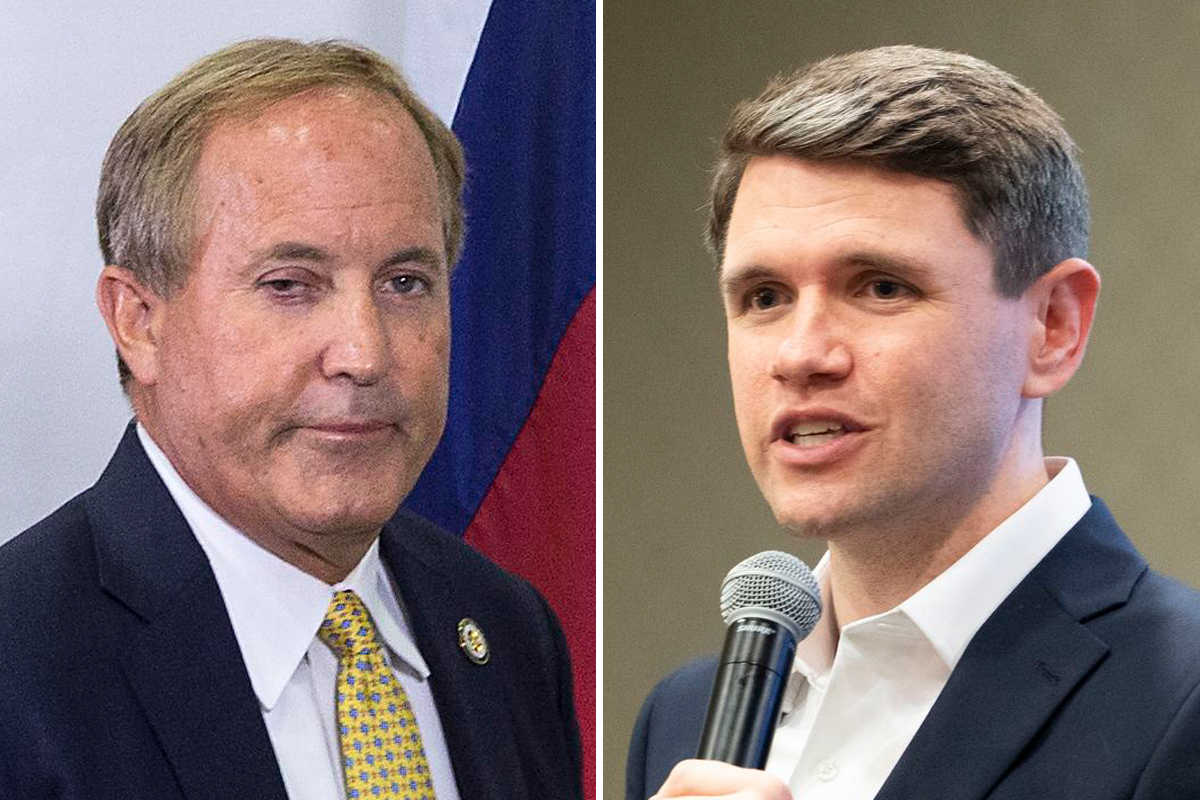
More than 30 years since a Texas Democrat held a statewide office, several are gaining momentum in this fall’s election, led by state Rep. James Talarico’s 4-point lead over Republican Attorney General Ken Paxton for U.S. Senate, a recent poll shows.
A poll conducted by the the Texas A&M Bush School and ReconMR, a Texas-based research institute, found that in the race for governor, Democratic state Rep. Gina Hinojosa is just 1 point behind GOP incumbent Greg Abbott, and for lieutenant governor state Rep. Vikki Goodwin has a 2-point lead over Republican incumbent Dan Patrick.
The poll surveyed 619 likely voters July 27-30, asking participants how they feel candidates for statewide positions would handle issues ranging from affordability and water supply to immigration and the Iran War. The results have a margin of error of plus or minus 4.7%.
Talarico’s lead of 47-43% over Paxton is a shift from a tied race in June at 46-46%. He is leading voters in Austin and the Dallas-Fort Worth area, but the Houston and San Antonio areas are closely split. In rural areas, Paxton is in the lead, the poll found.
It also found voters had more confidence in Talarico’s ability to keep prices affordable (51-38%), handle the war in Iran (50-39%), keep Texans safe (50-43%) and manage the state’s water supply (49-39%). Voters had a slight bit more confidence in Paxton’s ability to secure the border with Mexico, at 48-44%.
The poll revealed that the race for governor has gotten tighter. Hinajosa is just one point behind Abbott in the recent poll, 46-45%, after trailing 49-43% in June.
“The governor’s race looks much more competitive than it did in June, suggesting that Democrats could have opportunities in several statewide contests,” Texas A&M Professor of Political Science Kirby Goidel said in a news release.
Patrick is facing tough competition from Goodwin, his lesser-known Democratic opponent, who held a 2-point lead on Patrick in the recent poll. Goodwin’s lead among independents has doubled since June, from 9 points to 18, the poll found.
Goodwin’s lead suggests “many voters are making decisions based primarily on the broader political context and party cues rather than the candidates themselves,” Goidel said.
Goidel said, however, the races are far from over.
“As the campaign unfolds and voters become more familiar with the Democratic candidates, and weigh the candidates’ stances on the issues, the dynamics of the race could shift considerably,” Goidel said.