
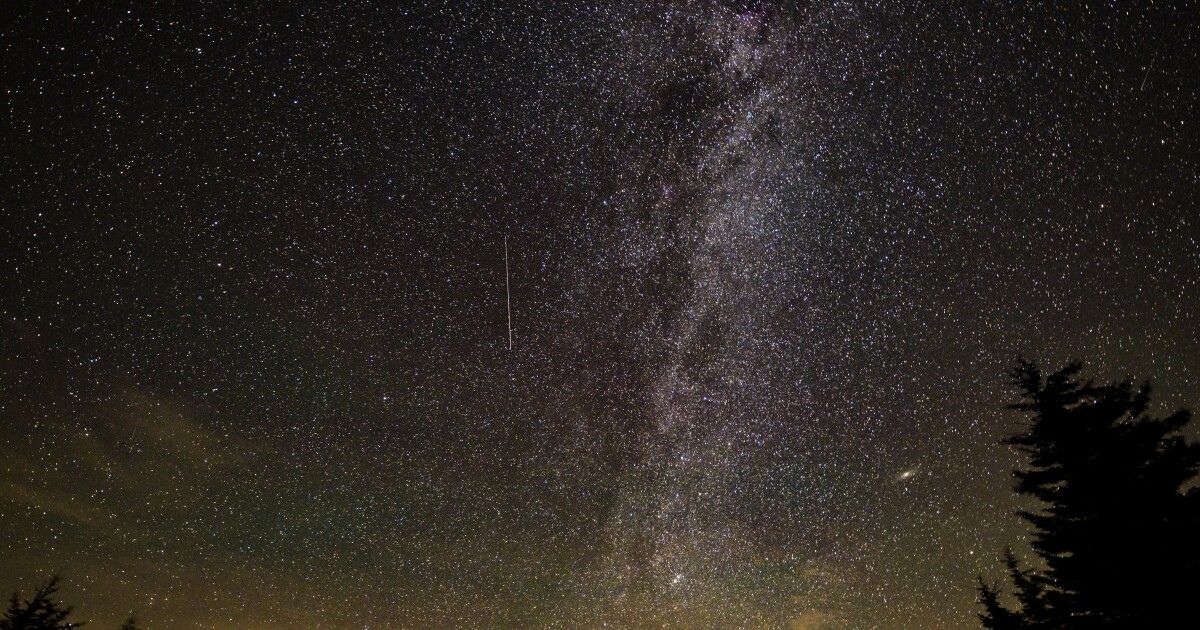
One of the best meteor showers of the year will reach its peak overnight Wednesday into Thursday. If you haven’t stayed up to watch the Perseids before, you’ll have an especially good opportunity this time around. The peak aligns with a new moon, allowing for “ideal” visibility against a dark sky, according to NASA.
The Perseids are popular because they produce lots of meteors — as many as 60 to 100 per hour during the peak, said Lara Eakins, senior program coordinator at the University of Texas at Austin’s Department of Astronomy. The meteor shower is also known for fireballs, brighter meteors that are easier to spot in the sky. And because it takes place in the summer, viewers can be outside late at night without getting cold.
The meteors are formed from space debris left by the Swift-Tuttle comet. As the Earth passes through the cloud of debris in its orbit, the particles burn through the atmosphere and create the streaks of light known as meteors.
“These meteors are actually the size of a grain of sand,” said Nielsa Rose Lachapelle, outreach chair for the Austin Astronomical Society.
Eakins, who has watched the Perseids at Enchanted Rock, said it’s a great experience to share with other people.
“You’re just laying there and all of a sudden this cool streak just goes across, and then maybe 30 seconds or a minute later, another one goes across,” she said. “It’s like nature’s fireworks.”
How to get the best view around Austin
The Perseids are active for around a month, so you can already catch some meteors now and continue to see them after the peak. But your best bet for observing the greatest number of meteors will come after midnight on Wednesday and before dawn on Thursday, as the Earth passes through the densest part of the comet debris, Eakins said.
The Perseids are named after the constellation Perseus because the meteors appear to originate from it. But you don’t need to focus your eyes just on the constellation, Eakins said. The meteors can emerge across the sky.
You also don’t need equipment like telescopes or binoculars — just your eyeballs and a dark sky. That means getting away from the city and its ever-present shining lights.
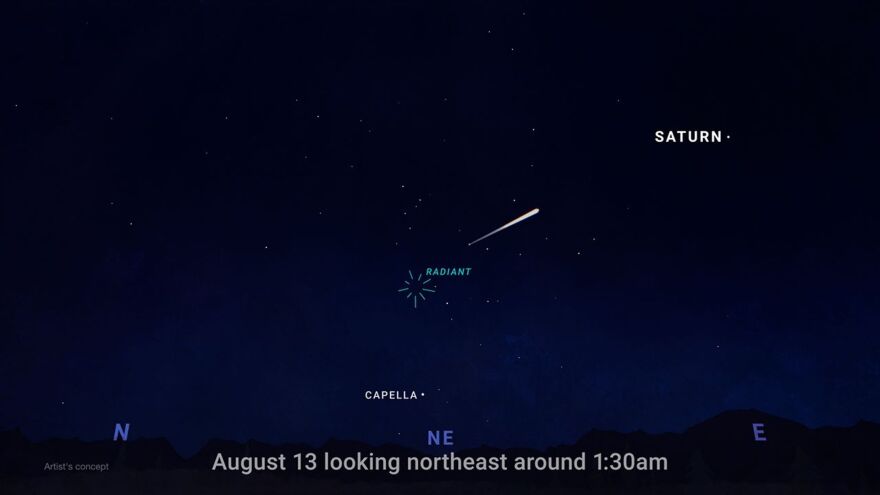
NASA recommends looking northeast, toward the constellation Perseus, then letting your eyes wander.
Lachapelle recommends traveling to a town or park that’s been certified by DarkSky International for protecting against light pollution. In the Austin area, that includes Liberty Hill, Bee Cave, Jonestown, Dripping Springs and Wimberley. If you can’t go far from the city, try looking for the darkest area you can with trees that can block some of that light.
Once you’ve picked a spot, you’ll want to give your eyes half an hour to adjust to the darkness. That means avoiding any additional light sources from cars, flashlights or phones, or switching to red light to preserve your night vision, Lachapelle said.
Don’t forget to bring water, snacks, bug spray and a comfortable chair.
“This is not an event that you’re going to spend 15 minutes at,” Lachapelle said. “This is something that you’re probably going to want to spend a few hours sitting and watching.”
Throughout the year, the Austin Astronomical Society hosts star parties that are open to the public. While the nonprofit doesn’t have an event tied to the peak of the Perseids, it’ll host Austin Under the Stars at St. Stephen’s Episcopal School on Saturday from 7:30 to 11:30 p.m., while the meteor shower is still active.
What other astronomical events can you see in Austin?
The Perseid meteor shower garners a lot of fame, but it’s just one of many celestial events that Austinites can look forward to this year.
A partial lunar eclipse will take place across the U.S. on the night of Aug. 27, causing the moon to darken and redden. You can observe it in the Austin area from around 9:30 p.m. until just before 1 a.m. the next day, Eakins said, with the maximum eclipse happening at 11:12 p.m. You don’t need special eclipse glasses — lunar eclipses are safe to view with just your eyes, according to NASA.
Saturn will be at opposition on Oct. 4, meaning it will be opposite the sun from Earth. “When the sun sets, Saturn will be rising, which means it’s at its roughly closest to us, so its biggest and brightest,” Eakins said. This will kick off a period of being able to see Saturn more easily in the early evenings this fall.
If you miss the Perseids, don’t worry: August won’t be your last chance for meteor showers. The Leonids meteor shower will peak in mid-November, with the Geminids following up shortly after in mid-December.
Find a longer list of things you can see in the sky in the upcoming months on NASA’s website. You can also listen to StarDate, an astronomy radio segment from UT Austin’s McDonald Observatory, on the program’s website.