
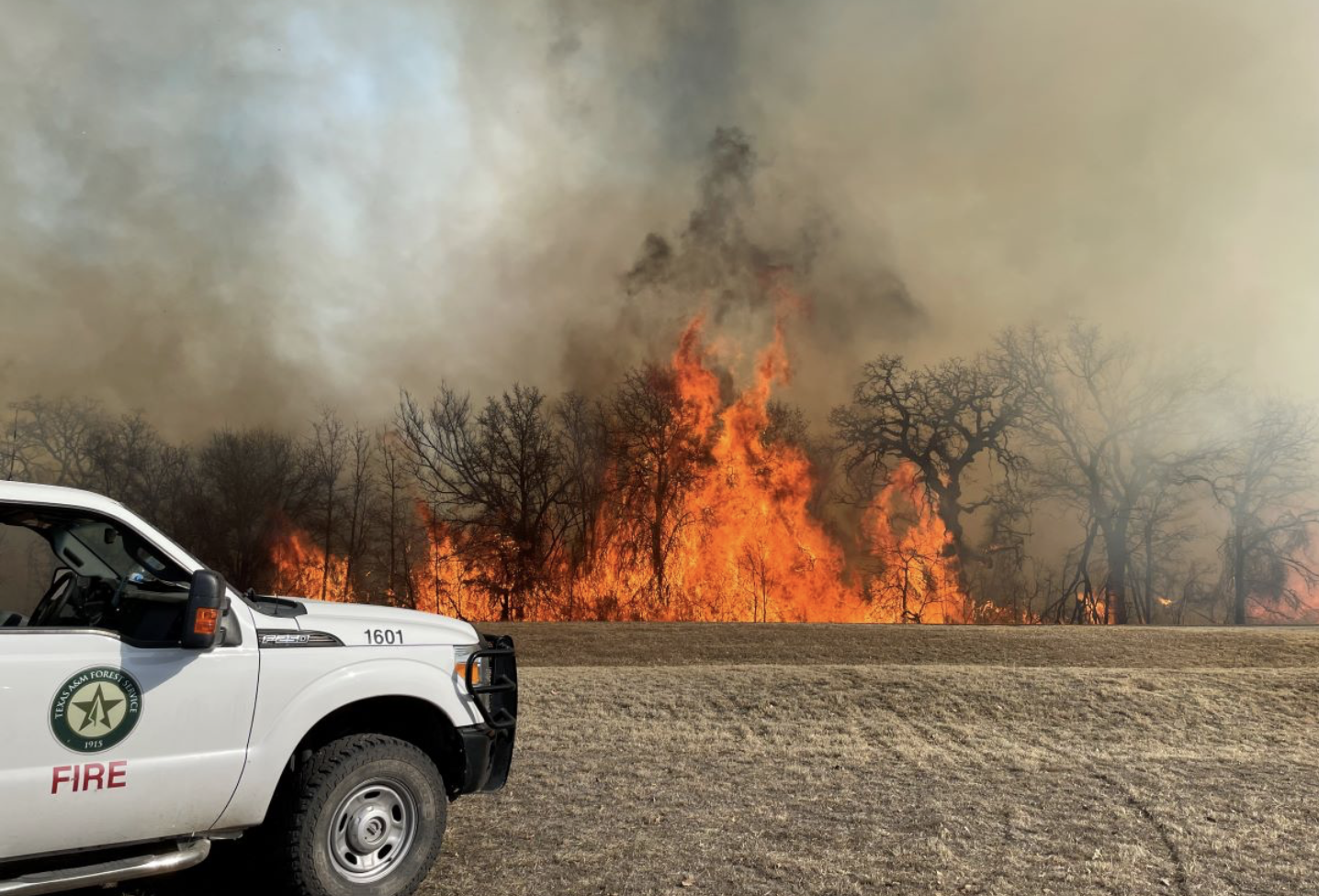
Austin officials are urging residents to prepare for wildfires before the next blaze threatens the city, emphasizing home assessments, evacuation plans and early detection as development expands into fire-prone areas.
This call to action came during a wildfire preparedness symposium last week at City Hall, where local, county and state officials outlined the region’s wildfire risks and steps residents can take to protect their homes and communities. The City of Austin led the symposium in collaboration with the Austin Area Firewise Alliance and Austin Fire Department (AFD).
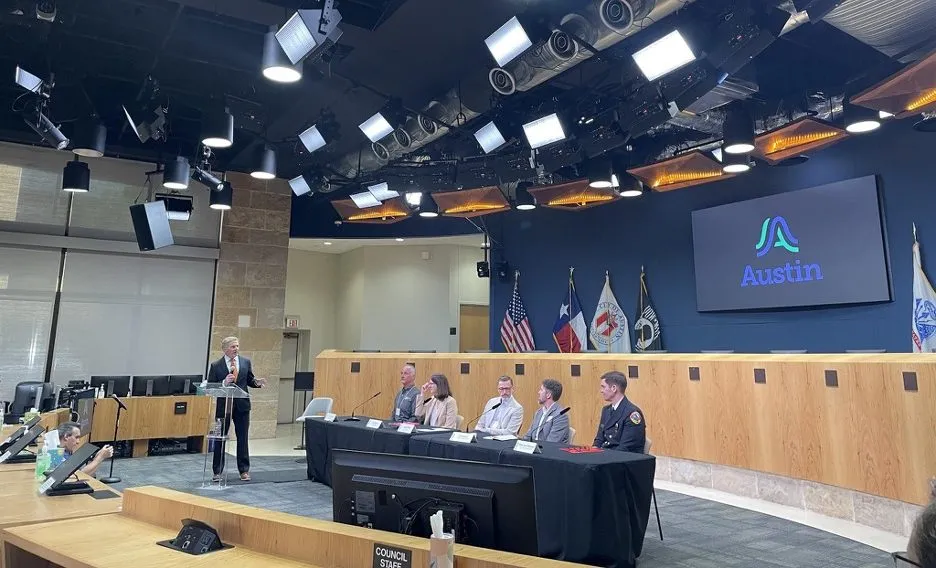 City and county officials address preparedness during a panel moderated by Austin Area Firewise Alliance board president Fred Richardson.
Credit: Piper Guinn
Wildfires have consumed more than 6 million acres this year in the U.S. alone. “Everything is burning across the Northern Hemisphere,” said Fred Richardson, president of the Austin Area Firewise Alliance board. “We know it’s a question of not if but when we see fire again” here.
The symposium featured two panels — one on community preparedness, the other on wildfire response and recovery. Richardson told the crowd that although Austin and Travis County have plans to address wildfires after they occur, more work must be done on preparedness and prevention.
Speakers included representatives from city utilities and public health officials, as well as Travis County Emergency Services, the Texas Division of Emergency Management, Texas A&M Forest Service, the International Code Council and Pano AI, a wildfire early detection technology.
Thanking local fire and emergency management staff present, Austin Mayor Kirk Watson said, “I frequently get asked, ‘What keeps you awake at night?’ And right at the top of that list is wildfire preparedness.”
Extreme weather events in the Austin area — the 2011 Labor Day fires, winter storms in 2021 and 2023 and Hill Country flooding the past two summers — alerted Watson to an urgent need for disaster preparation, he told the crowd. Changing weather patterns also affect vegetation, creating wet and dry cycles that build up trees and plants, which can become kindling.
“It’ll rain for a while and everybody will think, ‘We’re at less risk for wildfire because the ground has been damp.’ But (that) grows a lot of fuel,” Watson said, underscoring how alternating floods and droughts lay the groundwork for wildfires.
Following the 2011 Labor Day fires, which burned 7,000 acres in Travis County and 34,000 acres in Bastrop County, Austin and Travis County formed the Joint Wildfire Task Force and developed a Community Wildfire Protection Plan. The plan includes a community profile, risk assessment, fuel mitigation methods and implementation strategies. City and county staff acknowledged that wildfire preparedness has historically focused on west Austin/Travis County, potentially sidelining marginalized communities in the Eastern Crescent.
High-risk Austin
Luke Ball, wildfire mitigation officer for AFD, outlined the stakes, pointing out that the Austin area has the nation’s fifth highest insurance replacement cost estimates. “If Austin had a fire in a high fire danger area, in the worst case scenario, there would be an enormous amount of economic loss,” he said.
Ball also spoke about the risk of low frequency, high-intensity fires — rare but dangerous disasters that drastically impact air quality, transportation, infrastructure, and residences. Regional topography — dense vegetation, rolling hills, and sprawling prairies — historically allowed such fires to catch and spread quickly in Austin.
 Kari Hines
Though urban growth has fragmented open space, Ball said the threat of fire remains, with a new source: civilian infrastructure. Kari Hines, fire adapted communities coordinator for the Texas A&M Forest Service, emphasized the importance of suppressing flames as they move from vegetative land to urban areas and watching for embers near residences.
‘Minutes matter’
In an urban area, the space within five feet of a structure is most susceptible to flame. Keeping that area safe and up to code is vital for preventing wildfire spread, according to Justice Jones, senior fire and disaster program manager for the International Code Council.
The Austin Fire Department and Austin Area Firewise Alliance both conduct free, confidential community home assessments. If fire code violations are found, no penalties are enforced.
 David Skowron
, chief of AFD’s wildfire division, urged residents to participate. “The more houses that are hardened against fire and don’t catch fire in the event of a big wildfire, the safer our firefighters are,” he said.
For its part, Austin Energy set up 13 Pano AI cameras across its service territory. The 360-degree cameras capture panoramic pictures and send them to a computer system with smoke-assessment technology.
 John Gale
The computer assessments are verified by humans, and if fire risk is detected, emergency responders are immediately alerted. The technology has been used to mitigate fires around Austin, including along the Barton Creek Greenbelt, according to John Gale, Pano’s federal affairs director.
“It’s the modern-day fire tower,” Gale said. “Minutes matter and the sooner you get to a fire, the smaller footprint you can contain it to.”
In some cases, Austin Energy will use Pano AI intel to temporarily shut off power to prevent electrical equipment from fueling the flames, according to the Utility Wildfire Mitigation Plan under development by Austin Energy and Austin Water.
“What we can do with (Pano AI) is take additional measures to make sure that we have cleared the zone for the firefighters to do their job,” said Austin Energy Chief Operating Officer Lisa Martin.
Be ready
 Chief J.J. Wittig
Wildfire response is managed by local, state, and federal participants through the Incident Command System, which coordinates response among key players. Travis County Emergency Services District 3 Chief J.J. Wittig said this effort is necessary, given that “no one agency has all the resources.”
 Chief Paul Gunnels
Austin falls under the jurisdiction of Texas Department of Emergency Management Region 8. Paul Gunnels, Region 8 chief, said response begins locally and is backed up by the state. His department works with the city and county to catch wildfires early and develop mitigation plans.
“The trick is being proactive. If you’re on your heels, you’re already going to lose,” Gunnels said.
The city’s General Fund covers the Austin Fire Department’s response to fires within city limits. Every firefighter within the department receives wildfire training, with Battalion 5 specifically trained for advanced wildfire response.
The proposed city budget for the coming fiscal year would increase AFD’s operating budget from $269 million to $288 million (7%). The budget for Austin Emergency Medical Services, which also responds to fires, would increase from $151 million to $157 million (4%).
 Dr. Desmar Walkes
, Austin Public Health medical director, spoke about the health risks of wildfire smoke and the importance of wearing a mask. She said her department educates residents to respond to a fire quickly with emergency kits and exit routes.
Residents can sign up for the Warn Central Texas alert system to learn whether a fire or other disaster is near. Those with limited mobility can register for the State of Texas Emergency Alert System to receive priority evacuation assistance from first responders.
“Be ready. Have your kit,” Walkes said. “And when they tell you to go, go.”
Piper Guinn is the health equity reporter for the Austin Free Press, covering the disproportionate health burden carried by our city’s most vulnerable. Piper is a native Texan and recent graduate of Whittier College, where she received a B.A. in political science.