
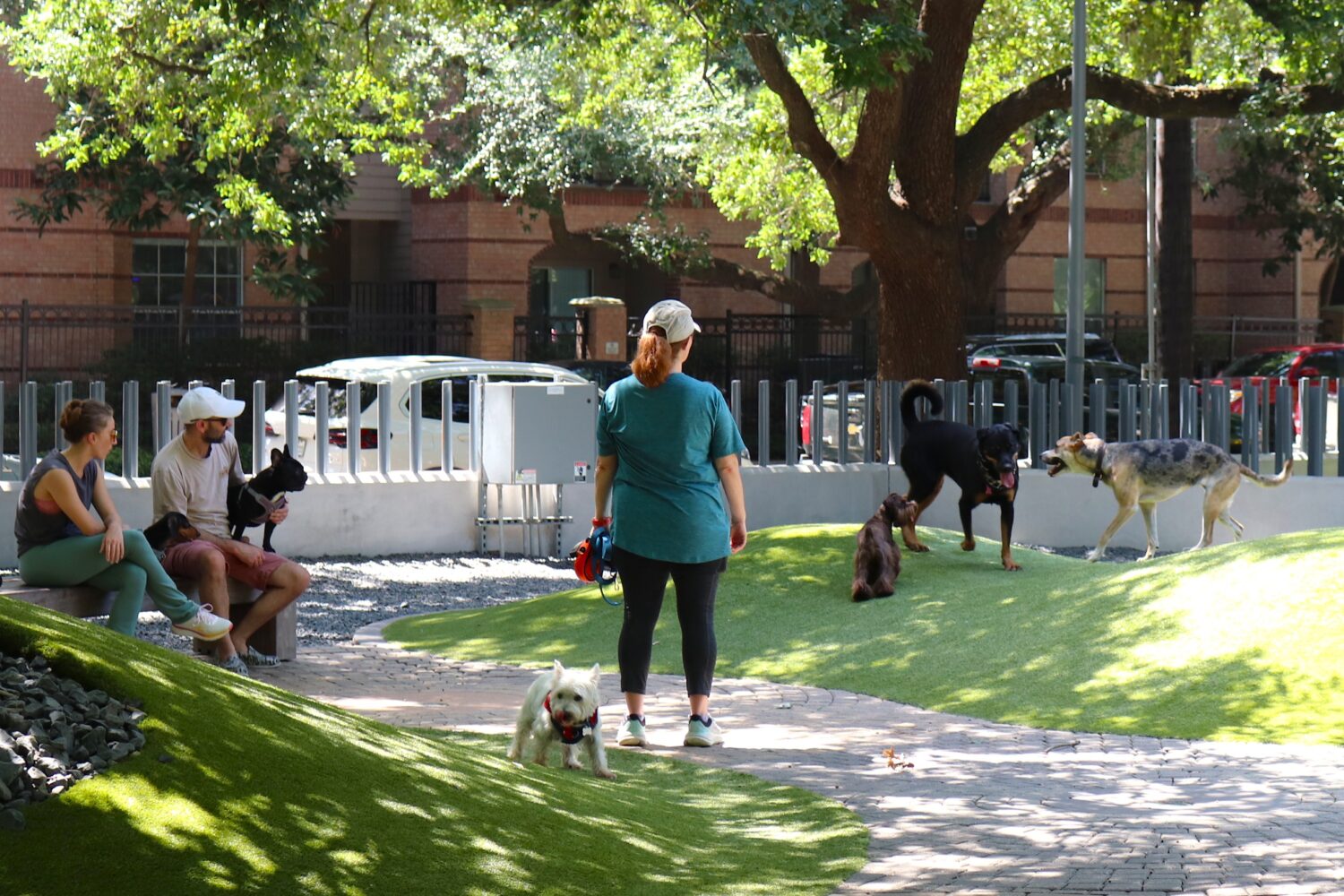
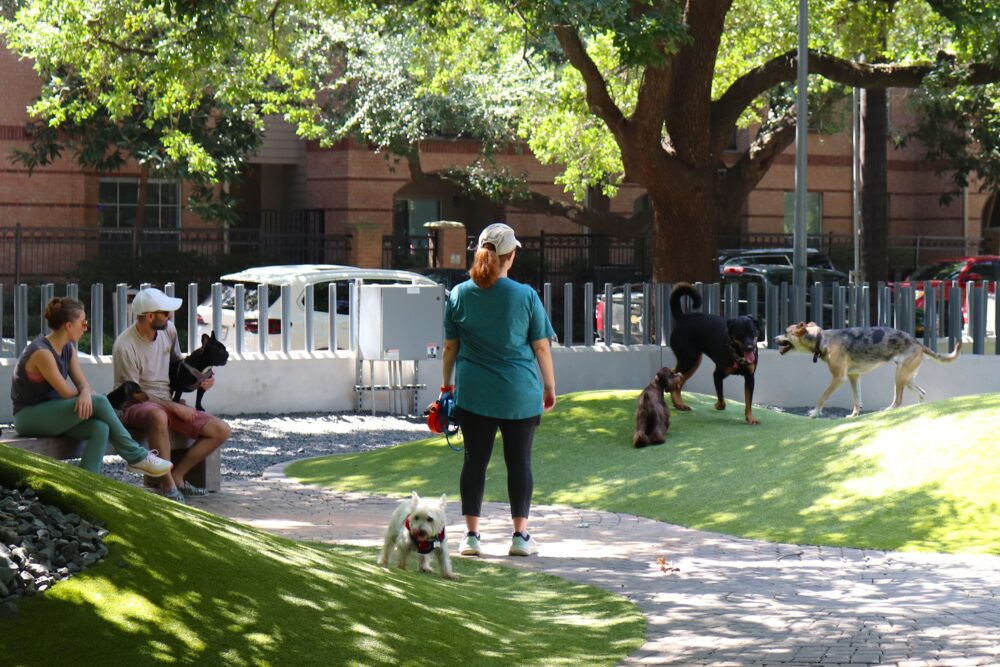
Keenan Vaughn / Houston Public Media
Dogs play at a dog park in Houston.
What’s the top dog in Houston? It depends on where you live.
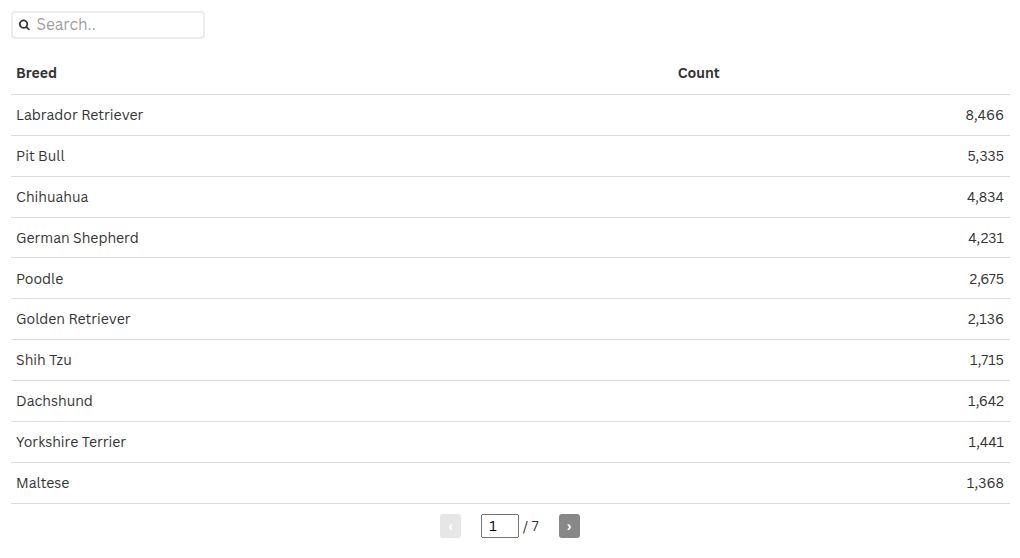
According to five years of dog registration data obtained by Houston Public Media, Labrador retrievers, pit bulls and chihuahuas are the three most commonly registered breeds across the city.
Labs dominate zip codes on the west side of the city. Pit bulls and chihuahuas wrestle for the top spot along the north, east and south areas of Houston.
Sign up for the Hello, Houston! daily newsletter to get local reports like this delivered directly to your inbox.
“Actually, that lines up with what I would guess,” said Mario Castillo — a dachshund-mix dad, self-described “dog lover and animal fan,” and city council member who represents a slice of east and north Houston, often advocating for more animal welfare funding.
“When I was running for office, I block-walked my district, and a lot of the dogs you would see either out in the yard or pop up through the window — they tended to be like a pit bull mix or some kind of chihuahua mix,” Castillo added. “You saw a lot of it. So, I’m not surprised.”
In a few pockets of the city, German shepherds hold the top spot. And two zip codes stand out as outliers — 77046 in the Greenway/Upper Kirby area, where more poodles are registered than any other breed, as well as 77094 in the Eldridge/West Oaks neighborhood of far west Houston, where golden retrievers are at the top of the pack.
Castillo attributed the spread to the cultural demographics of Houston.
Dog parents react
Hannah Payne always had a dog by her side while growing up in Baytown and living in Southwest Houston.
She lives near McWilliams Dog Park in Hermann Park — the favorite playplace for her two three-year-old long-haired dachshunds, Brue and Benny.
McWilliams Dog Park falls within the 77030 zip code, which has 428 registered dogs. The top three breeds there are Labrador Retriever, German Shepherd and Golden Retriever.
“That makes sense,” Payne said.
Dachshunds are the eighth-most registered dog in the city, but they hold the top spot in Payne’s heart.
“I just think they’re really cute,” Payne said. “I like their temperament. I know it’s a hit-or-miss for people. I like that they become attached to one person, and they get really protective of one person.”
At the Danny Jackson Family Bark Park near West University Place, Kathryn Tyler suspected her six-year-old Husky and American Eskimo mix was an outlier.
After 47 years in Houston, what was her guess for the city’s top dog?
“I see lots of labs,” Tyler said.
Danny Jackson Family Bark Park is in the 77081 zip code, where 373 dogs are registered. The top three breeds are Labrador Retriever, Chihuahua and Pit Bull.
“Nailed it,” Tyler said.
Doggone data caveats
The data captures only a fraction of the total dog population in Houston.
The city of Houston’s Bureau of Animal Regulation and Care (BARC) requires annual registration of animals. Over the past five years, about 56,000 dogs were registered.
But in 2023, more than 40% of survey respondents told Rice University’s Kinder Institute their household had a dog, and about half of them said they had two or more dogs — indicating over half a million household dogs in the city.
To register with the city, owners must provide proof their dog has been microchipped and vaccinated against rabies.
“I don’t think a lot of people know that you are required to register your dog with the city,” council member Mario Castillo said. “I think there should be more of an educational campaign to make sure folks are aware that this is a requirement in the city of Houston. I think it boils down to promoting and sustaining responsible pet ownership throughout the city.”
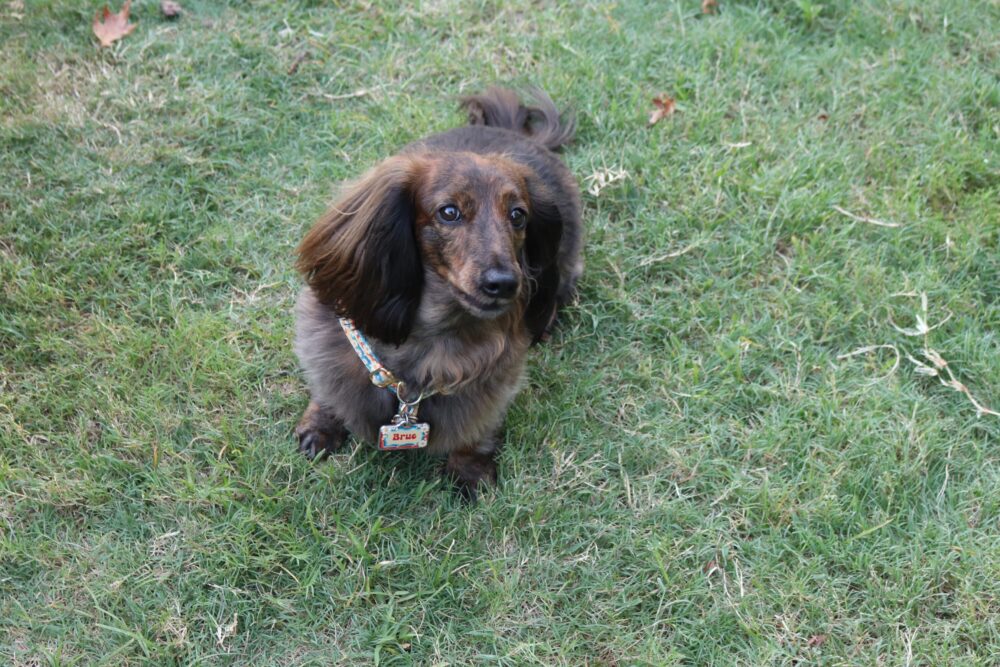
Keenan Vaughan / Houston Public Media
A long-haired dachshunds named Brue plays at a dog park in Houston.
BARC doesn’t require DNA testing to register, so breeds are reported by dog parents — who aren’t always accurate. Many dogs are mixes of multiple breeds.
“I’m not surprised that people report that these breeds of dogs are so prevalent in Houston,” said Melissa Taylor, behavior and training director at Friends For Life Animal Shelter in Houston, “but I’m skeptical about whether their guesses are accurate based on what we’ve experienced here at the shelter and based on what we read in the literature about how accurate folks are about guessing dog breeds.”
For a 2013 study in the American Journal of Sociological Research, researchers examined the accuracy of people using visual identification to guess the breeds of 20 dogs compared to DNA tests of those dogs. With more than 900 people providing answers, correct guesses across different breeds ranged from 0% to 82% — findings the authors said “raise questions concerning the accuracy of databases which supply demographic data on dog breeds.”
So, if you’re looking for a perfect picture of the city’s dog population in this story, you may be barking up the wrong tree.
Full disclosure: The author of this story cares for what appears to be a lab-pit mix and a lab-greyhound mix.