
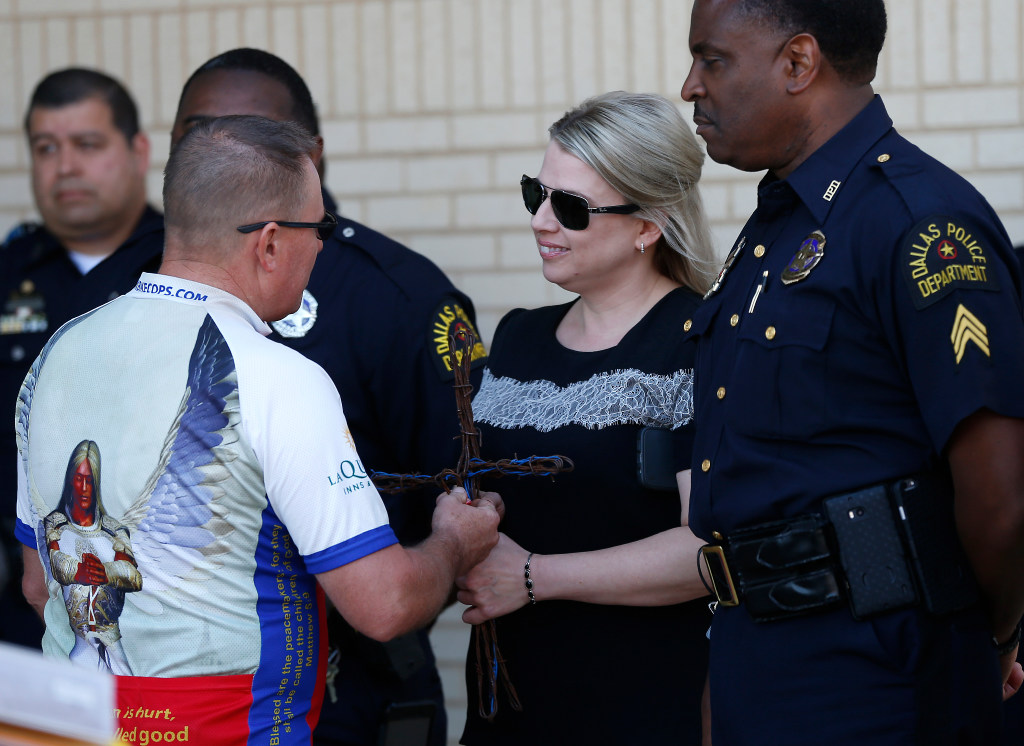
Katrina Ahrens, center, accepts a handmade memorial cross during a 2017 ceremony at Dallas police headquarters. A Johnson County jury Tuesday rejected allegations by Ahrens, the widow of Dallas Senior Cpl. Lorne Ahrens, that the Dallas Police Association mishandled donations sent after the 2016 sniper attack that killed five law enforcement officers.
CLEBURNE — A Johnson County jury on Tuesday found that the Dallas Police Association did not mishandle more than $10 million donated after the 2016 sniper attack that killed five law enforcement officers, rejecting a claim for damages by the widow of one of the slain officers.

The verdict followed about 3½ hours of deliberations at the end of a weeklong trial. Katrina Ahrens filed the lawsuit in Johnson County, where she lives, about an hour southwest of Dallas. The jury also determined that attorney Bob Gorsky, who worked for the police group, had not conspired with it to hold the funds “hostage” as Ahrens’ complaint had alleged.
The verdict marks the end of a decade of litigation by Ahrens against the city’s largest police union. She hung her head as State District Judge Sydney Hewlett read the verdict. She declined to comment afterward.
Article continues below this ad
“While we’re disappointed in the jury’s verdict regarding the DPA and Bob Gorsky, we are pleased the jury found the [Assist the Officer] converted donations for the families of the Five Fallen and breached its fiduciary duty to Ms. Ahrens,” Ahrens’ attorney, Casey Griffith, said in a statement. The Assist the Officer charitable organization, which is affiliated with the police group, previously settled with Ahrens out of court and was not a defendant in the trial.
In a statement issued after the verdict, Gorsky thanked the jury and wished Ahrens and her family well. Her children, now 18 and 20, were not part of the lawsuit and did not attend the trial.
“We have maintained all along that we gave our best advice to ensure the millions of dollars in donations made by thousands of generous people all over the country got into the hands of the families,” Gorsky wrote in his statement. “That’s what happened and we’re grateful the jury agreed.”
Ahrens’ husband, Senior Cpl. Lorne Ahrens, had served as a Dallas police officer for more than 13 years when he was fatally shot. The sniper was killed hours later by explosives delivered by a remote-controlled police robot.
Katrina Ahrens was also a Dallas police officer when her husband was killed. She retired earlier this year after more than 25 years with the department.
Article continues below this ad
Related: Inside the Dallas ambush memorial that nearly didn’t exist, with the librarians who saved it
After the attack that also wounded several officers, checks, letters and gifts for the slain officers’ families poured in from thousands of people around the world. Because donors generally did not know where to send them, most of the items were delivered to police headquarters or City Hall.
Testimony during the trial showed the city was unprepared to handle such an enormous outpouring of support. About three months after the shooting, city officials entered into a written agreement with Assist the Officer. Under the plan, the charity would collect the items, deposit the checks into its bank account and later distribute the money to the families.
Katrina Ahrens testified that no one from the city or the police organization told her about the agreement or sought her approval.
Ahrens filed her lawsuit in July 2017, a year after the shooting. She initially also named the City of Dallas and Assist the Officer as defendants. Both settled with Ahrens out of court. The settlement with the city came earlier this year after the City Council voted to pay up to $2.8 million. The settlement amount with the charity remained private.
Article continues below this ad
Ahrens testified she also was not told, or consulted with, about a plan to place the funds into a trust for her and her two children rather than be directly distributed to them. Letters and gifts designated for her and her family also were never turned over to them, she said.
Griffith told jurors the nonprofit failed to keep proper records of the donations, and decided that any money received after 2016 would stay in the fund. The money would be used for future officers’ needs even if it was specifically designated for the 2016 victims, the attorney said.
Among the evidence Griffith presented were small, handwritten notes that volunteers had jotted donation amounts on.
“We’re talking about $10 million dollars,” he said during his closing argument to the jury. “And they’re recording the donations on Post-it notes.”
A banner honoring slain Dallas police officer Lorne Ahrens hangs near El Centro College in downtown Dallas on Sept. 26, 2016. Banners honoring the five police officers killed in the July 7 ambush line some of the downtown Dallas streets as a reminder of the officers’ heroism. (Rose Baca/The Dallas Morning News)
Rose Baca/Dallas Morning News
Griffith also presented emails and letters showing the nonprofit group had continually assured donors that the money would be quickly distributed to the families. There was no mention of trusts being set up, he said.
Article continues below this ad
Lawyers for the police group and Gorsky told jurors they always had the families’ best interests in mind. They decided to divide the money equally, with each family getting about $2.1 million.
The money would be put in trusts, with half going to the officer’s spouse and the other half to their children. The idea for the trusts came from talking to officials in other cities that had received a large outpouring of support after a tragedy, according to the lawyers.
Attorney Jennifer Johnson, who represented the police association, said it was the Assist the Officer group that made the decisions, not the police association. But she also argued that the charity did nothing wrong and was doing its best to help the families under extraordinary circumstances.
“The DPA is not the ATO,” Johnson told the jury. “It has no power over the ATO.”
Article continues below this ad
The jury’s verdict suggested that they were confused that the nonprofit group was not a defendant in the trial. In their answer to a question about whether the police association misappropriated funds, the jury wrote, “DPA, no. ATO, yes.”
None of the other victims’ families filed lawsuits. A forensic accountant who testified for Ahrens told the jurors he had determined that the amount that should have been paid to her was $3.1 million, which included money that was donated for the victims after 2016. Griffith asked the jury to award $3.1 million, plus whatever punitive damages it thought was appropriate.