
LUBBOCK, Texas (KCBD) – The Lubbock City Council set a property tax rate ceiling, the maximum it could later approve, during its meeting Tuesday. This is a procedural step taken during each summer’s budget work, ahead of the council adopting a budget and supporting tax rate.
Mayor McBrayer thanked City Manager Jarrett Atkinson for the “extremely difficult and long process” of preparing budget proposals to council. Now, he said it is time for the council to determine priorities after reviewing the city manager’s presentations.
“It’s not an easy thing to do, to balance the needs that we feel and the needs that come to us from the citizens and then our responsibility as we levy a tax on them,” the Mayor said Tuesday.
Council approved a maximum rate of 51.3421 cents per $100 valuation. Council can later adopt a lower rate; after Tuesday’s vote, it cannot go above this mark.
RELATED AUG. 7: Lubbock City Council considering new budget, new property tax rate
RELATED AUG. 5: Lubbock City Council, staff begin budget discussions
Exemptions factoring into revenue
Councilman Tim Green pointed to a significant increase in tax exemptions, approved by voters statewide in November, as proposition 9 amending the Texas Constitution. It increased the business personal property exemption from $2,500 to $125,000.
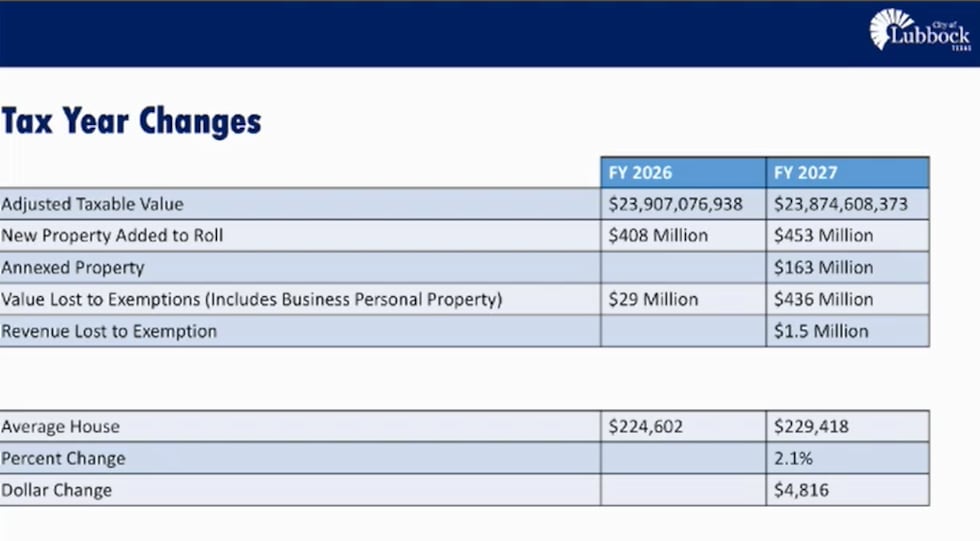
The city manager’s presentation last week, which included the graphic below, highlighted exemptions reduced the taxable value across the city by $29 million last fiscal year. This upcoming year those exemptions reduce taxable value by $436 million. This results in about $1.5 million less tax revenue to the city.
The total taxable value across the city decreased from last year to this year, noted in the top row of the chart below. This was despite new property added to the tax rolls and annexed property.
 City manager’s presentation Aug. 7, 2026.(City of Lubbock)
Because of these exemptions, Councilman Green pointed out this year’s no-new-revenue rate of 47.5154 cents per $100 valuation is higher than the rate adopted last year of 47.2191 cents.
Proposed tax bill
Tuesday the city manager showed if council approved the budget proposal as presented, and also approved “meet-and-confer” agreements with fire and police, the average homeowner will pay $117.33 more to the city in property taxes for the year. The total would be $1,177.88.
The figure below shows last year’s tax bill at $1,060.55, and cites the average taxable value increase of 2.14 percent. For the upcoming year, the average taxable property value is $229,418. This proposal uses a tax rate of 51.3421 cents.
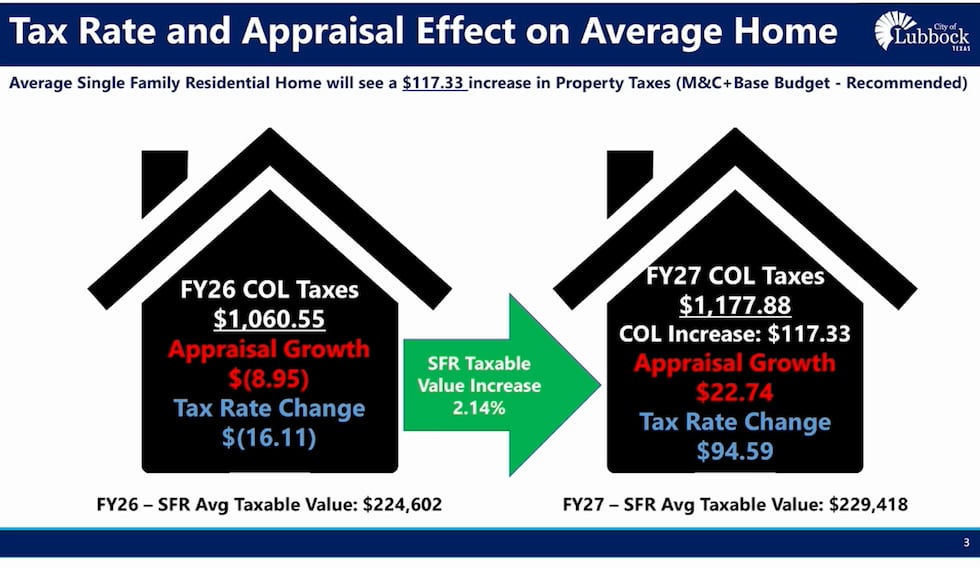 Figure from city manager’s presentation Aug. 11, 2026(City of Lubbock)
If “meet-and-confer” agreements are not approved, the average homeowner will pay $90.75 more to the city in property taxes for the year. Under this scenario, members of the fire and police forces would receive a three-percent raise, like most other city employees in the proposed budget.
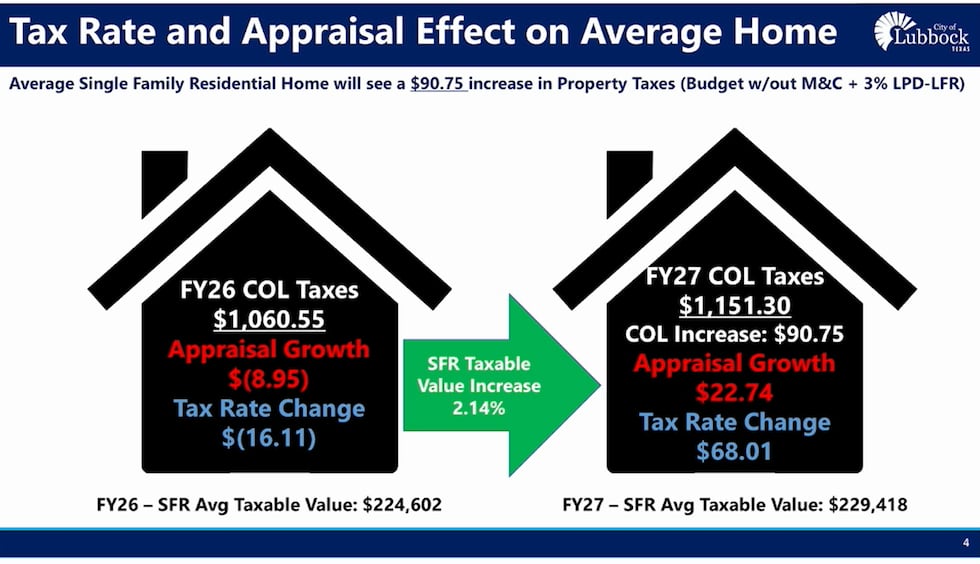 Figure from city manager’s presentation Aug. 11, 2026(City of Lubbock)
This is a comparison of the tax rates needed to support the base budget the city manager proposed (without any changes regarding police and fire), the budget proposed with approval of meet-and-confer, and the budget without meet-and-confer (which removes cost savings in base budget from meet-and-confer).
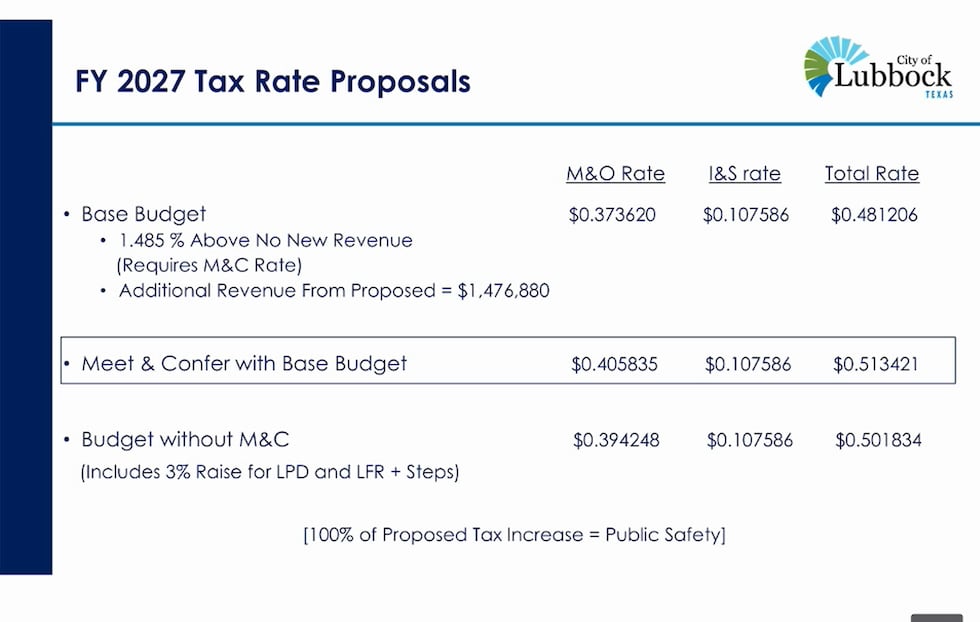 Comparison of tax rate proposals(City of Lubbock)
“There are a lot of other things we’ll be doing as a council,” Mayor McBrayer said. “We all have our homework in front of us and a month to get it done as we discuss it and move forward in this process.”
The mayor said LP&L’s budget is among the areas he will be interested in reviewing, to “find ways to help our citizens with the cost of their utilities.”
Public hearing scheduled
Tuesday’s vote also included the scheduling of a public hearing. It will be 6 p.m. Tuesday, Sept. 1 at Citizens Tower.
The council must adopt a budget and tax rate by Oct. 1.
Key tax terms
Here are some key terms when various local governments work on setting a property tax rate.
No-new-revenue tax rate: This takes into consideration how much appraised values have changed, and would provide the taxing entity with roughly the same revenue from properties on the tax rolls for both years. It does not take into consideration new development or other significant changes to property.
If your property’s appraised value change is in line with the average change across your district/city/county, the no-new-revenue rate means your tax bill will be the same as last year.
Voter-approval tax rate: In most cases, according to the Texas Comptroller’s Office, if a government adopts a rate above the voter-approval rate, it triggers an election for voters to approve the tax increase.
A property tax rate does not continue from one year to the next. Taxing entities must set a rate every year.
Exemptions: The Texas Comptroller’s Office has information on the homestead exemption, exemptions for those 65 or older, citizens who are disabled, disabled veterans or their surviving spouses, surviving spouses of first responders killed in the line of duty, and others.
Copyright 2026 KCBD. All rights reserved.