
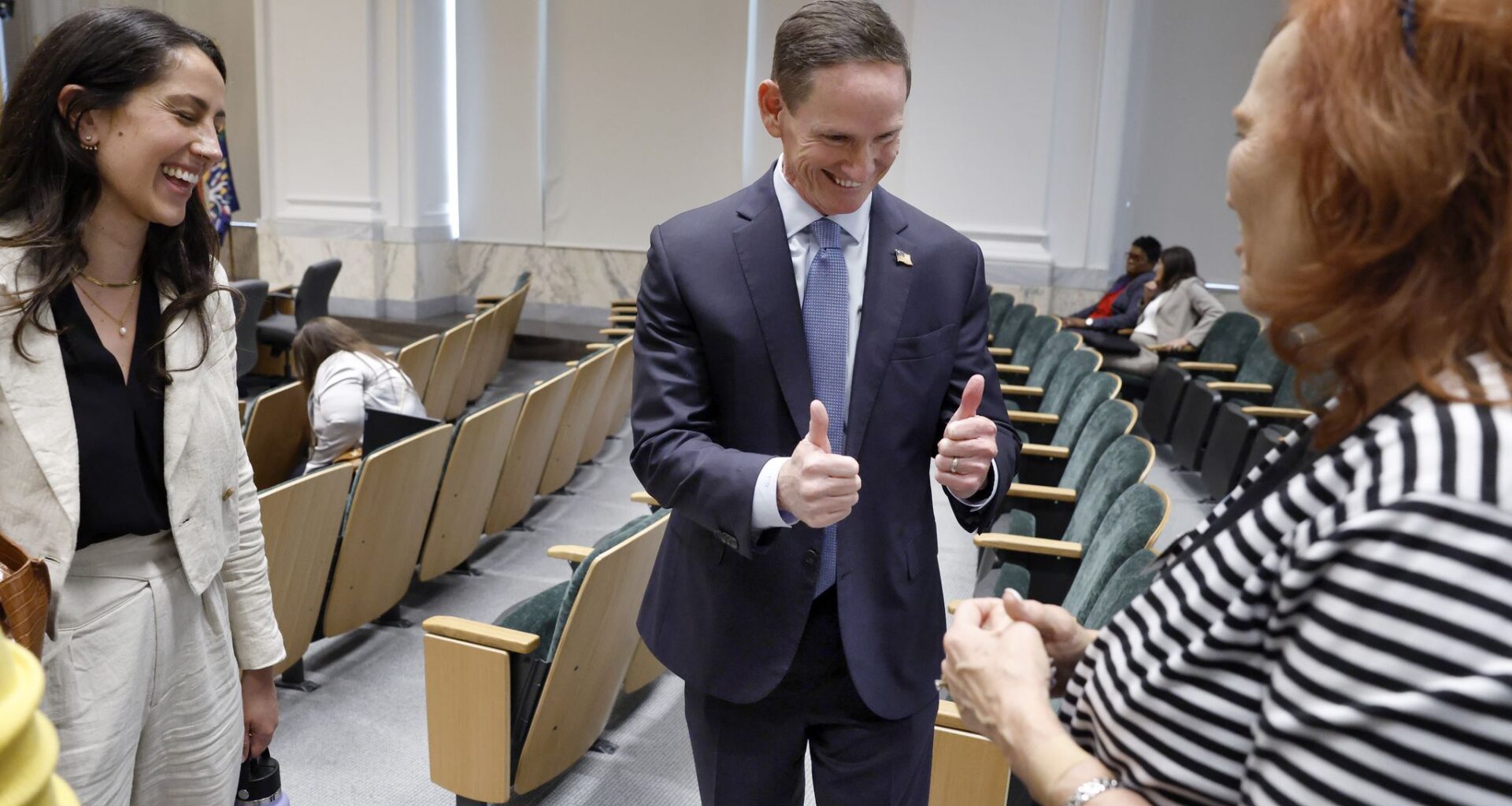
Dallas County Judge Clay Jenkins gives a thumbs up to Brenda Snitzer Executive Director of The Stewpot (right) as he met with she and Housing Forward’s Rachel Wilson at Dallas County Commissioners Court, August 11, 2026. Commissioners voted to put a higher tax to pay for homeless services on the November ballot.
Tom Fox/The Dallas Morning News
The Dallas County property tax rate will rise slightly next year, but voters will decide this fall whether to triple the increase to fund housing and intervention services targeted at ending homelessness.

The Dallas County Commissioners Court on Tuesday voted unanimously to adopt a fiscal year 2027 tax rate of 22.46 cents for every $100 in property value, about one cent higher than this year and the first rate hike since 2010.
In separate divided discussion, commissioners voted 3-2 to place a question on the Nov. 3 ballot asking whether voters want to raise the tax rate by another 2.4 cents to generate about $103 million for housing, mental health and public safety efforts related to homelessness.
Article continues below this ad
Advocates with the nonprofit Housing Forward pushed the proposal as an investment to eliminate street sleeping instead of footing costs of homeless people burdening the jail, emergency rooms and the community’s quality of life. While a majority of commissioners favored giving voters the chance to decide on the tax, Commissioners John Wiley Price and Elba Garcia dissented, raising concerns about the plan’s viability and pressures on residents already struggling with the cost of living.
“Homelessness is not somebody else’s problem,” Commissioner Andrew Sommerman said. “It is our community challenge and together it can become our community triumph.”
Commissioners Dr. Theresa Daniel (left) and Andy Sommerman confer following a vote at Dallas County Commissioners Court, August 11, 2026. Commissioners voted to put a higher tax to pay for homeless services on the November ballot.
Tom Fox/The Dallas Morning News
The base tax rate approved for fiscal year 2027 will result in a $602 bill for a home with the median taxable value of $268,056 – $25 more than last year.
If the additional rate increase for homeless services is approved in November, the same homeowner would pay another $64 on top.
Article continues below this ad
County Judge Clay Lewis Jenkins pointed to a recent survey, where majority of 837 likely voters polled by Housing Forward said spending more money would help address homelessness. But the question did not mention a tax increase, according to phrasing the nonprofit provided to The Dallas Morning News.
“I’m OK putting this in front of the voters and letting them have a say on an issue that they very much want to have a say on,” Jenkins said.
The five-year proposal crafted by Housing Forward states the extra tax revenue would fund short-term rental and stability assistance; long-term treatment and housing services; diversion hubs for police to take people for treatment instead of jail; training for law enforcement to handle people with mental health needs; increasing access to residential substance abuse treatment; and other interventions.
Last week, commissioners advertised a higher rate for the proposed homelessness tax but lowered it hours before Tuesday’s vote to put it on the ballot. Housing Forward CEO Sarah Kahn said the homelessness and public safety services in the plan remain unchanged but officials were able to find savings by adjusting costs in the first year while the plan ramps up.
Housing Forward President & CEO Sarah Kahn (second from right) visits with colleagues before Commissioners reconvened at Dallas County Commissioners Court, August 11, 2026. Commissioners voted to put a higher tax to pay for homeless services on the November ballot.
Tom Fox/The Dallas Morning News
Proposed ballot language advertised by commissioners this week identified the funding as being used for homeless and public safety services; the language approved Tuesday will only tell voters the funds will be for homelessness. Public safety initiatives like crisis intervention training for police and case managers for people repeatedly cycling through the system remain in the plan.
Article continues below this ad
Since 2021, Kahn said Housing Forward and its partners have helped 24,000 people out of homelessness. She said there are 11,000 households in need each year but the organization only has funding to reach 60% of them.
“The question is not whether or not we’re going to pay for this, the real question is are we going to continue managing the problem and paying for the consequences or give residents the opportunity to invest in solving it,” Kahn told commissioners.
If the homeless tax ballot initiative fails Nov. 3, the county’s tax rate will remain at the 22.46-cent rate approved Tuesday, which staff used to build the $904 million budget.
If it passes, Housing Forward would enter a five-year contract with the county to receive and distribute the extra revenue alongside its other funding as the agency leading the region’s homeless response.
Garcia raised concern about locking taxpayers into a five-year commitment for initiatives that have not yet been proven to reduce the jail population or the burden on the courts.
Article continues below this ad
She said the commissioners court has a record of supporting housing and other nonprofits without raising taxes over the past 16 years. In January, commissioners dedicated $10 million to Housing Forward, matching the allocation from the city of Dallas, to help expand its downtown homeless outreach.
Commissioners (from left) Dr. Theresa Daniel, Andy Sommerman, Judge Clay Jenkins, John Wiley Price and Dr. Elba Garcia listen to monetary scenarios surrounding funding the homeless at Dallas County Commissioners Court, August 11, 2026. Commissioners voted to put a higher tax to pay for homeless services on the November ballot.
Tom Fox/The Dallas Morning News
Garcia said she’s not comfortable asking residents to consider the additional costs and bureaucracy this new tax would bring when many struggle to choose between paying for food and prescription medication.
“I believe our residents deserve accountability, and more importantly, our residents deserve a clear path with results, and I honestly don’t see this in this proposal,” Garcia said.
Earlier this year, education advocates pitched a separate tax increase for the fall ballot to pay for child care services as about 9,500 families remain on a waitlist for assistance. Commissioners did not vote on whether to advance a child care tax to the ballot by the Aug. 4 deadline to advertise such a measure, effectively killing the idea.
Article continues below this ad
On Tuesday Price said he felt like the entire tax rate election discussion “has been hijacked” since officials were first approached by the child care advocates before homelessness groups brought their own proposal.
He worried the higher tax will disproportionately burden low-income families, those with housing insecurity and others who may not show up to the polls to vote. He said homeowners will not be the only ones paying more if the initiative passes as costs are often passed on to renters.
“The people who decide a referendum are not demographically interchangeable with everyone who bears the consequences,” Price said.