
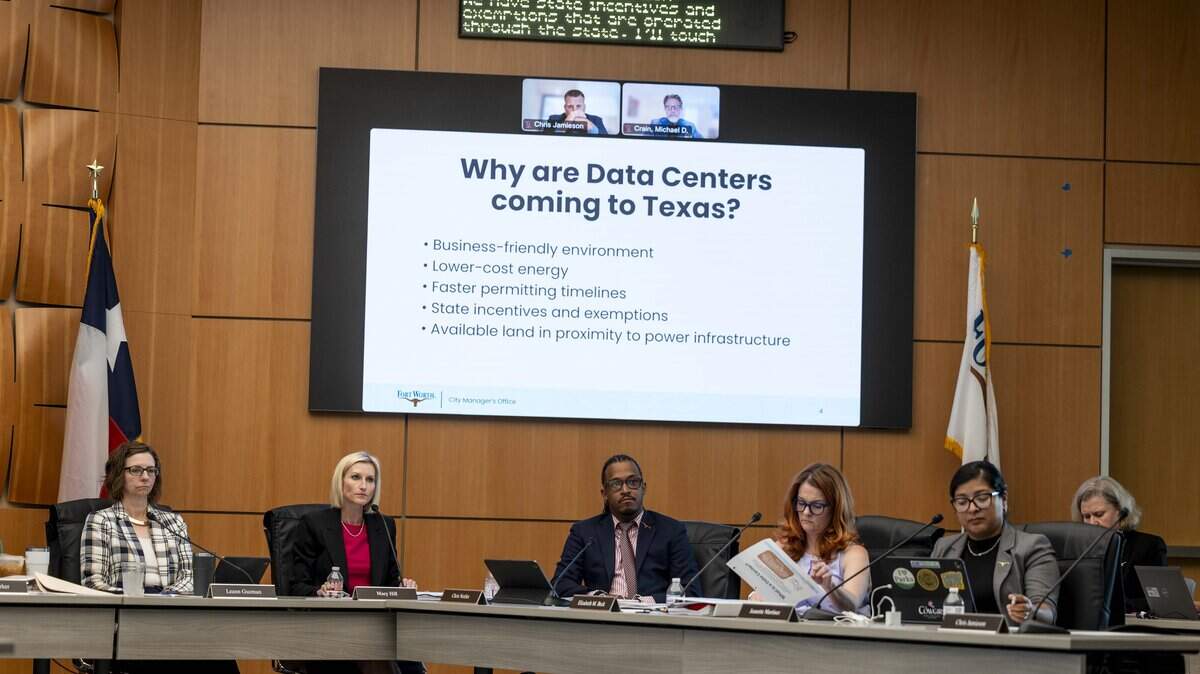
Fort Worth City Council listens to a presentation on data center development regulations from Assistant City Manager Jesica McEachern during a City Council work session on Tuesday, June 2, 2026 in Fort Worth, Texas.
Abigail Dollins
Fort Worth Star-Telegram
After a summer of fits and starts, with multi-billion dollar developments circling the city, Fort Worth took major steps on Tuesday to regulate and limit the growth of data centers — with a potential moratorium now taking shape.
Past 11:30 p.m. at the Fort Worth City Council’s Aug. 11 meeting, after several hours of public comment, council members approved several measures related to the local regulation of data centers, and began a lengthy process of implementing a local moratorium on new data center developments.
It’s a move that local advocacy groups have been calling for for months, even as the city instead focused on a large package of new regulations for data centers.
Data center committee, regulatory requirements
Along with initiating the moratorium process, the city will now establish a Data Center Infrastructure Commission that would, according to the resolution passed on Tuesday, “conduct a comprehensive, fact based evaluation of data center development.”
The commission will be made up of 11 members, led by Dr. Mike Slattery, director of the Institute for Environmental Studies at Texas Christian University. The commission will include industry experts and academics, plus several community members. The ultimate goal of the commission will be to produce a report to the city council in November.
The council also approved a resolution that, following a directive from Gov. Greg Abbott for Texas to pause the approval of new data centers until two state regulators can audit all existing applications, any data centers developers looking to build in Fort Worth would have to receive necessary state approvals before the city would approve any development permits.
Council members approved the measure after dozens of residents gave more than two hours of public comment, including state representatives who are running for statewide office.
“As I have been traveling around the state, I have been hearing from so many people about all the issues and concerns around data centers,” said Rep. Vikki Goodwin, an Austin democrat who is running for lieutenant governor. “I know you’re not the legislature, but anything that city councils do tends to send a signal to the legislature.”
The measures are imperfect, residents said — many at City Hall on Tuesday said that the committee’s makeup did not put enough of an emphasis on community input — but it’s a start.
“I’m in favor of having a data center task force,” Lydia Faith, a Fort Worth activist, told council members. “My hope would be that there would be a citizen task force. I’m concerned about the city manager having appointed a chair without community input.”
At a press conference before the meeting began on Tuesday, a group of local advocates expressed support for the moratorium and called for the committee to include more input from residents.
“A moratorium isn’t a tantrum; it’s a time out,” said Krista Erbe, a Fort Worth resident who formed the 2871 Community Coalition, a group that was initially started because of a proposed data center in west Fort Worth but has since become a strong voice among groups advocating for the moratorium. “Cities have learned the hard way that if we don’t plan for ourselves, no one in Austin is going to do it for us. The data center committee needs to have significant representation from Fort Worth residents.”
The three measures all passed almost unanimously. Council member Macy Hill abstained from the vote on the data center commission, and council member Chris Jamieson voted against the requirement related to state regulatory approvals.
The year of data centers
Data centers have been one of the most prominent topics at City Hall throughout the year. Four data centers are operational in Fort Worth, with one in construction and four others proposed within city limits. Two more are proposed in the city’s extraterritorial jurisdiction.
The package first presented to the city council in June was initially meant to include changes to the city’s zoning code, noise and water regulations, and the city’s economic development policy.
The June presentation, given by Fort Worth Assistant City Manager Jesica McEachern during a council work session, laid out a timeline for the city to adopt data center regulations that made one thing clear: by August, the city wanted something on the books.
As the summer progressed, that timeline fell apart.
In July, the Fort Worth Zoning Commission voted against recommending that the city council approve the proposed zoning regulations after commissioners said the process felt rushed.
Days later, five city council members formally called for a moratorium. The city pivoted, announcing that a moratorium would be considered at the next meeting, but not the other regulations.
A presentation on the moratorium scheduled for the council’s Aug. 4 work session was suddenly shortened after Gov. Greg Abbott announced a directive to halt approvals of all new data center projects in Texas until state regulatory agencies can audit data center projects currently seeking to join the Texas power grid.
Council member Elizabeth Beck said at Tuesday’s meeting that earlier in the year, the city initially wanted to adopt regulations quickly to avoid a rush of proposals— but as resident protests grew, it became clear that proper rules might take more time.
“We are here to work with you on this,” Beck said. “We aren’t your enemy in this fight.”
What comes next for Fort Worth’s data center moratorium?
Here’s what comes next, if the council keeps to the schedule proposed by McEachern at Tuesday’s meeting:
The data center committee will conduct research and prepare a report to be given to the city council in November. The city must hold two public hearings on the moratorium, and then two additional hearings to read the approved ordinance.
If the council approves the moratorium by supermajority, it could begin in February and end in May with the option to extend it for an additional 90 days into August.
Between August and November, the DCIC could conduct their research and prepare a report that could be given to the city council on Nov. 3. Hearings on the moratorium will be held between November and January, with the moratorium beginning on Feb. 16.
The initial 90-day moratorium would end on May 17, with an option to extend it until Aug. 15. After that, the city cannot implement another moratorium for two years.

Fort Worth Star-Telegram
Emily Holshouser is a local news reporter at the Fort Worth Star-Telegram.