
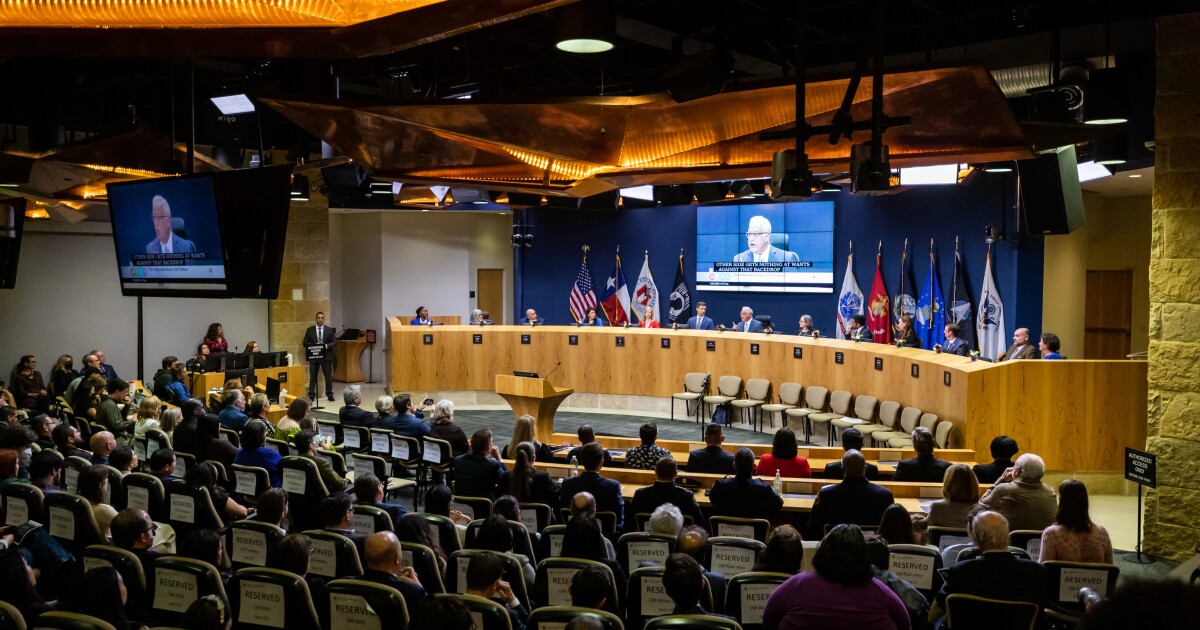
The Austin City Council adopted a budget on Wednesday that makes cuts to several programs and services and sets up the framework for a new office aimed at speeding up emergency response times.
Austin Mayor Kirk Watson and Council Member Marc Duchen voted against the budget, citing concerns about the city’s spending as residents struggle with affordability.
“At this point in time, we could have done more to meet the needs of people struggling in our community,” Watson said.
The $6.6 billion budget includes more than $5 million in cutbacks to social service contracts, which are agreements the city makes with nonprofits and groups that serve people in need. But an unexpected $4.7 million in additional property tax revenue will allow the council to restore some of those contracts through one-time funding.
A recent city audit found that several local nonprofits had been underperforming and were not consistently providing promised services. The audit did not identify the nonprofits by name.
Austin City Council members are now asking city staff to take a deeper dive into those contracts to determine which programs are performing well and how they benefit the community.
While city leaders work to figure out which programs will get funding, they’re also focused on improving Austin’s 911 system and addressing slow response times.
Council Members Krista Laine, Mike Siegel, Ryan Alter and José Velásquez cosponsored an amendment which would move 911 call takers from the Austin Police Department to a newly created office focused on emergency communications, funded by $1.3 million from the police budget and other city funds.
“We need change, and we need to make a commitment as a council to continue on the path to excellence in emergency communication,” Laine said.
Six council members voted in favor of creating the office, with Watson and Duchen opposing it. Council Members Chito Vela, Paige Ellis and Natasha Harper-Madison abstained from the vote. City staff and public safety leaders advised against the move, saying it was premature.
“I think we are all sharing a similar need here,” Ellis said. “But I worry this could be something that inadvertently slows down response times and creates confusion and chaos at the worst possible moment.”
The budget also includes $3 million to keep a temporary emergency shelter known as the Marshalling Yard open, along with $6 million for permanent supportive housing services and $6 million to fund overtime costs for the Austin Fire Department.
The council added some expenses using certificates of obligation, a type of loan that does not require voter approval. That includes $32 million for mobility projects that will add sidewalks, bike lanes and urban trails, $3 million to upgrade and expand the Austin Animal Center and $1 million for traffic calming devices, like speed bumps.
It’s been several weeks since Austin City Manager T.C. Broadnax presented a draft budget to the City Council, stressing spending constraints. City staff have blamed limited property tax and flat sales tax revenues for financial challenges.
The city tried to fill the gap last year with a proposed property tax hike known as Proposition Q, but voters soundly rejected that effort.
In November, the city will put a $295 million bond proposal before voters, which would increase property taxes.