
Sonia Kinyua/Houston Public Media
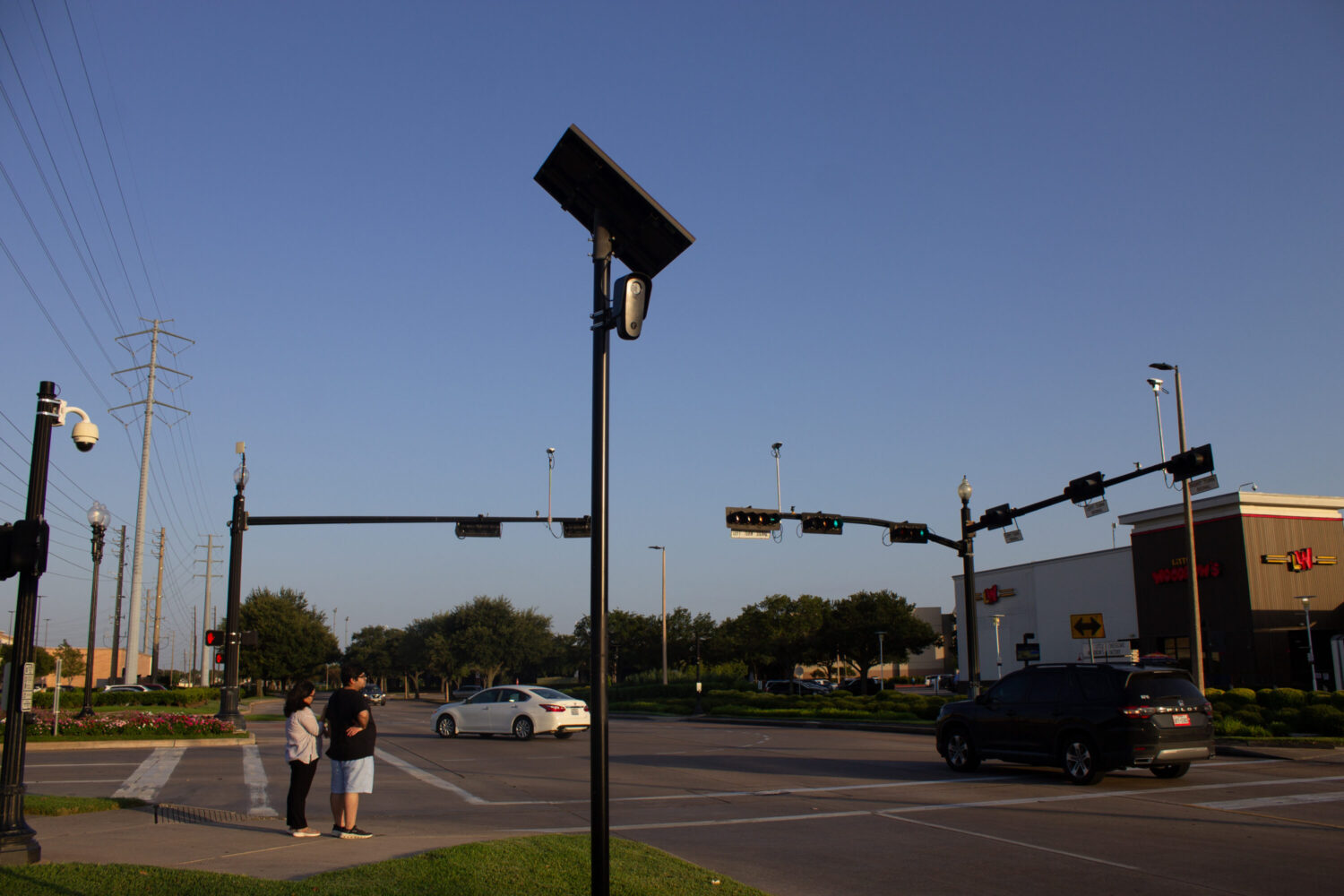
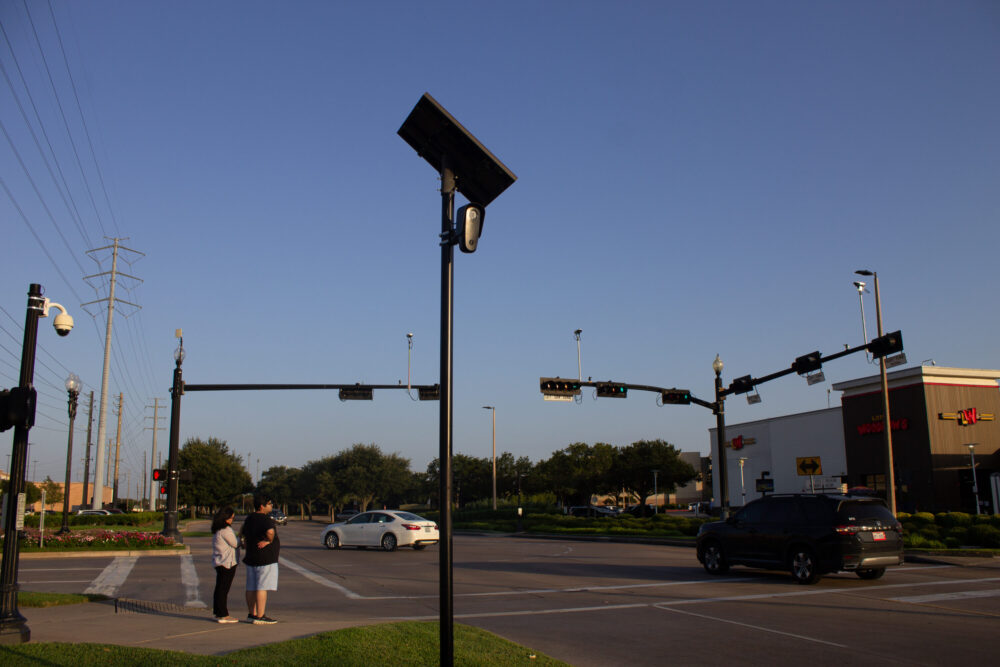
A Flock Safety camera towers above an intersection in Sugar Land, Texas.
Hanging above the nearly 7,000 miles of roads that stretch across Harris County are hundreds of carefully positioned cameras.
Adorned on black steel poles, the artificial intelligence-powered cameras scan license plates and capture a vehicle’s make and model, adding the information to one of the largest law enforcement databases in the nation.
This is for the sake of public safety, according to Flock Safety, one of the most popular companies in the U.S. for automated license plate readers, or ALPRs.
But, privacy concerns about mass surveillance have created growing public mistrust with the company and the technology itself.
Click here for more inDepth features.
At a Harris County commissioners business court meeting in May, several people spoke out against Flock as the elected commissioners considered renewing a contract for nearly $1 million.
Business court meetings are intended to last between 10-15 minutes. However, public comment stretched the meeting to more than an hour of discussion.
“We do not want to repeat the same financial predicament as last year by investing in programs that do not address the root causes of violence and instability,” resident Marilyn Allen said.
Several commissioners spoke in favor of the contract.
Among them was Precinct 2 Commissioner Adrian Garcia, a Democrat and former Harris County sheriff.
“I have great confidence that this tool is used for the maximum benefit of our community, especially those victims of crimes,” he said.
Ultimately, commissioners ended up renewing the Flock contract through June 2027. They promised to address the public’s concerns at subsequent meetings through a series of amendments.
But commissioners have yet to amend the contract.
“Harris County is expanding a mass surveillance system without the administrative infrastructure to regulate it,” said Mariah Dayakah, a Harris County resident. “There are no clear public-facing policies that tell this community how data is collected, who can access it, how long it’s stored, and how that misuse is prevented.”
Dayakah appeared last month at one of those subsequent meetings, urging commissioners to cancel the county’s yearlong contract with Flock, rather than amending it.
“We are not enhancing public safety,” she said. “We are creating new risks, particularly for Black and brown residents who already bear the burden of over-surveillance.”
Data utilized by ICE?
Surveillance concerns resurfaced after last month’s shooting death of Lorenzo Salgado Araujo, a Mexican immigrant who had lived in Houston for years and was killed by a federal immigrant officer in the city’s East End.
Some worry about Flock data being used by U.S. Immigration and Customs Enforcement (ICE), which has ramped up arrests and deportations during the second term of President Donald Trump.
Sonia Kinyua/Houston Public Media
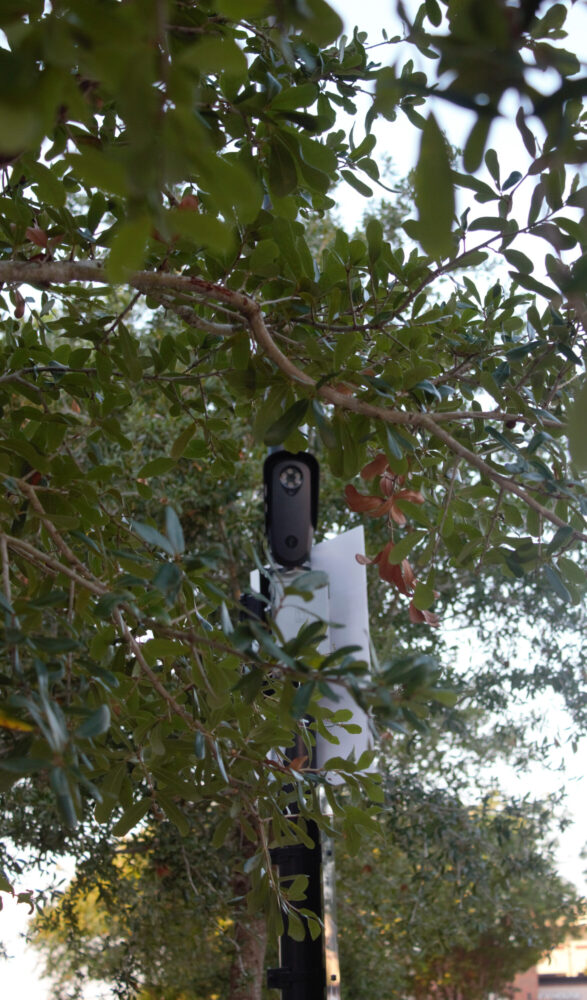
A Flock Safety camera is stationed near a tree in Sugar Land, Texas.
Flock Safety did not respond to a request for comment from Houston Public Media about surveillance concerns with its equipment. The company does not have a direct, public contract with ICE, but those federal agents can request Flock data from local police departments.
RELATED: Border Patrol is monitoring U.S. drivers and detaining those with suspicious travel patterns
“This is not how you build public safety or trust. Secrecy is detrimental to democracy,” said Christopher Rivera, a representative of the Texas Civil Rights Project. He says the cameras do not protect the public. “They are a mass surveillance device and are used to criminalize and deport our most vulnerable community members.”
Imran Ghani, the director of the Council on American-Islamic Relations (CAIR) in Houston, said there is a ripple effect surveillance cameras can have on the East End community, a predominantly Latino neighborhood reeling after Salgado Araujo’s death.
“His family is grieving, and a community already living with fear has been left with even more uncertainty,” Ghani said. “That is exactly why now is not the time to expand mass surveillance.”
The proliferation of Flock cameras and other technology that can be used for surveillance has left many residents feeling unheard and increasingly agitated.
Johnny Nhan, a professor of criminology and criminal justice at Texas Christian University, said the rapid growth of these cameras – and a lack of individual consent over their use – has contributed to public frustration.
“They didn’t sign anything saying that they allowed this. So it seems like the government, cities and police departments are just putting them up there,” Nhan said. “It creates a ubiquitous big brother effect where, ‘Hey, everywhere I go, I’m being recorded.’ ”
Not just Flock
Multiple video surveillance companies like Flock are being used in six counties in the Houston metro area.
The companies say their cameras help law enforcement recover missing people, solve violent crimes and return stolen vehicles.
Flock Safety said in a statement that a Flock alert in June helped Houston-area law enforcement identify a vehicle tied to a robbery. The company also said an automated license plate reader helped trace two abducted children to a Houston-area apartment complex.
However, the cameras’ benefits may be overstated.
Flock tapped Nhan to analyze its 2024 study about its contributions to solving crimes. The study claimed the company was instrumental in solving 10% of reported crimes across the country.
But Nhan says the many variables in criminal apprehension make it hard to attribute Flock to a direct percentage of arrests or convictions.
“The way that the data is recorded by the police department is flawed. Some departments have no way of tracking whether Flock was used,” Nhan said. “Some departments have a little checkbox and say, ‘Hey, Flock initiated this police chase of a stolen vehicle,’ while others don’t do that.”
Other concerns include the misuse of Flock camera data by law enforcement, a case of which was reported just in the past month.
A Pasadena police sergeant resigned after allegedly using Flock cameras to track and stalk a fellow officer. The department said its internal investigation is near its conclusion.
In Fort Bend County, a lieutenant for the sheriff’s office reportedly used Flock cameras to look up two specific plate numbers more than 100 times. The searches were unrelated to any law enforcement work, according to ABC13, which reported the data was not shared or acted upon, resulting in a two-day suspension.
Also, Baytown police are investigating an officer for potential misuse of Flock data, but have not detailed the specific allegations. While the officer has now resigned, Baytown police said both a criminal and internal investigation is ongoing.
Camera vandalism
Amid the mounting controversies, several Flock cameras have been vandalized across Harris County. There have been reports about cameras found knocked over with spray-painted lenses, sawed down steel poles and even a camera cut in half with a U.S. flag stuck in it.
Sonia Kinyua/Houston Public Media
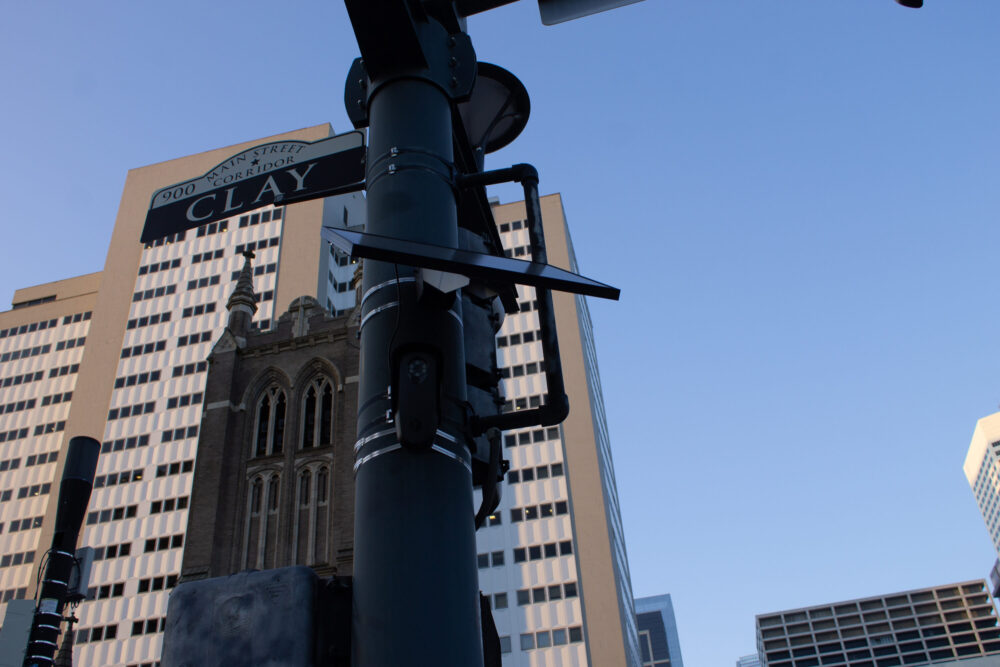
Pictured is a Flock Safety camera at the intersection of Clay Road and Main Street in Houston.
The Houston Police Department and Harris County Sheriff’s Office are withholding incident reports regarding details of the damages, citing ongoing investigations in response to requests from Houston Public Media.
In its statement, Flock Safety said it condemns this type of behavior while noting that damaging public safety equipment is illegal and puts the community at risk.
“When a camera is taken offline, an investigative lead can disappear, and a time-sensitive alert tied to an AMBER Alert, a missing-person case, or a violent crime suspect on the move may never reach the officers who need it,” a Flock spokesperson said. “This vandalism is especially concerning over a busy holiday weekend, when crime can increase, and agencies need reliable tools to respond quickly.”
Sarah Hamid is with the Electronic Frontier Foundation, a nonprofit that advocates for digital privacy and internet civil liberties. She said the vandalism shows the community is at a breaking point.
“It’s coming from a real place of anger because their democratic voices are not being acknowledged and those policies are not being enacted in the ways that they’re coming out and speaking up for,” she said.
Hamid says law enforcement agencies should treat the cameras as policy choices, not just tools, and ask whether they truly protect people or simply offer a cheap, fast fix.
“It’s easy to ask that question, ‘If not this, what?'” said Hamid. “The harder question here is, ‘What is the surveillance policy that’s going to make communities safe?’ And that’s the question that we want law enforcement to be really reckoning with.”