
Have you ever been eating at an Austin restaurant and seen a roach? Maybe you’ve wondered if the plates on the table are actually clean.
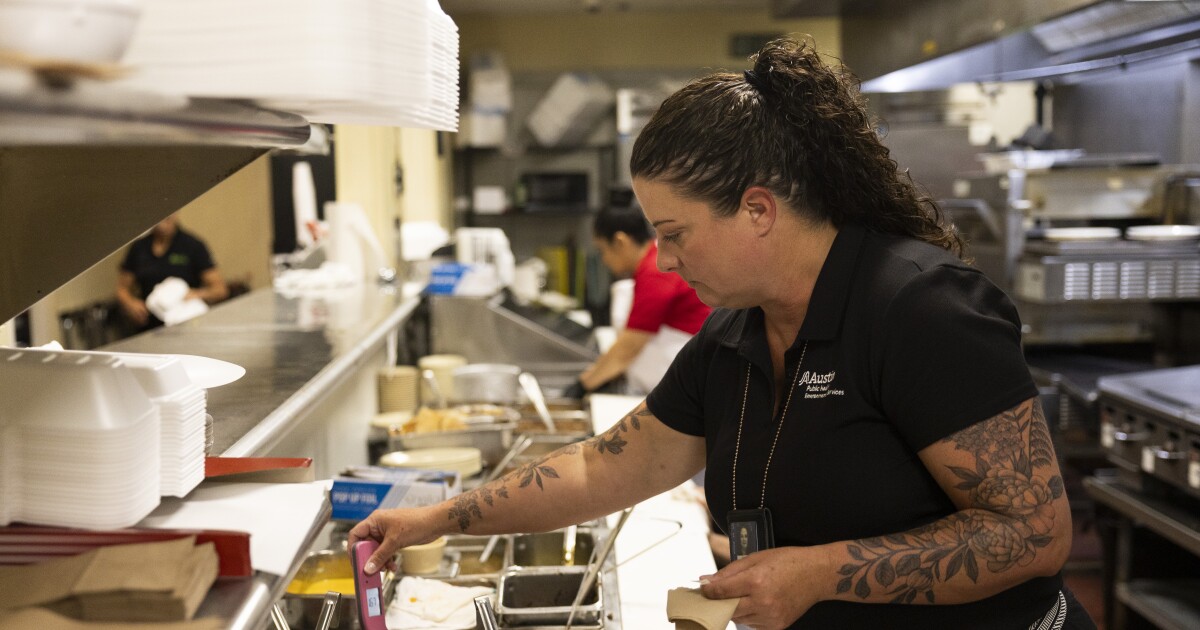
Well, that’s why food inspectors like Alicia Wilcox exist. Wilcox is an environmental health officer with the city of Austin and has performed safety inspections for five years.
At the Environmental Health Services division, inspectors wear multiple hats. The division covers things like pools and spas, farmers markets and foster care, and it even does mosquito surveillance.
“We might start off in the morning before it’s super hot and go do one or two pool inspections and then switch gears and do food in the afternoon,” Wilcox said. “So everybody’s day is different, and I think that that’s what a lot of us like about the job.”
Note: Not every restaurant in Austin will be located in the map below. Austin Public Health switched databases last year and is missing some inspection locations.
In general, inspectors like Wilcox cover about three to five restaurants a day, but it depends on how big the kitchens are, she said.
Behind the kitchen door at Amaya’s Taco Village
Amaya’s Taco Village let KUT News and Austin Public Health run a mock inspection for this story. It allowed an inside look into how inspections are done.
The restaurant usually performs well on its inspections. In November 2025, it scored a 94 out of 100. In July 2026, its most recent inspection, the restaurant scored an 88, according to Austin’s public database.
“The only time they know we’re coming back is, of course, if they fail,” she said. “We don’t tell them what day we are coming back, but they know in general it’s going to be within two to four weeks.”
Lorianne Willett
/
KUT News
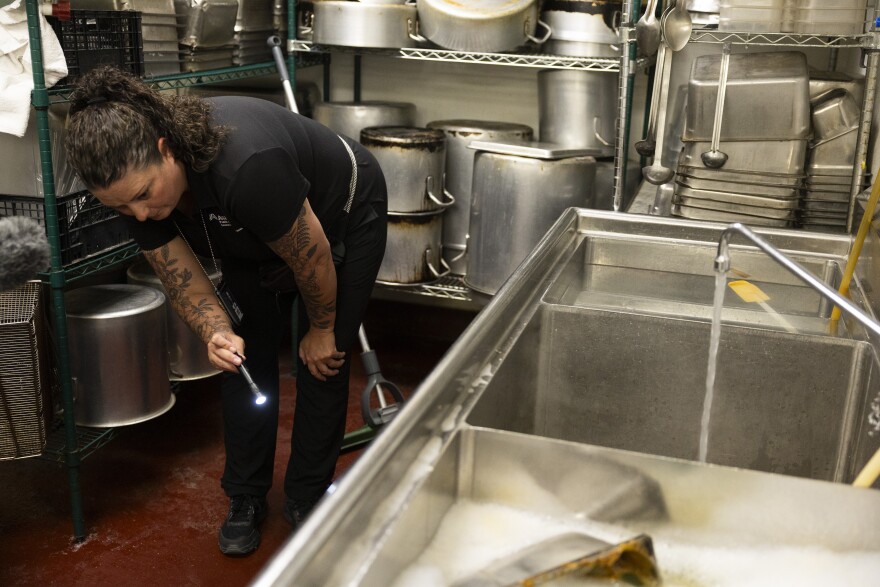
Health inspector Alicia Wilcox looks under sinks during her mock inspection of Amaya’s Taco Village, located just off the North Interstate 35 frontage road near East Koenig Lane.
As she walked in the door, one of the owners, Richard Amaya, greeted her. Together, they headed into the kitchen to start the mock inspection.
Inspectors switch areas every two years. Before the schedule shift, Wilcox was the inspector for restaurants like Amaya’s Taco Village, Bartlett’s, Titaya’s Thai Cuisine and Enchiladas Y Mas. She’s since moved on to a new role where she focuses on struggling food establishments with low scores that would like to improve.
Wilcox said that over the two years she served as the inspector for Amaya’s Taco Village, she built a rapport with the owners. She said building a connection is one of her favorite parts of the job.
“Sometimes if they don’t understand, and they feel like you’re just there, like ‘I gotcha,’ and just mark everything and not really take the time to explain to them and educate, they may not understand why this even matters,” Wilcox said. “To them, it may just be like, ‘They’re marking me again.’ But if you explain why it’s a risk, they are more likely to fix the items.”
It’s lunch rush, and the workers at Amaya’s Taco Village are on full throttle.
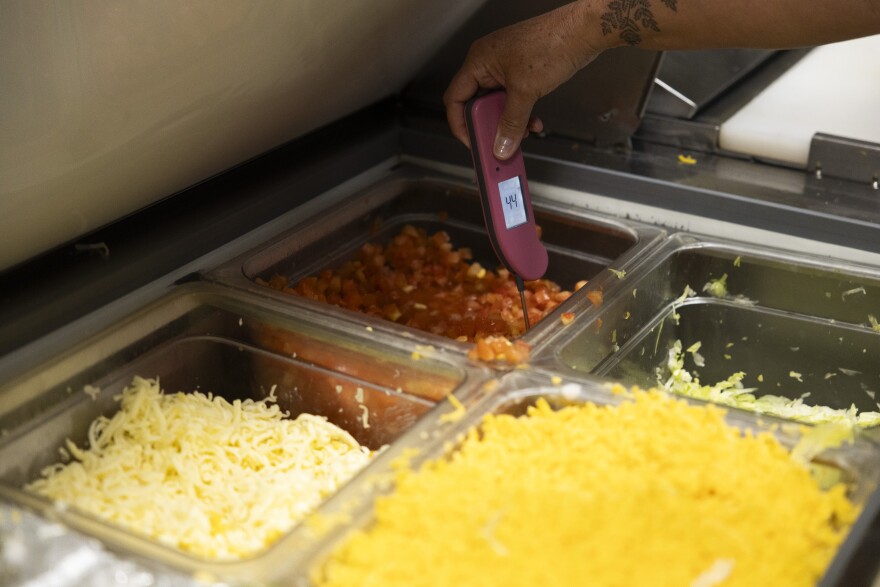
Wilcox passes through the kitchen, checking the temperatures of the ingredients, like refried beans, and asks when the tomatoes were diced. As she makes her way around, workers tiptoe around grilling food, serving plates and carrying containers.
While inspecting cleaning supplies, Wilcox found unlabeled bottles, which she then handed to Amaya to mark up. Small things like that can be fixed immediately, she said.
How are restaurants scored?
As she continues walking, Wilcox has a checklist she works off of that covers things like clean cooking surfaces, food separation, proper food labeling, updated permits and dishwashers. The system works out of 100, and a score below 69 is considered failing. A 70 or above is a passing score.
Every mistake leads to a lower score.
If a restaurant fails an inspection, they have to pay a $134 fee, and the inspector comes back, usually within a 10-day window, according to Wilcox. The restaurant is then placed on a compliance list for the next three years.
If the restaurant fails again within the three years, a criminal complaint is filed in court, according to Austin Public Health. The restaurant would also have to pay the fee again and be reinspected. If a restaurant fails a third time, it is closed and its owner has to meet with a program manager at Austin Public Health to create an action plan.
The inspector can also close a restaurant immediately.
Lorianne Willett
/
KUT News
One of health inspector Alicia Wilcox’s duties is checking the temperature of food.
“If there’s a roach, we’re not gonna close an establishment,” Wilcox said. “For us to close for an infestation would mean that the food is directly impacted that a customer would be served. If there’s rat infestations, sometimes we’ll see signs of the food being chewed through in the dry store.”
Pest control would then be called to control the situation, Wilcox said. Restaurants can also be closed for sewage backups.
In her five years on the job, Wilcox said she’s closed about 10 to 15 restaurants.
Customers can sometimes be completely unaware of violations going on in the kitchen, Wilcox said.
“It can be a lot of temperature violations, or they’re not cooking the food to the proper temperatures,” she said. “If there’s an infestation of some sort, generally, the customers alert us that they’re seeing signs of pests. So there are times that they’ll know, but not always.”
Support for KUT’s reporting on health news comes from St. David’s Foundation. Sponsors do not influence KUT’s editorial decisions.