
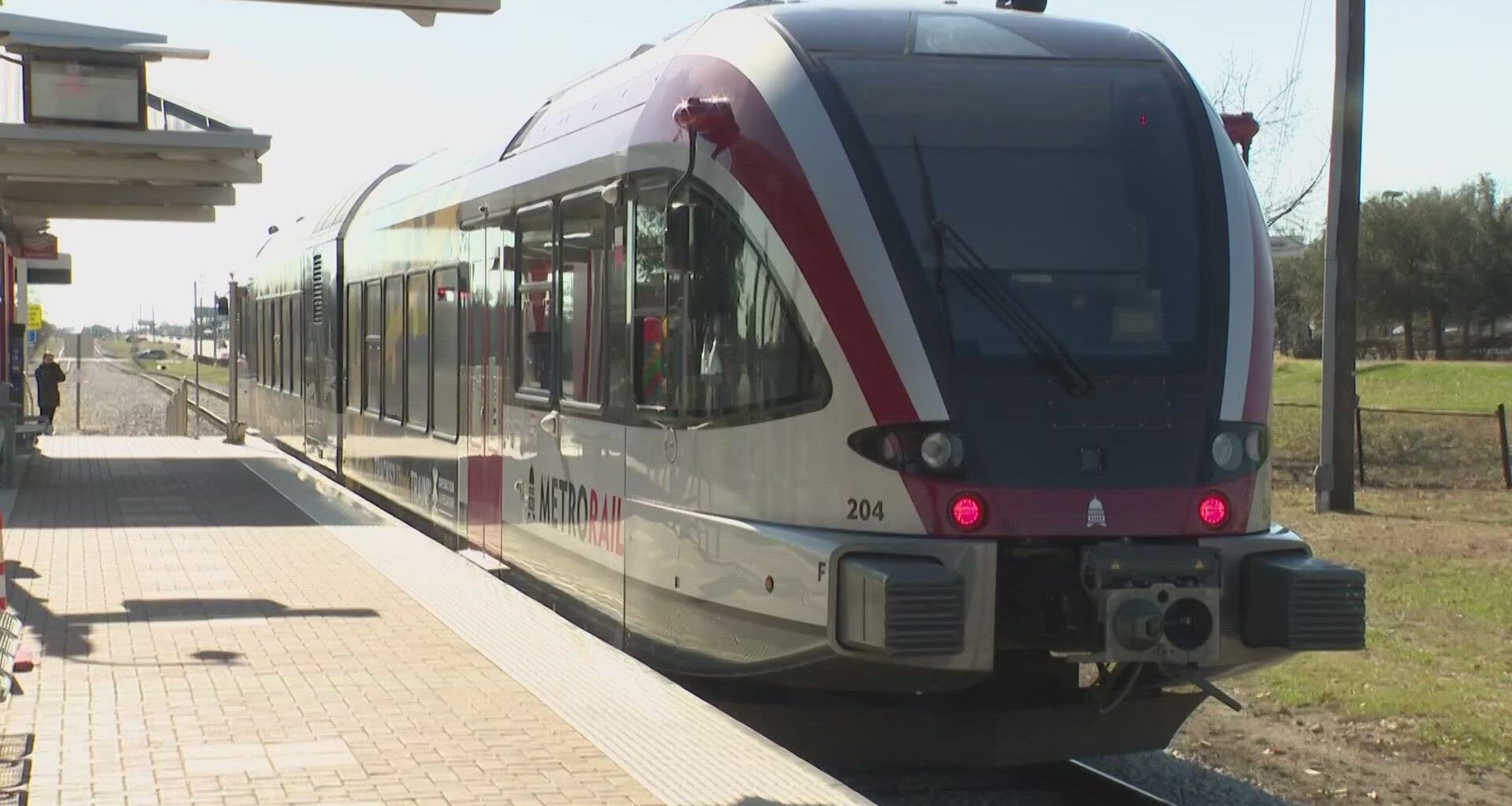
Project Connect is the voter-approved, taxpayer-funded effort to revamp public transit across Austin.
AUSTIN, Texas — A Travis County judge denied a pair of motions Thursday, leading to a temporary snag in legal cases involving Project Connect, Austin’s multi-billion-dollar light rail project, which Austin voters approved almost seven years ago.
At issue is whether the city and the Austin Transit Partnership could legally skip asking the Texas Attorney General’s Office about ATP’s authority to issue bonds and instead ask a court.

This story continues below.
In 2024, the AG’s office filed a plea of jurisdiction challenge to the $150 million bond-verification lawsuit brought by ATP and the City of Austin.
The district court declined to rule on the plea, which the AG’s office appealed, and the appellate court dismissed the appeal. In May, the Texas Supreme Court said the district court erred by failing to rule on the plea and ordered the lower court to address the jurisdictional issue and rule on the AG’s motion. The Texas Supreme Court did not rule on the plea’s merits in May.
The AG’s office argued that ATP and City of Austin bonds related to Project Connect are “subject to the review and approval of the Attorney General of the State of Texas” under Chapter 1202 of the Government Code, which they argued is the normal, independent state review that Texas bonds go through.
However, the city and ATP filed a bond-validation lawsuit under a different statute, Chapter 1205, and are asking a court to approve the bonds.
Texas Government Code 1205.001(1) defines an issuer as “an agency, authority, board, body politic, commission, department, district, instrumentality, municipality or other political subdivision, or public corporation of this state. The term includes a state-supported institution of higher education and any other type of political or governmental entity of this state.”
Government Code 1202.001(2) defines an issuer as “an agency, authority, board, body politic, department, district, instrumentality, municipal corporation, political subdivision, public corporation, or subdivision of this state;” or “a nonprofit corporation acting for or on behalf of” one of those entities.
Assistant Attorney General Lynn Saarinen argued that neither the city, which is not issuing the bonds in this case, nor ATP, which is a local government corporation, is qualified as an “issuer” and is therefore entitled to bring such a suit.
“The attorney general takes no position on the transit project itself,” Saarinen said. “He only reviews and objects to the way it is being financed as being invalid and unauthorized.”
Elliot Clark, an attorney for ATP and the City of Austin, argued that the city is a municipality and, as such, may seek a court order allowing it to issue bonds.
“Accepting their argument requires this court to accept the conclusion that a governmental unit by statute is not a type of governmental entity,” Clark said. “That is an absurd conclusion to reach under the plain terms of the statute.”
Clark made the case if the AG’s office succeeded in its arguments, it would allow a single disgruntled taxpayer to prevent future bond issuances across Texas.
“If the court accepts the attorney general’s arguments today that the definition of issues is correct, that means local government, corporations, housing, finance, corporations, public facility corporations, and any other what they call for on behalf of nonprofits that are authorized by statute to issue public securities have never come to court to have their public securities validated,” Clark said.
Judge Maria Cantú Hexsel denied the plea to jurisdiction on Thursday afternoon, thereby allowing the city and ATP to proceed with the bond validation lawsuit.
However, the AG’s office, ATP, and the City of Austin have filed accelerated appeals of the ruling, which brings the case to a halt. A temporary stay is now in place as the appeals play out before the 15th Court of Appeals.
“There are scenarios in which the trial order is asked and, for efficiency purposes, decides jurisdictional issues and potentially injunctions and summary judgments at the same time and has that all go up. I think there’s a lot of work in our trial courts in which that is the more efficient way to do it,” Judge Hexsel said. “In this particular case, I do have the mandate from the Texas Supreme Court with respect to this case, and so that’s what I do intend to follow closely. For that reason, while it is up on appeal, the underlying proceedings are stayed.”
In a statement after the hearing, Austin Transit Partnership Executive Vice President Casey Burack said ATP and the City of Austin filed the bond validation lawsuit in 2024 to have a judge confirm that the city and ATP complied with state law in moving Project Connect forward.
“Today’s ruling confirms that the legal tactic used by the Attorney General to prevent a judge from ruling on our bond program has no legal basis,” Burack said. “We appreciate the court’s quick action to remove this procedural roadblock and look forward to our day in court.”
Bill Aleshire, who represents a group of taxpayers suing, arguing that leaders cannot use that tax to pay bond debt and saying voters never approved the current funding plan, said he is pleased with the outcome. He called it a victory for the taxpayers of Austin.
“The city of Austin is collecting this tax, giving it to ATP, which is going to go out and borrow. Right now, they’re asking to borrow $150 million,” Aleshire said. “The city of Austin has now put a condition on giving them that money by saying it is subject to annual appropriation. Well, if they stop giving ATP those funds, we’re going to have a bond default, exactly what the Texas Constitution is intended to prevent.”
Judge Hexsel also rejected an effort by the City of Austin and ATP to dismiss parts of the lawsuit, which argues that the Project Connect funding structure is unconstitutional. To pay for the new transit system, Austin leaders proposed a 20% permanent property tax increase across the city.
“They don’t have a commitment from the City of Austin that they’re going to give all this money, which is what the ballot said in perpetuity, unconditional to ATP,” Aleshire said. “That’s an unconstitutional debt between the city and ATP and that claim survived, as well as the claim that they can’t use this Project Connect money for debt service, and they can’t wink, wink, give it to an entity they created that acts on their behalf and let them issue the bonds.”
Lawyers for the City and ATP asked Judge Hexel to dismiss two claims related to maintenance and operation taxes, as well as the unconstitutional debt claim Aleshire referenced.
“The attorney general has never taken the position that ATP cannot issue these bonds and secure them with a contract,” Paul Trahan, an attorney for the City and ATP said. “The city makes payments to local government corporations; local government corporations issue bonds that are secured by those payments. These payments are subject to a no appropriation and the bonds are not a debt us are not a debt of the city.”
Judge Hexsel’s decision is a victory for Aleshire, in the sense that the claims will proceed to a full trial, during which both Aleshire and ATP representatives expressed confidence Thursday that they would prevail.
Aleshire called the ruling on Thursday a “victory for the taxpayers.”
“Our point is that sooner or later, I’m hoping that the mayor and the Austin City Council are going to realize that continuing on the course they’re on is legally, really risky and that because if the Supreme Court of Texas eventually decides they don’t have the authority to issue bonds, they have put themselves in a real pickle,” Aleshire said.
While the stay freezes the case until the 15th Court of Appeals can rule on the appeal, both Aleshire and the lawyers for the city and ATP expressed a desire for that to happen quickly so they can keep the case moving. The appeals court will rule on ATP’s bond financing program and Prop A before the rest of the case can proceed.
It is worth noting, in his May opinion, Texas Supreme Court Chief Justice Jimmy Blacklock wrote that “appellate courts confronted with such appeals should resolve them with the dispatch the circumstances demand, particularly in expedited proceedings where delay is most costly.”
Project Connect has faced a number of setbacks and widespread criticism since voters approved it in 2020, when the light rail plan changed and became more expensive.
The plan was drastically scaled back in 2023 after inflation and rising costs pushed its price tag past $11 billion. It has faced opposition from groups that say it was a “bait-and-switch scheme,” as the project’s scale has shrunk and costs have risen.
The total cost of the project is $8.2 billion, up from the initial $5.8 billion. It is less than half the originally proposed length. The number of stops on this transit system has been scaled back. It is no longer expected to reach Austin-Bergstrom International Airport in the first phase. It has become the costliest public transit project per mile in Texas history and the seventh-most-expensive light rail project per mile in the U.S.
Under its current plan, the project, worth several billion dollars, will add almost 10 new miles of light rail and 15 light rail stations across the city. The route for the first phase of the light rail runs from the University of Texas, then goes on Guadalupe Street from 38th Street to downtown, and from downtown to the east along East Riverside, and south on South Congress to Oltorf.
Austin Transit Partnership says the light rail system is needed because Austinites should have more options for getting around the Austin area, given how fast it is growing.
ATP leaders say the lawsuit has not delayed work on Austin’s light rail. Pre-construction started back in May, and ATP has said they still hope to break ground early next year.