
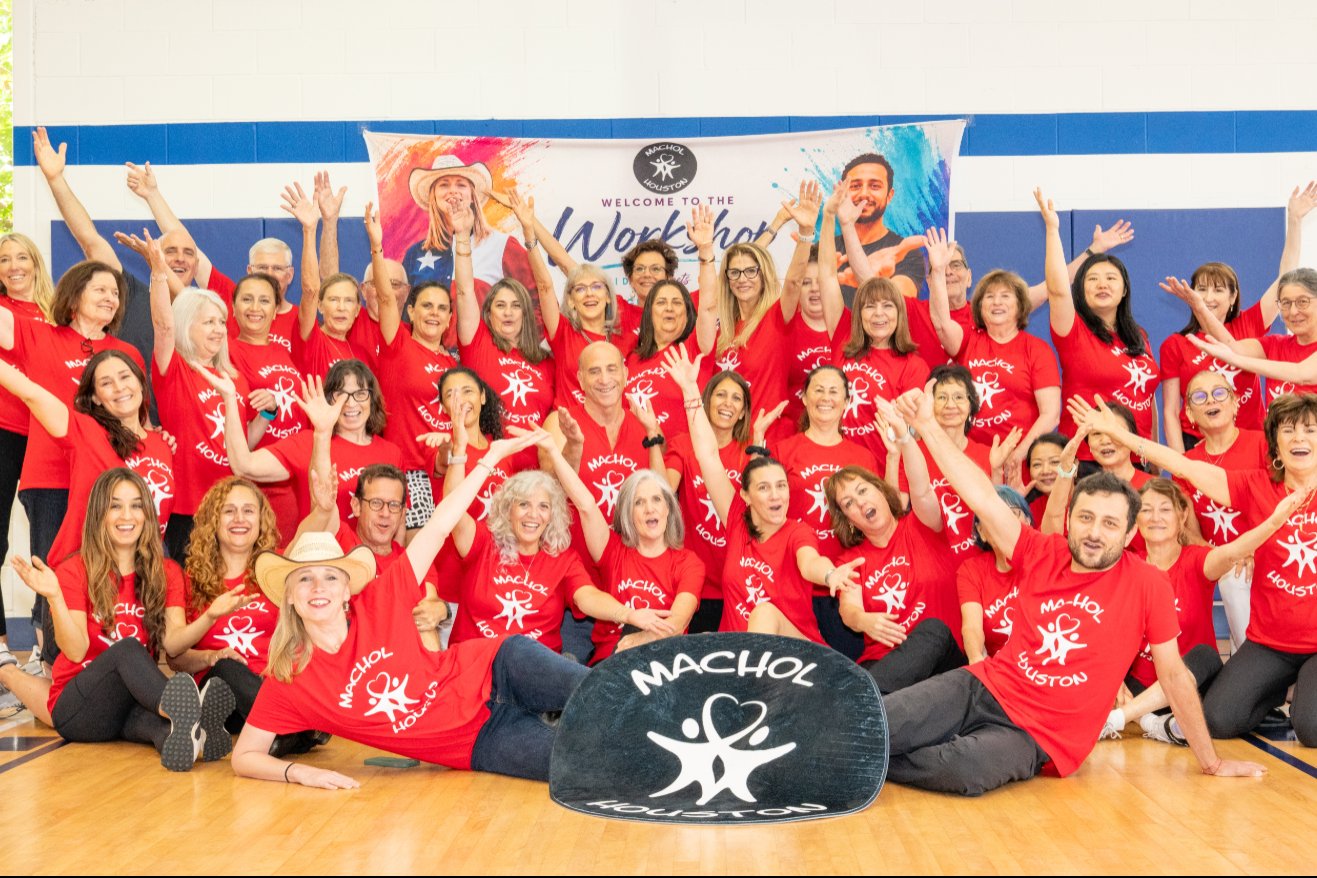
On Aug. 7-9, 47 dancers from Houston, San Antonio, Austin, Dallas and Colorado gathered for a uniquely Texas celebration of movement, heritage and community as Machol Houston presented its annual workshop. This year’s theme was “Israeli Dance Meets Line Dancing.”
Featuring internationally known Israeli dance instructor Marcelo Marianoff and Texas line dance instructor Britt Beresik, the three-day workshop brought together two traditions that, at first glance, might appear to have little in common. By Sunday afternoon, however, participants had discovered that circles and lines can lead to the same place: community.
The weekend began Friday at noon at Seven Acres Jewish Senior Care Services, where Marianoff led a special Israeli dance activity with residents. Music, movement and familiar rhythms filled the room, providing a joyful opening to a weekend that would repeatedly demonstrate how dance can cross generations, preserve memories and bring people together.
Later that evening, participants gathered at Congregation Beth Yeshurun for Shabbat services. Rabbi Brian Strauss welcomed workshop participants and Marianoff was invited to share his personal story and lifelong connection to Israeli dance.
Born in Córdoba, Argentina, Marianoff described a family history that reflects the many journeys of the Jewish people. His maternal grandparents and great-grandparents came from Lebanon and Syria; his paternal family came from Poland and Russia. All left behind difficult circumstances and eventually built new lives in Argentina.
Marianoff began Israeli folk dancing as a young boy. What started in Córdoba eventually became a lifelong journey through ballet and Israeli dance that took him to communities around the world.
His story also illustrated how Israeli dance itself has traveled and evolved. Shaped by cultures, rhythms and traditions brought together by Jews from different corners of the world, Israeli folk dance created a shared language. Different backgrounds, histories and languages could meet through music and movement. And there is something particularly powerful about the circle.
When people form a circle to dance, there is no front or back. People look at one another. They move together. Often, they hold hands. A person may enter the circle not knowing the dancer beside them, but for the next song they share the same rhythm, steps and space.
That simple act reflects something much deeper: People want to belong. They want to connect. They want to hold hands. They want to be part of something larger than themselves.
Marianoff experienced that human need in a very different way during the COVID-19 pandemic. When dancers could no longer gather physically, he turned to Zoom. What began out of necessity became an unexpected international community.
Week after week, dancers from different countries, languages and backgrounds appeared on one another’s screens. They learned dances together, celebrated together and developed friendships, even though many had never stood in the same room.
Eventually, Marianoff began imagining the next chapter: What if all those Zoom friends could finally meet?
An international gathering was organized in Israel this past March. After years of seeing one another inside small squares on computer screens, dancers would finally have the opportunity to meet face to face, embrace, hold hands and form a real circle together. For many, it would be the first chance to turn virtual friendships into physical ones and to dance together in the land at the heart of the tradition that had connected them.
Travel plans were made and excitement grew. Then, the war with Iran erupted and the gathering had to be canceled.
For Marianoff, however, there was something deeply familiar in that experience. Adapting, rethinking and finding another path is hardly new to the Jewish story.
Generations of Jewish families have, like his, faced moments when carefully made plans suddenly changed and the future had to be reconsidered. And yet communities continued.
When circumstances prevented their gathering in Israel, the desire to someday meet, hold hands and dance together did not disappear. Instead, it provided a fitting introduction to what followed Saturday and Sunday in Houston.
When the workshop continued at Beth Yeshurun, Machol Houston introduced something different. Beresik took the floor, and Israeli dance met Texas line dancing.
Cowboy boots and Western flair appeared alongside dancers accustomed to Israeli circles. Beresik led two hours of line dancing Saturday night and returned for another two-hour session Sunday, while Marianoff continued extensive Israeli dance sessions throughout both days.
The pairing highlighted an intriguing contrast. Israeli dancing frequently brings people into circles, sometimes physically connecting dancers hand to hand. Line dancing places people side-by-side in rows, each learning the same sequence and moving together.
Different formations. Different music. Different histories. Yet the human experience behind them is remarkably similar.
Both require people to pay attention to those around them. Both invite experienced dancers and newcomers to share the same floor. Both depend on people learning together. And both create those special moments when dozens of individuals suddenly begin moving as one.
For Machol Houston, that was precisely the purpose of bringing these two traditions together.
Machol Houston, a nonprofit organization, works to preserve and promote Jewish heritage through Israeli dance and music while creating opportunities to connect with others. The goal was never to make Israeli dance more like line dancing or line dancing more like Israeli dance. It was to place two traditions beside one another, celebrate what makes each unique and discover what they have in common.
The weekend became much more than a series of dance classes. Its lessons extended well beyond the dance floor. With curiosity, dancers listened to someone else’s story, experienced another tradition and became willing to learn a few unfamiliar steps.
For one weekend in Houston, 47 dancers danced in circles; they danced in lines. They held hands. They laughed, learned, adapted and moved together.
And somewhere between the circles and the lines, they created something the Jewish people – and dancers everywhere – have long understood:
When circumstances and plans change, we find another step, another path. And when we come together, we create community.
See more photos in our e-edition.
Lots of stories and special features are only available in the print and E-editions of the Jewish Herald-Voice. To make sure you are not missing out, subscribe to the print edition or subscribe to and read the E-edition right now.