
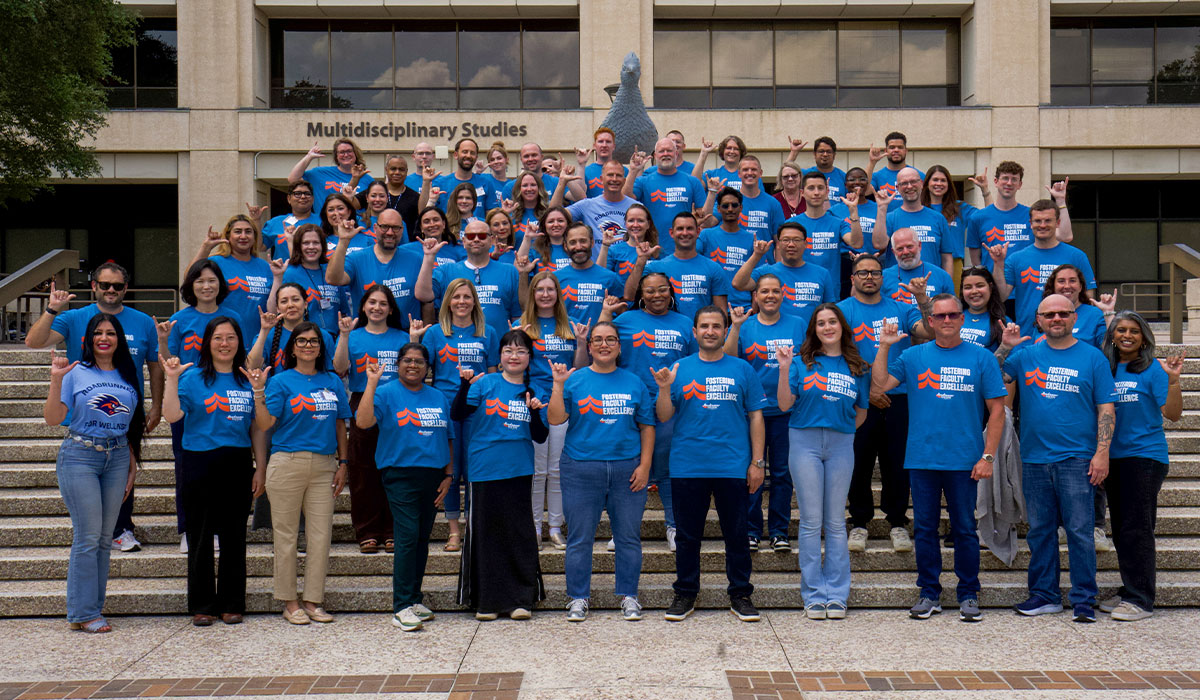
UT San Antonio is welcoming more than 90 new full-time faculty members across its academic colleges for the 2026–2027 academic year. The incoming group includes tenured, tenure-track and full-time fixed-term-track faculty recruited from leading institutions worldwide.
Of the incoming faculty, 65% earned their highest academic degree, also known as terminal degree, from Carnegie R1 institutions.
Additionally, more than 30% of the new faculty received their terminal degrees from top research institutions that are members of the Association of American Universities (AAU), including Cornell University, Princeton University, the University of Chicago, the University of Virginia, Duke University and the California Institute of Technology.
“This year’s faculty cohort brings extraordinary talent and expertise to UT San Antonio from top institutions across the nation and around the world and reflects our continued investment in academic excellence,” said Heather Shipley, provost and senior executive vice president for academic affairs. “Their contributions will enhance student success, foster new opportunities for research collaboration and strengthen our position as a premier public research university.”
Promoting interdisciplinary discovery
This year, five incoming tenured and tenure-track faculty members were hired through the Clustered and Connected Hiring Program (CCP), an initiative funded in part by The UT System Board of Regents’ Research Excellence Program to recruit top scholars in various academic fields. As part of the program, these faculty will join dedicated research clusters focused on topics such as space science, technology and human performance; transdisciplinary materials science and engineering; and artificial intelligence in education.
Through the CCP and other strategic initiatives, the university is positioning itself as a leader in research excellence by driving innovation, growing national distinction and increasing federal funding opportunities.
Two new faculty members are joining the research cluster focused on artificial intelligence in education this fall: Heidi Furey, PhD, an associate professor of philosophy and classics in the College of Liberal and Fine Arts, and Chunling Niu, PhD, an associate professor of data science and interdisciplinary learning and teaching (ILT) in the College of Education and Human Development.
This cluster will work to understand how artificial intelligence can be ethically used to support foundational teaching and learning, with an emphasis on language learning, mathematics and computer science.
“My research program addresses a fundamental challenge of our time: how can we harness artificial intelligence to transform education while rigorously measuring its impact and ensuring equitable outcomes?” Niu said. “I appreciate the amazing research resources and support UT San Antonio provides me, and I can’t wait to start with my own new research team here.”
The incoming faculty cohort also includes new academic leadership. Katrin Gaardbo Kuhn, PhD, will serve as the new chair and professor of the growing Department of Biology, Health, and the Environment in the College of Sciences. She brings more than 20 years of experience in infectious disease epidemiology, and most recently served on the faculty of the Biostatistics and Epidemiology department at the University of Oklahoma Health Campus.
“I chose The University of Texas at San Antonio because of the opportunity to lead a growing department at an R1 institution and help shape its future in research, education and student success,” Kuhn said. “I am excited to work with talented faculty and students while building programs that address important human and environmental health challenges in South Texas and beyond.”
The new faculty cohort recently participated in a multiday orientation designed to introduce them to UT San Antonio and its resources. As part of the university’s New Faculty Academy, the cohort will have regular check-ins throughout the year with members of the Faculty Success, Academic Innovation, and Research and Innovation teams, attend sessions focused on teaching, research and other topics, and participate in the Peer Mentoring Teams program.
They will join more than 1,500 faculty members who teach and conduct research across UT San Antonio’s academic colleges.