

The Texas Education Agency has released 2026 A-F accountability grades for all Texas school districts and campuses. The grades give administrators, parents and community members insights into academic performance across several categories at every school in Tarrant County.
The grades are broken into three categories: student achievement, student progress and closing the gaps between student demographics. Student achievement results are weighted the heaviest when determining a school’s overall A-F grade.
“This year’s A-F ratings illustrate the progress Texas public schools are making and acknowledge the hard work of our educators while illuminating areas of needed improvement to ensure that all students have access to a high-quality education,” wrote TEA Commissioner Mike Morath in a statement. “Through our commitment to transparency and accessibility, parents and the public can explore the ratings and associated resources to clearly understand the performance of their schools.”
Statewide, 24% of districts and campuses increased in rating compared to 2025, according to TEA. Eighty-five percent of campuses that received a rating achieved acceptable academic performance, which is a grade of C or higher.
TEA also said that 49% of high-poverty campuses received an A or B rating, which is up from 47% last year, while the total percentage of F-rated campuses in the state also declined.
“Just being born on a bed of money does not give you the gift of reading. What gives you the gift of reading is good teaching with rigorous curriculum,” Morath said.
The grades for every public school and district in the state can be viewed at TXschools.gov.
More information on how they’re calculated can be viewed here.
Fort Worth ISD sees boost in letter grades, overall rating 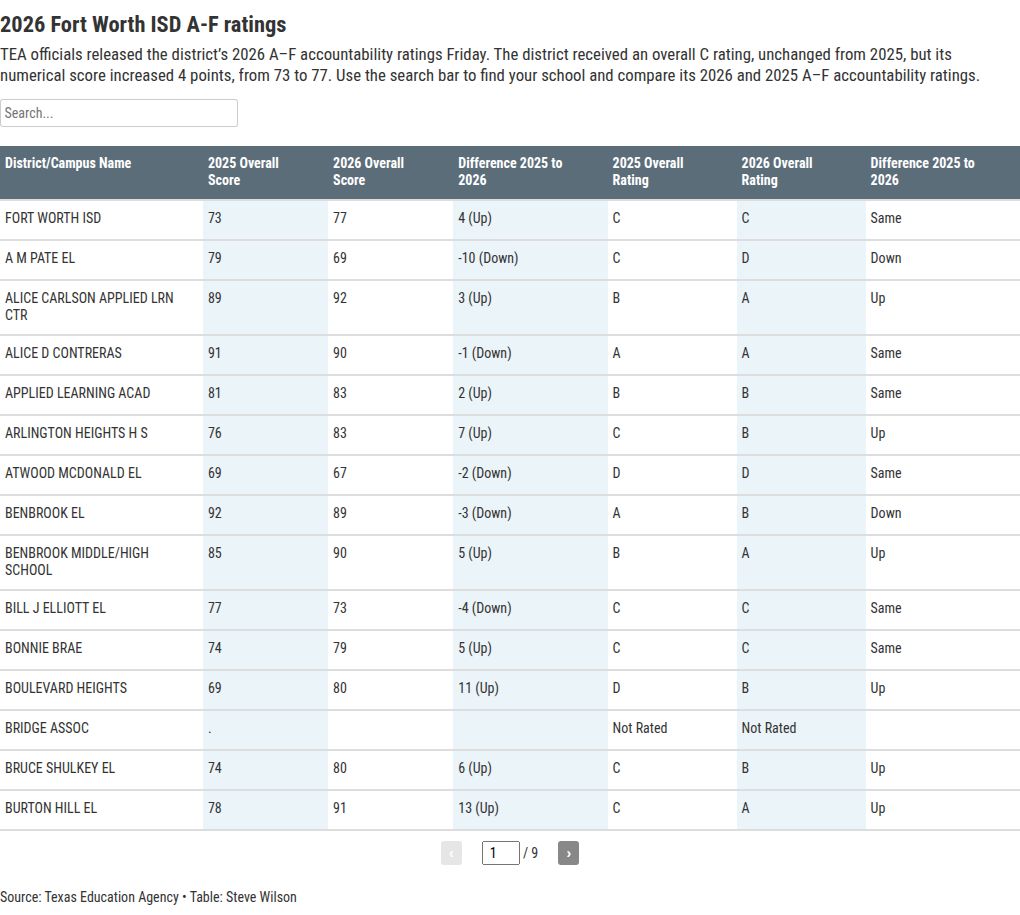
Fort Worth ISD’s overall district rating remained a C, but the total score increased from a 73 to a 77, according to TEA data. A score of 80 is needed for a B.
The total number of campuses rated D or F also decreased compared to last year. In 2025, the district had 10 F-rated campuses and 27 D-rated campuses. This year, Fort Worth ISD has seven F-rated campuses and 19 D-rated campuses.
As a district, Fort Worth ISD also improved in TEA’s subcategories. It improved from a D to a C in student achievement, and increased its rating from a 73 to 76 in closing the gaps, but still remained with a C rating.
The district also maintained the same number of A-rated campuses from last year to this year, with 17 earning the highest designation.
Fort Worth district leaders announced last week that three schools went from an F to C, 11 went from D to C, four went from D to B, and 13 went from C to B. Diamond Hill Elementary was the most improved campus in the district, jumping from a D rating to an A.
In total, Fort Worth ISD’s final grades were:
17 A-rated schools38 B-rated schools43 C-rated schools19 D-rated schools7 F-rated schools
In a statement Friday, Fort Worth ISD officials said 66 campuses increased their overall accountability scale score from last year, and 43 campuses improved by at least one letter grade. Nine campuses improved by two or more letter grades.
“Nineteen campuses received a D rating and seven received an F,” the district wrote in the statement. “Fort Worth ISD will continue providing targeted academic and operational support to those campuses, with a focus on strengthening instruction, accelerating student achievement and ensuring sustained improvement.”
Fort Worth ISD’s improvements come as the district enters its first year since it was taken over by the state in March after a now-closed campus earned a fifth F rating in a row. That triggered a Texas law that allows Morath to either close the campus or take over the district by naming a new superintendent and replacing the elected school board with a Board of Managers. Morath appointed Peter Licata as the district’s new superintendent in March.
William James Middle’s 2026 F rating is also its fifth consecutive F, which typically triggers a campus closure or a state takeover. Since Fort Worth ISD is already under state control, Morath now has the ability to close the campus and reassign students to higher-performing or adjacent neighborhood schools. He can also opt to implement “intensive, specialized operational restructuring,” which could include turning the school into an in-district charter partner.
Morath said he does not plan to close the school at this time, and that there is a team in Fort Worth with a plan, but did not expand on what it was. William James Middle is part of Fort Worth ISD’s new Elevate Network instructional model, which emphasizes a consistent routine to maximize time students spend learning, district officials have said.
“Our real high hope is that the students at William James will see a significant improvement in the quality of their experience this school year relative to what has happened for many, many years past,” Morath said Friday during a press conference at Bell Manor Elementary in Bedford.
 Texas Education Commissioner Mike Morath visits Bell Manor Elementary to talk about the release of the 2026 A-F accountability ratings on Friday, Aug. 14, 2026. in Bedford. Abigail Dollins Fort Worth Star-Telegram
Licata, just five months into his tenure as superintendent, gave former Superintendent Karen Molinar credit for the district’s progress in removing a large number of D- and F-rated schools from its roster but noted that more work needs to be done.
Friday’s A-F results from TEA are still considered preliminary, as districts have an opportunity to appeal them for further review.
Staff writers Maven Navarro and Lina Ruiz contributed to this report.
This story was originally published August 14, 2026 at 9:28 AM.
Related Stories from Fort Worth Star-Telegram

Fort Worth Star-Telegram
Samuel O’Neal is the K-12 Education Reporter at the Fort Worth Star-Telegram, covering public schools and policy that impacts them. He previously worked as a staff writer at the Philadelphia Inquirer and is a graduate of Temple University.